Why Generic Video Monitoring Platforms Miss the Threat Signals That Matter Most in Active Truck Yards
Generic platforms generate endless false alarms without knowing which yard movements are authorized.
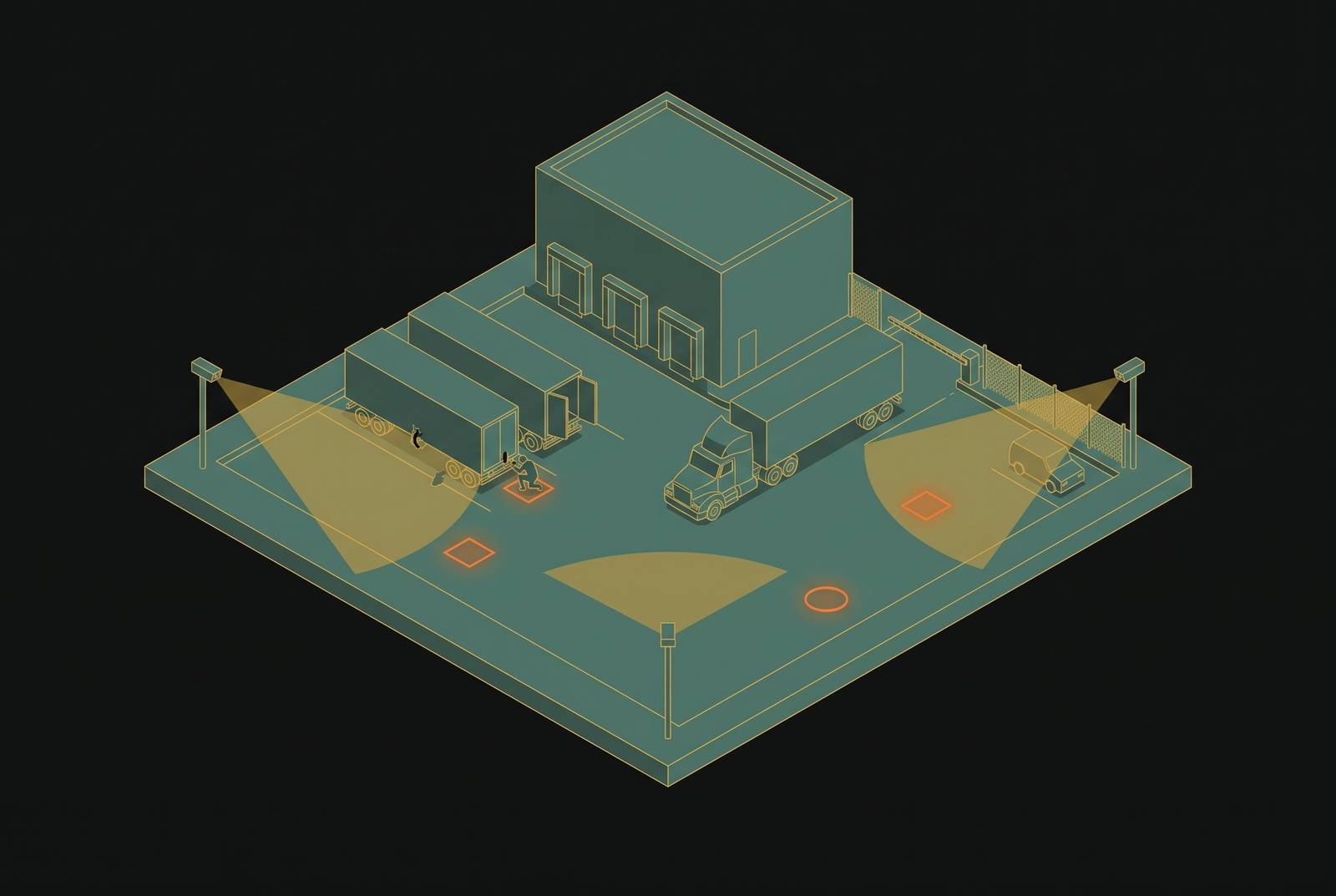
AI-augmented remote video monitoring for truck yards and freight facilities needs site-specific context to distinguish threats from routine activity. Generic platforms miss that difference when they detect motion without knowing the authorized schedules, normal movement patterns, or where staged trailers are parked. The effective architecture evaluates those conditions before sending a verified threat to a human operator for response, rather than sending every detection into an alarm queue.
Why truck yards are not like other commercial sites to monitor
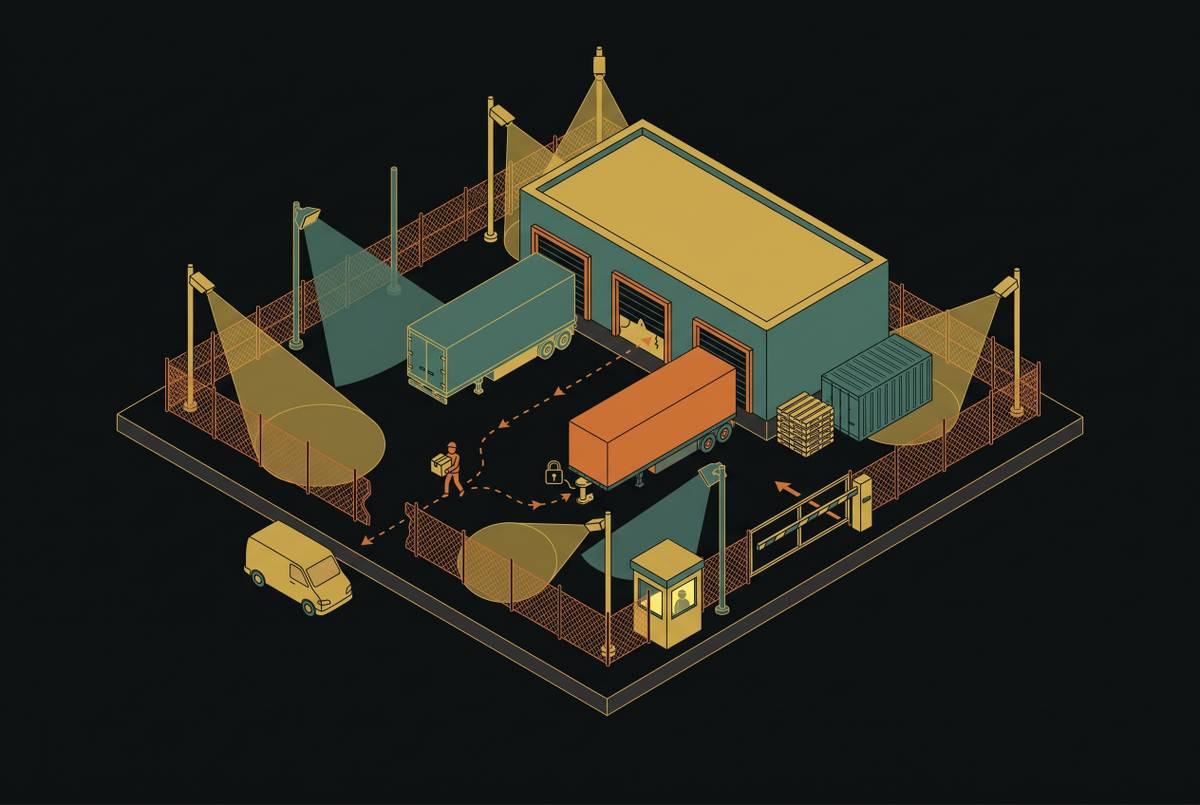
Truck yards combine four distinct exposure zones, including controlled entry, the open lot, the fuel and equipment area, and the after-hours window. The gate is an identity checkpoint, while the open lot is a changing arrangement of tractors, trailers, and equipment. Overnight and weekend operations add a timing problem because loaded trailers can remain unattended when on-site staffing is deliberately reduced or eliminated. No single passive tool addresses all these exposures simultaneously.
At the gate, a vehicle’s arrival is not proof that its driver has the right to collect a load. A plate and timestamp establish that a vehicle appeared, but the pickup check establishes authorization for the load to leave. Fraudulent pickup exploits that distinction. Carrier and broker impersonation can look like routine gate activity until the shipment fails to arrive, making an apparently ordinary departure part of the threat.
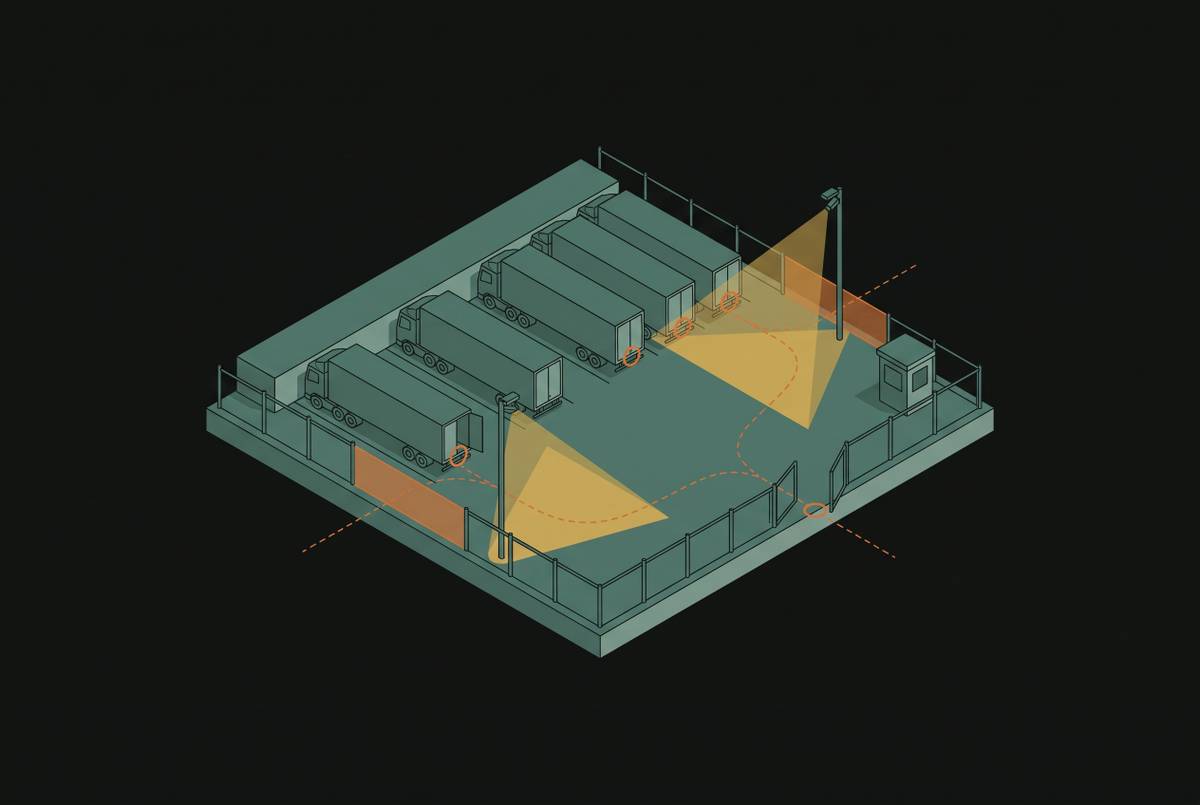
Beyond the gate, rows of trailers parked close together leave blind spots that fixed cameras and patrols cannot fully cover. The geometry changes as trailers are repositioned, even though cameras remain static. Meanwhile, drivers, carriers, and staff keep moving through the areas the cameras can still see. After hours, those same spaces hold staged assets with fewer people around.
How constant legitimate activity turns a yard’s normal operations into an alarm flood
A motion-triggered platform turns that legitimate movement into a stream of alarm candidates. Trucks move, drivers cross the lot, and equipment travels between working areas. Each detection may be accurate as a record of movement while being useless as a security alert. The distinction is between detecting activity and identifying danger. A platform that treats all motion alike cannot make it.
Asylon Robotics says that the amount of normal activity in a yard leads to frequent false alarms. With traffic moving all the time, it is hard to tell at a glance who has permission to be there, especially during multi-carrier access windows. Another vehicle can closely follow a truck cleared at the gate, so unauthorized entry looks like normal traffic. Asylon describes this tailgating scenario as one that can be discovered only after the fact. Busyness therefore provides cover as well as generating noise.
The same ambiguity follows activity into the lot. A trailer door opening at 2 AM in a blind-spot row is significant, but any resulting motion alert can enter the queue with no more apparent urgency than the routine movements before it. The platform has detected an event without establishing its meaning. To separate a threat from normal work, the system needs to know what activity is authorized, where it belongs, and when it is expected.
What generic platforms are missing — the interpretive layer that turns a signal into a verdict
The missing component is an interpretive layer that relates a detection to the yard’s operating state. Camera coverage determines what can be seen, but context determines what an observed event means. Adding cameras does not supply an appointment schedule or establish a driver’s right to take a load. Hawk Surveillance distinguishes these limits through concrete examples. A gate log cannot see under a parked tractor, a fence cannot validate pickup paperwork, and a passive camera cannot respond to an after-hours alert. Each tool has its own job, but none can tell on its own whether there is a threat.
Authorized schedules provide the first missing layer. A third-party driver at Dock 3 at 10 AM during a scheduled pickup window fits what the yard expects. The same driver at the same dock at 2 AM without an appointment does not. The visible subject may be unchanged, but the authorization conditions are different. Without the schedule, the platform lacks the basis for that distinction.
Normal movement patterns provide the second layer. A tractor moving slowly through the yard in daylight can be routine, while similar movement at 3 AM in the rear lot near a loaded staged trailer can be anomalous. Staged trailer positions provide the third layer. A trailer parked in Row G since Monday has an expected status that gives meaning to a door or seal event on Saturday night without a scheduled pickup. The detection becomes useful only when it is related to that status.
Missing these layers can leave theft unrecognized while it occurs. Asylon describes a weekend scenario in which cargo is quietly removed from a trailer in a blind-spot row and the loss is discovered days later when the trailer is opened. There is no clear record of when it happened because the event was not recognized as anomalous. This is more than a recording shortfall. The system lacked the context needed to identify an intervention point.
Why the alarm queue makes the interpretive gap fatal, not merely inconvenient
Without contextual filtering, events that seem equally serious go into the same queue. Routine movements then wait alongside real threats to be checked, even though the harm they could cause is very different. A detection does not become actionable merely because it has been delivered. Someone or something still has to establish what it means. When that work happens only after queue entry, normal yard traffic determines how much sorting precedes a response.
Physical validation adds another delay. Asylon identifies expansive yards as a setting where incidents can conclude before a dispatched responder arrives, leaving fragmented evidence and heavy reliance on human recollection. When a trailer break-in is over in under 4 minutes, there is little time to wait behind unrelated alarms. The sequence of detection, queueing, validation, and dispatch can consume the available intervention window. Faster alarm generation alone does not resolve that timing mismatch.
Alert fatigue follows from this architecture. Asylon describes operators deprioritizing notifications as false alarms accumulate, which exposes a later genuine threat to the same treatment. The underlying defect is a stream of undifferentiated signals that requires human triage before the system can identify urgency.
The consequences extend beyond the incident itself. Asylon also describes a shipment dispute in which footage cuts out at a key moment and the patrol log records only a scheduled pass. An event that was not identified as meaningful at the time may therefore leave both a missed response opportunity and an evidence gap. The correction has to begin before the queue, where relevance can determine which events reach an operator.
How site-specific context changes what a monitoring platform can reason about
A platform with yard-specific context can evaluate a detection against the conditions that make it expected or suspicious. Schedule awareness supplies a concrete example at Dock 3. A person there at 10 AM during a logged appointment fits the schedule, while the same detection at 2 AM without an appointment calls for an alarm. The sensor input alone does not explain the difference. The appointment record does.
Staging context supports a different judgment. A trailer staged since Monday with no weekend pickup appointment has an expected overnight state. Door activity on Saturday night conflicts with that state, whereas a generic motion system cannot distinguish it from an authorized load check. The relevant unit of analysis is therefore not simply the door event. It is the event in relation to the trailer’s position, staging history, and pickup schedule.
Expected movement patterns add the yard’s spatial logic. Slow tractor movement has a different meaning during normal daylight operations than at 3 AM near a loaded trailer in the rear lot. This makes the deviation available for evaluation before an alarm is passed onward, with its significance established before operator review.
Context also has a clear boundary. It cannot make an unseen event visible, authenticate pickup paperwork through a plate read, or substitute for a response. Its role is to connect available signals with the conditions under which activity is permitted and expected. That changes the platform’s question from whether motion occurred to whether the motion fits this yard’s operation.
How AI and human operators can deliver verified truck-yard alerts faster
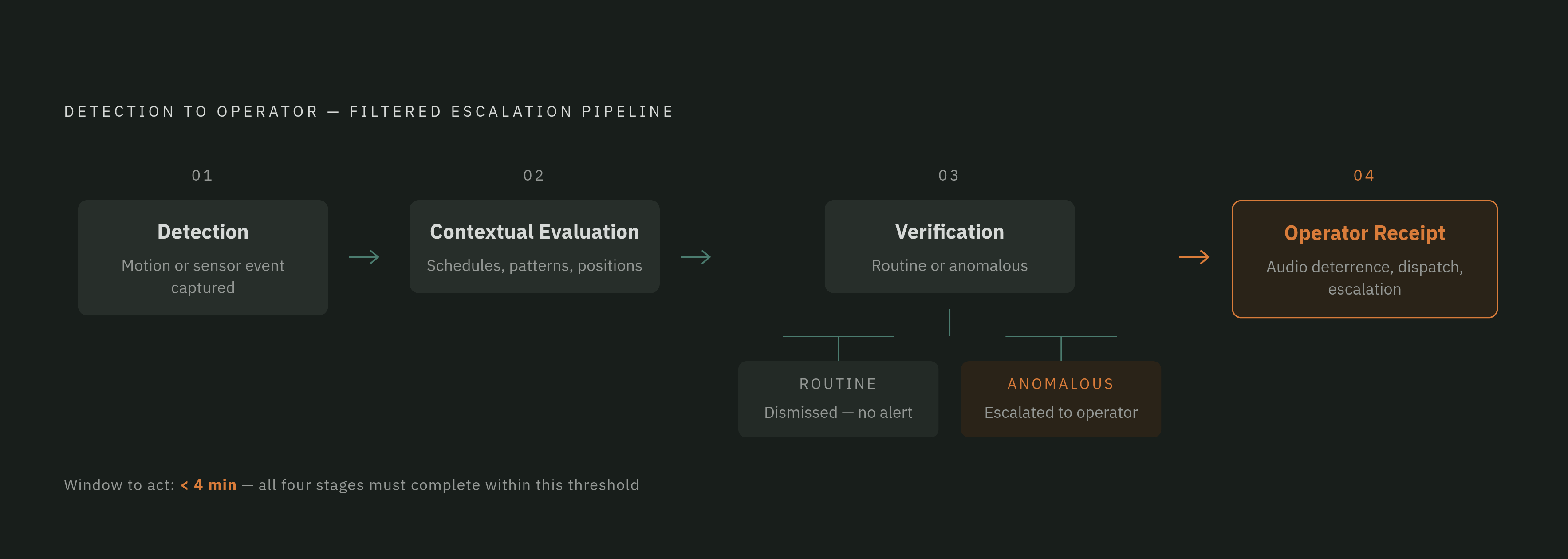
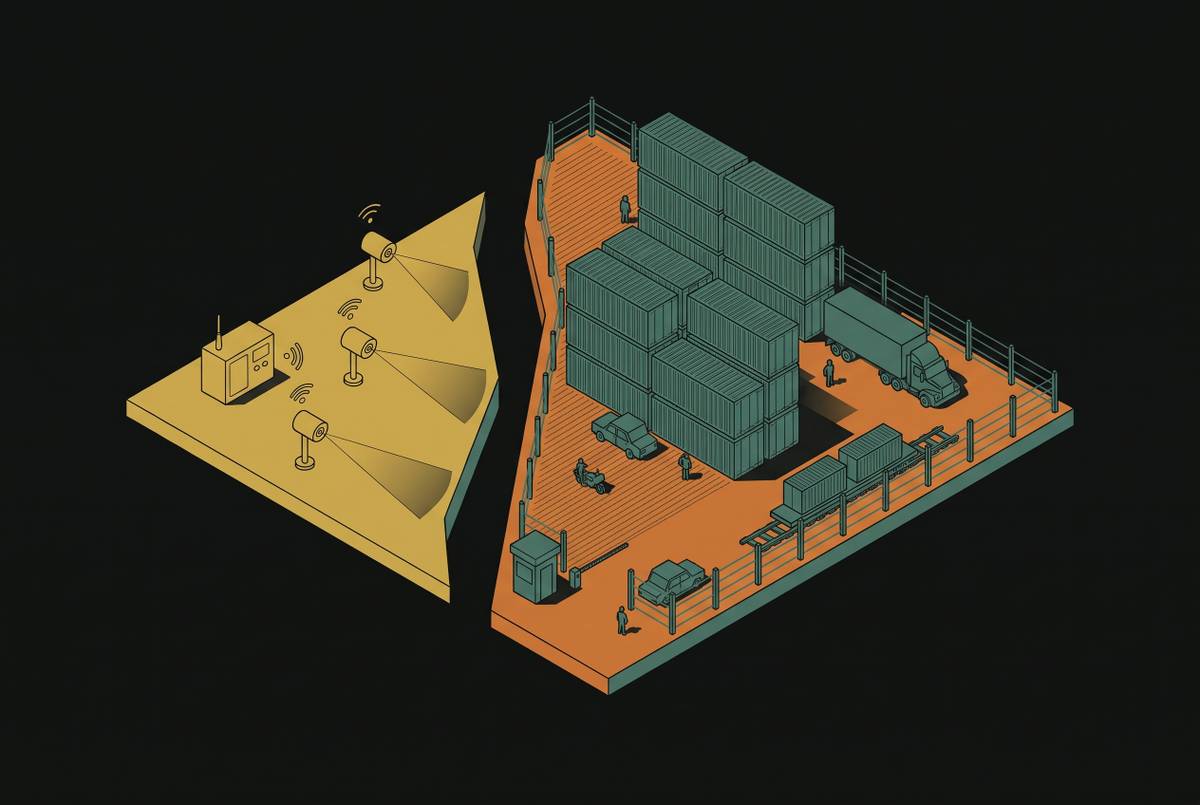
An architecture built around yard context assigns the first evaluation to AI agents and reserves consequential response decisions for human operators. The AI layer uses schedules, authorized carrier lists, and staging records to assess detections before escalation. Authorized activity can be dismissed without a person having to review it. The operator receives a verified threat with the initial triage already done. This division places contextual evaluation upstream of the queue.
An AI label attached to a motion-triggered workflow does not establish that the system understands the yard. The required work is to relate an event to the relevant authorization and asset records, then assess its need for escalation. Only when that evaluation precedes human review does the operator avoid processing the routine activity that overwhelms a generic alarm stream.
Audio deterrence, police dispatch, and protocol escalation call for decisions that context alone cannot make. The operator receives a contextualized, verified event and decides on the response. Intervention remains possible only if the total time from detection through verification to operator receipt leaves time to act.
After-hours coverage makes the division especially clear. Loaded trailers are still exposed when fewer staff are on site by design, but schedules and staging records can still show what to expect overnight. An AI layer can monitor continuously without fatigue and flag deviations from those conditions. The human operator then handles the response rather than repeatedly reviewing expected inactivity and routine authorized movement. This is the operating model that buyers should examine when assessing claims of immediate guard notification.
What security buyers should verify before trusting a monitoring platform with an active truck yard
Buyers should begin with configuration detail. Can the platform suppress alerts for authorized arrivals during logged appointment windows, and does that suppression change when the schedule changes? The answer needs to explain how this yard’s schedule affects its alert decisions. A general claim about detecting people or vehicles does not answer the question. Detection capability and authorization awareness are different criteria.
Buyers also need to check coverage because context cannot show what is out of view. Buyers should ask how the coverage plan accounts for trailers being repositioned and fixed-camera blind spots shifting after installation. Gate verification deserves the same scrutiny. Hawk states that license plate recognition cannot authenticate a driver, carrier, load, or paperwork, while CargoNet’s Q1 2026 analysis identifies carrier and broker impersonation as a central method. Plate reads alone do not resolve fraudulent pickup.
Buyers should check response claims against the verified-threat SLA as well as the alert-generated SLA. The relevant measure is how long it takes a human operator to receive a verified, contextualized threat event. An instantly generated alarm can still wait for interpretation. Buyers should distinguish that notification speed from the time required to establish a threat and put it before someone who can act.
Evidence completes the evaluation. Buyers should ask whether the platform produces a continuous, timestamped, exportable movement record for carrier disputes. Across scheduling, coverage, gate checks, escalation, and evidence, the standard is site-specific detail. A platform that answers only with generic capability claims has not demonstrated that it can distinguish an active truck yard’s normal work from the threat concealed within it.