Signal Fatigue and the Cognitive Ceiling That Breaks Traditional Monitoring Center Response
AI pre-filtering removes the noise that exhausts human operators before genuine threats reach them.
Alarm response time failure in traditional video monitoring centers is a structural problem. When human attention is the first filter for high volumes of false alarms, genuine threats wait behind noise while repeated false positives weaken vigilance. The remedy is to change how alarms reach operators, using site-aware AI for initial review and trained humans for threat response decisions.
Why human attention breaks under high alarm volume — and why it was always going to
Hospital alarm fatigue provides the clinical parallel. Decades of hospital research found that the vast majority of clinical alarms were false or non-actionable, and more than half of nurses in some studies reported silencing alarms. This was a response to sensory overload in an environment where repeated notifications rarely called for action.
The mechanism is habituation, in which the brain reduces its response to stimuli that consistently produce no meaningful outcome. This process operates below conscious awareness and is difficult to override fully through training or motivation. The “cry wolf” effect extends the damage. After sustained exposure to false positives, learned skepticism can spread to unfamiliar alerts, rather than remaining confined to the categories that produced the noise.
Physical security monitoring has the same vulnerability because over 98% of alarms reaching central stations are false. Operators must repeatedly distinguish an exceptional threat from a stream that overwhelmingly teaches them not to expect one. Attention is not an unlimited processing resource. Better hiring and stricter protocols cannot change this limit in the brain while the alarm architecture still asks people to take in the same number of alarms.
What the alarm queue actually looks like inside a traditional monitoring center
A sensor trips, its signal joins the queue, and an operator reviews it when its turn arrives. Arrival order becomes the basis for attention. Until a human reviews the event, this first-in, first-out model has no structural means of separating a genuine threat from the false signals ahead of it.
Security operations research illustrates the pressure that high alert volumes place on human review, although cybersecurity findings are not direct measurements of physical video monitoring. Cybersecurity Insiders 2025 data show that alert investigation consumes a significant stretch of time. Vectra AI’s 2026 research finds that a majority of alerts go unaddressed because of volume and that most teams cannot keep pace. Waiting compounds the work of investigation itself. These findings describe the same underlying bottleneck, in which incoming signals exceed the attention available to assess them.
Once an alarm reaches an operator, poor account data can make the decision take even longer. A “Zone 3” descriptor provides little help if zone metadata is stale, escalation contacts are outdated, and the available site context is generic. Research that tracked human operator feed-scanning found that it took an average of 20 minutes to detect an incident. In the queue scenario described here, a threat arriving behind dozens of routine signals can therefore take 20-plus minutes to reach verification, even in a well-run station.
Why the conventional fixes — more staff, muted cameras, offshored operators — do not close the gap
Adding operators lets a station review more alarms, but people still classify them in the order they arrive. Headcount scales linearly against signal volumes that hiring cannot necessarily match, while security workforce shortages constrain recruitment. More staff can relieve pressure temporarily.
Muting noisy cameras shortens the queue by keeping some alarms out of review altogether. The relief comes at the expense of coverage. Offshoring cuts labor cost but leaves the same number of signals for people to review, while overage pricing makes the client pay for excess activity. Neither change, by itself, improves the path from a genuine threat to a response.
Better detection rules and threshold tuning make a stronger case for these fixes because they can cut false positives while keeping alarms under review. Those improvements are useful, but their reach is bounded. The same Vectra research says that there were fewer alerts year over year, yet 63% of alerts still went unaddressed. These conventional remedies share a limiting feature when applied within the existing workflow, because human attention remains the first filter.
What it means to make AI the first filter rather than a faster version of the same queue
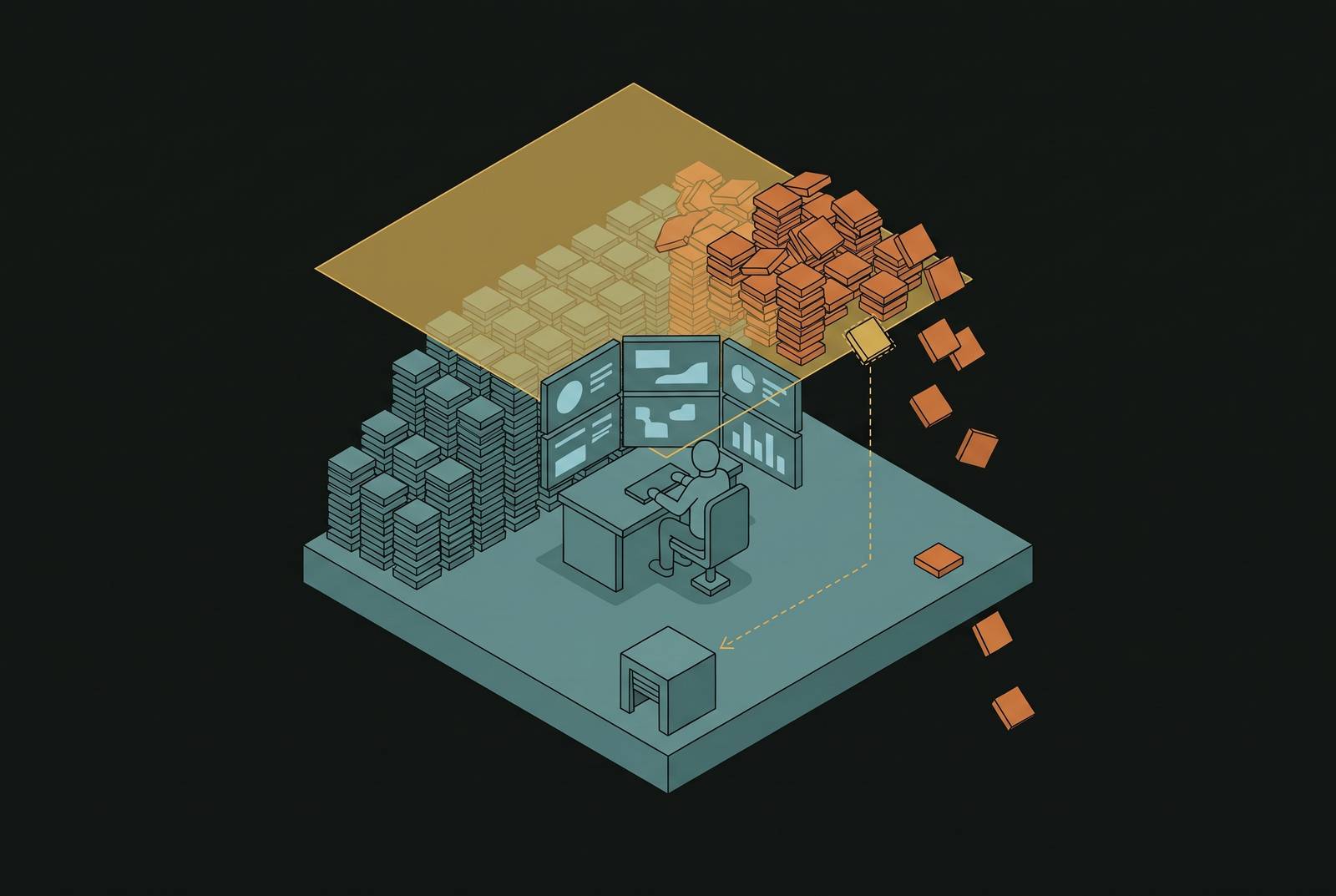
An AI-first architecture moves initial review ahead of the human queue. AI agents assess each signal, dismiss noise and authorized activity, and pass confirmed threat events to operators. This changes the entry point for human attention.
The distinction is between flagging and reasoning. A binary trip signal says that something happened, but does not establish whether it was permitted, expected, or threatening. Site-aware classification reads that signal against schedules, authorized activity, zone layouts, and response protocols. Context gives the event its operational meaning. An AI layer that merely generates better-looking alerts, while leaving a human to resolve every one, remains a faster version of the old queue.
In the proposed model, automation takes on the flood of alarms and their initial classification, while human operators get verified escalations with the context they need already gathered. Operators still make threat response decisions. The architectural objective is to remove the repetitive screening work that degrades the conditions under which trained judgment performs well.
How site-specific protocols determine whether AI pre-filtering works or just shifts the noise upstream
Default alarm settings describe an average site. A loading dock at a truck yard, an employee lot at a retail strip, and a mechanical room in a multifamily building have different authorized-activity profiles. Uniform rules erase those distinctions. AI pre-filtering inherits that weakness unless its classifications draw on the actual schedules, access arrangements, and zone descriptions for each site.
A vendor arriving at 11 PM on a contracted schedule illustrates the difference. Without the schedule, the arrival and an unauthorized intrusion at the same time can look identical in the signal stream. Timing alone cannot settle the classification. The protocol checks the event against what is allowed in that zone, so operators do not have to spend time reviewing expected work.
Traditional centers already use Enhanced Call Verification, an established way to verify alarms before dispatch. But people do that work after the queue, while site-specific AI protocols check the context before the human queue forms. That placement gives context its structural leverage. It also creates an ongoing data obligation because changing schedules, outdated contacts, and stale zone descriptions degrade pre-filtering. Maintaining those records is a solvable operational problem, with a smaller failure surface than routing every alarm through fatigued human review.
What a monitoring SLA should actually measure, and why the 90-second standard obscures the real gap
The 90-second standard serves a narrow purpose in traditional central-station monitoring by measuring signal receipt and handoff. It is not an end-to-end guarantee from the appearance of a genuine threat to a verified human response. Those are different performance claims. Treating the handoff standard as a complete measure of protection conceals the time spent waiting, interpreting the event, and establishing what action it requires.
The full operational sequence includes arrival, queuing, operator review, a decision, and dispatch. Site context affects the review, while the signals already in line affect when that review begins. The standard covers only a narrow portion of that sequence. A real threat behind routine alarms remains dependent on its position in the queue before the handoff can help it.
Verification also influences what happens after dispatch. In verified-dispatch jurisdictions, verified alarms get a response right away, while unverified alarms get lower priority or none. For an AI-first workflow, the relevant target is time from signal to verified threat in a human operator’s hands, measured in seconds. That target describes only the proposed architecture’s objective.
For buyers, the lesson is to separate the SLA’s defined interval from the broader response claim. What does the SLA actually cover, and what is the measured time between a genuine threat appearing and a trained operator acting on it? The endpoints must be explicit for comparison to be useful. Otherwise, a measure of retransmission alone can look like a measure of verified threat response, even though they cover different parts of the workflow.
How the cognitive ceiling argument applies differently across commercial, multifamily, and industrial sites
In commercial retail, cleaning crews, restocking, and HVAC cycling produce after-hours signals that can be expected, so knowing the schedule is key to avoiding needless review. Employee lots and truck yards have a different authorization pattern, with shift schedules and contracted access windows making time-of-day and credential context the primary filter.
Multifamily activity is continuous. Resident movement, visitors, package deliveries, and maintenance require protocols that distinguish unauthorized access from expected use of shared spaces.
Industrial monitoring adds a different verification problem. In safety-compliance uses involving protective gear, perimeter zones, and equipment envelopes, operators may need to distinguish a real violation from a camera-angle artifact before an escalation imposes operational cost.
What rearchitecting alarm flow actually requires, and what buyers should ask before they trust a monitoring provider
The structural test is where classification occurs. If a person must inspect an alarm before the system can decide whether it is meaningful, the provider is still operating a human-first queue, however efficiently that queue is managed. If AI classifies events first and operators receive verified threats with context, the workflow has changed. Camera count, operator headcount, and station certification alone do not establish that distinction. Cameras whose alarms go unreviewed can make a site seem covered without giving it effective coverage.
To evaluate that distinction, buyers should ask what share of alarms are resolved before human review and what false dispatch rate results. The two questions belong together because removing events from a queue is not, by itself, evidence of accurate classification. Protocol depth is the next test. A provider should be able to demonstrate what the system knows about the site’s schedules, authorized personnel, zone layout, and escalation contacts, and how that knowledge changes what an operator receives.
Buyers should ask how the system handles alarm surges, whether response time degrades, and what queue mechanism remains. Average speed alone leaves that question unanswered. The measured interval from signal to verified threat in a human operator’s hands should also have a clear SLA definition, rather than being substituted with a receipt or retransmission figure.
The standard buyers should hold providers to is an AI-first, human-verified workflow with a defined place for human authority. Accountability remains with the response decision. The purpose of rearchitecting alarm flow is to make that decision the operator’s central task, rather than the occasional outcome of working through a queue of noise.