Perimeter Breach Risk in Truck Yards and Freight Terminals
Monitored perimeter coverage closes the gap between alarm and human response that thieves exploit.
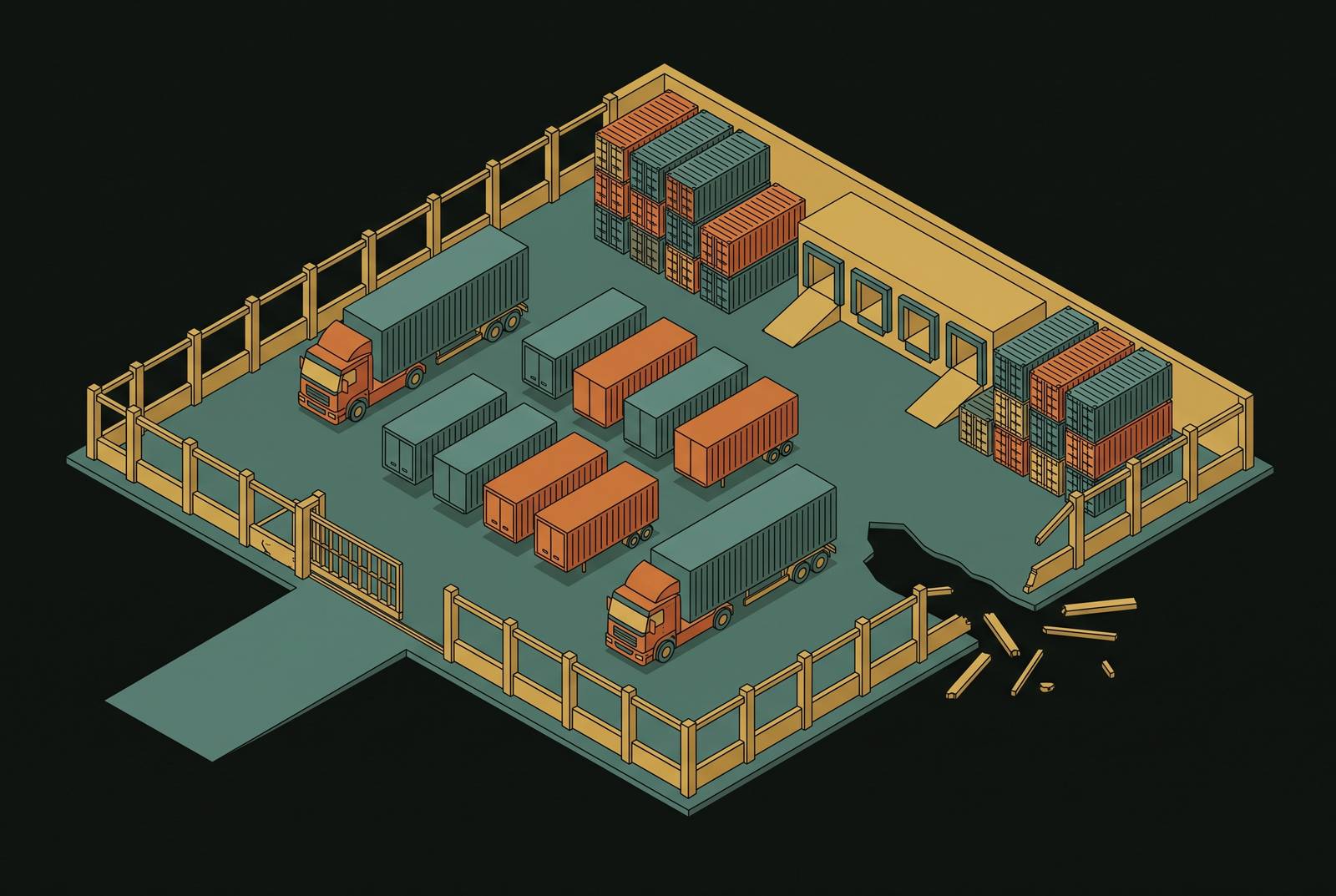
Perimeter breach risk at truck yards and freight terminals is at its core a monitoring problem: the gap between when an alarm fires and when a verified human response is actually moving, and that gap is where loaded trailers disappear.
Truck yards as a structurally attractive target for organized cargo theft
Organized cargo theft crews do not pick truck yards at random. They pick them because the conditions on site hand them what a patient operation needs: predictable dwell times, wide and irregular perimeters, thin overnight staffing, and enough routine gate traffic that one more tractor rarely draws a second look. A loaded trailer sitting in a staging lane is a far simpler target than freight inside a monitored warehouse. There's no building to breach, no internal access control to defeat, no dock schedule to work around, just a parked trailer and a tractor that can couple to it in minutes.
Drop-and-hook operations make this worse. A trailer dropped on a Friday evening may not move again until Monday morning, and every hour of that weekend is open time for a crew that already knows what the trailer is carrying. Reporting from Équité Association makes a related point that matters for how operators should read the scale of the problem: companies often absorb cargo theft losses quietly instead of filing a claim, so the theft is chronically underreported. That means published incident totals function as a floor, not a ceiling. The real number of yard thefts each year is higher than any public dataset shows.
The methods have also shifted in a direction that puts yard security back at the center of the problem. One 2026 industry guide notes that organized groups moved away from complex fraud schemes, like forged paperwork and impersonated brokers, after logistics platforms deployed anti-fraud tools that made those schemes harder to run. The response was not to quit. Crews returned to the simpler, older play: identify a high-value trailer staged in a yard and take it directly. That shift means the perimeter itself, not the paperwork trail behind a load, is now the primary line of defense.
The truck yard perimeter as a security problem
A truck yard does not have a perimeter in the way a warehouse has a wall. It has a shifting, semi-permeable boundary that moves faster than most security plans can track. Trailer rows get rearranged. Containers get stacked and restacked. Tractors park somewhere different each week depending on what's loading and what's waiting. A camera angle that covered the highest-risk row last quarter may be aimed at an empty lane this quarter, simply because the yard's own layout changed under it.
Bay Area operators deal with this in a particularly acute form. Port-adjacent facilities, multi-gate yards, and dense freight corridors mean these sites are rarely simple rectangles with a fence around them. Operational density, more trailers packed into the same footprint, shorter dwell windows, more constant gate movement, outpaces what a static security plan can account for. A yard built around a fixed set of camera positions and a fixed patrol route is already behind the operation it's supposed to protect.
A breach is discovered slowly: a missing trailer or a broken seal may not surface until the next scheduled yard check, so the loss window can stretch across an entire shift, or an entire weekend, before anyone on site even knows something is wrong. Terminal security practitioners have a name for the underlying failure: perimeter drift, where fencing, lighting, or camera coverage has quietly fallen behind how the yard is actually being used. The yard evolves operationally. The security plan, left alone, does not.
Guards and Fixed Cameras Cannot Close the Coverage Gap
Guards and fixed cameras both do real work on a truck yard, and neither one is the weak link by itself. The trouble is what happens when the two are asked to cover a multi-acre site on their own, without anything closing the space between them. A single guard can watch only a small fraction of a large perimeter at any given moment. Patrol routes create time gaps by design, and Hawk's 2026 perimeter analysis states this directly: a person can cross a fence line, move between trailer rows, or slip into a back-lot equipment area in the window between one patrol pass and the next.
Fixed cameras solve a different part of the problem, and they solve it well at stable chokepoints: gates, dock doors, fuel islands, known traffic lanes. Where they struggle is everywhere the yard itself is in motion, among trailer rows, stacked containers, or temporary fencing that gets moved around as inventory shifts. Adding more fixed cameras helps at the stable points but leaves the mobile coverage gap untouched. Each new installation needs mounting, power, network access, trenching, lift work, landlord approval, and IT coordination, and by the time it finally goes live, the highest-risk area it was meant to cover may have moved somewhere else.
There's a related failure mode separate from any physical coverage gap: gate fatigue. Terminal security practitioners use the term to describe officers processing vehicles quickly under operational pressure and gradually easing off on verifying details, because the humans at the chokepoint were asked to move too fast to check thoroughly. Fraudulent pickups expose the same limit from another angle. License plate recognition records the plate. A gate guard can check a document. But no combination of plate and paperwork check can authenticate whether a carrier actually has the authority to take a specific load, unless there's a real verification workflow running behind the gate, not just a person standing at it.
None of this argues for fewer guards or fewer cameras. Hawk's 2026 truck yard framework maps each exposure to the control that actually addresses it: guards for judgment calls, access control, and incident response; fixed cameras for the stable chokepoints; monitored coverage for the open lot and the after-hours window when nobody is walking the fence line. The controls are complementary. None of them, alone, covers a perimeter that moves as fast as a modern yard does.
How the alarm queue becomes the breach window
A truck yard generates alarm volume that most other commercial sites never approach, and that volume is the mechanism by which a real threat ends up waiting in line behind noise. Trucks, wildlife, weather, and vegetation are all in near-constant motion on a working yard. Any detection zone that touches an active lane or a road running past the property will throw alerts continuously, almost none of them real.
The predictable response is for operators to treat high-volume cameras as background noise. Detection zones get widened, sensitivity gets dialed down, alerts get muted, and the yard's effective coverage shrinks even though the camera count on the books stays exactly the same. Human attention adds a second, harder limit on top of this. The vigilance decrement, the well-documented drop in detection accuracy during sustained monitoring, is a physiological limit, not a reflection of staffing quality. Trained professionals watching video in a sustained review task detect only about half of the target behaviors they're supposed to catch, and false alarms stay high throughout.
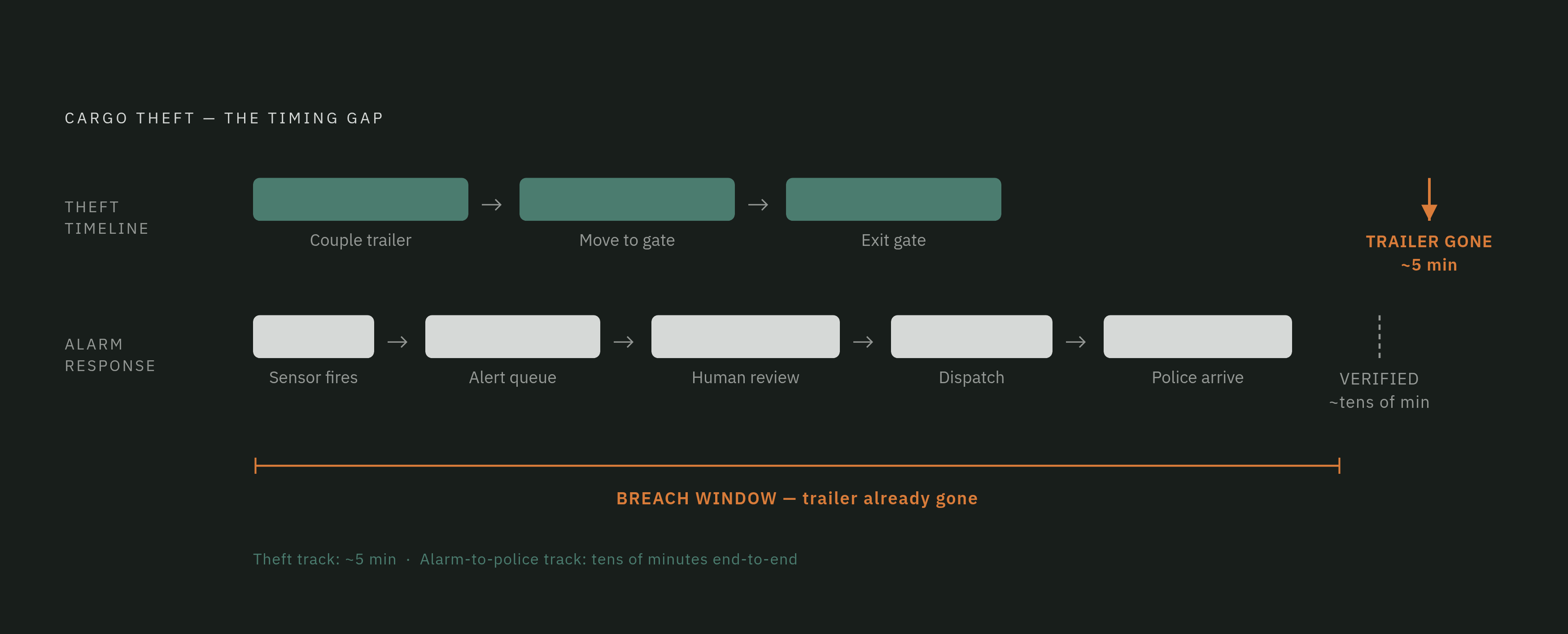
Put a stopwatch on this: end-to-end alarm response in a traditional monitoring setup, from the moment a sensor trips to the moment police actually arrive, can run to tens of minutes. Coupling a tractor to a loaded trailer and driving it out a gate takes only minutes. A legitimate alarm can fire, sit in a queue behind a dozen false positives, and still be waiting for review by the time the trailer is already three exits down the highway. The breach, in other words, does not happen because a sensor failed to detect anything. It happens in the space between a correct detection and a verified human response that reaches it in time to matter.
What AI Agents Do When an Alarm Fires in a Truck Yard
The advance that AI agents bring to truck yard monitoring is not speed in flagging events. A threshold-triggered sensor already flags movement instantly. What an AI agent adds is contextual reasoning that happens before a human ever sees the alert, cross-referencing a fence-line trigger against the time of day, the trailer's position in the yard's inventory, license plate recognition data, and historical incident patterns, before deciding whether the event deserves escalation. That's a different kind of work than sounding an alarm. It's closer to the judgment a seasoned yard supervisor would apply, run automatically and continuously.
AI triage determines how much alert volume actually reaches a human operator. One monitoring center reported that monthly alerts dropped by hundreds of thousands after this kind of triage was put in place, so existing staff could manage more accounts while dealing with far less noise, and video-verified alarms produced a faster police response once they did go out. Deep-learning filters that can tell a human or a vehicle apart from a branch moving in the wind catch false positives at the source, before they ever reach muting or operator tolerance.
The practical effect on timing is that Mean Time to Acknowledge, for the queue itself, approaches zero. The AI begins investigating the instant an alarm fires rather than waiting for a human to reach it on a list. By the time a person does get involved, they're looking at an enriched, already-verified event instead of a raw, unqualified alert sitting at some position in a backlog. A yard alarm during authorized carrier hours at a known gate lane means something entirely different from the same sensor firing at 2 a.m. on a rear fence line, and an AI agent without that context cannot tell the two apart in any meaningful way. One built with that context can clear most of the queue before a human ever needs to look at it. None of this replaces the human operator. It sharpens what that person is actually for: the judgment call, the dispatch decision, the voice-down over a speaker, the escalation to police. Trained human judgment still does something AI should not be asked to do.
Site-specific protocols separate verified response from another alarm in the queue
An AI agent that doesn't know the specific site it's watching is just a motion detector running on a faster processor. What makes triage meaningful instead of mechanical is the configuration behind it: what counts as authorized, what counts as anomalous, what counts as urgent, for this yard specifically. A truck yard is not a retail store, and treating it like one means importing the wrong assumptions. Operating hours, carrier rosters, trailer inventory, gate procedures, and yard lane layouts are all inputs specific to one site, and they define what normal looks like there, and what counts as a deviation from it.
The control-to-exposure mapping makes this concrete. Fraudulent pickup risk calls for driver and paperwork verification layered on top of license plate recognition, because the protocol is what gives the camera record its meaning in the context of that specific load movement. The same logic applies to after-hours coverage. A monitoring feed that successfully verifies a threat but routes the alert into an undefined response chain, with nobody clear on who receives it or what authority they have to dispatch, has not closed the breach window. It has only moved the breach window one step later.
Terminal security practitioners describe a structural failure mode called disconnected reporting, where operations, maintenance, and security each hold a separate piece of the picture and none of them sees the whole thing. The operational standard these sites need is integrated protocols that route a verified alarm to a mobile patrol, update an incident log, and produce an exportable evidence record within minutes, not a notification that lands somewhere and waits.
Regulation is starting to touch this from the guard-training side. California's SB 652, taking effect in 2026, reforms general security guard training statewide by requiring the Power to Arrest and Appropriate Use of Force course to be completed through a single certified provider within six months of a guard card application. Some security industry commentators suggest insurers may increasingly look at compliance documentation like this when they underwrite cargo coverage, though that is not yet an established regulatory requirement.
For an operator evaluating a monitoring provider, the useful question is not how many cameras a vendor can watch. The useful question is what the triage logic actually knows about that yard: its carriers, its operating hours, its layout. That's the line between coverage that produces a faster-moving queue and coverage that actually closes the breach window.
A monitoring architecture that closes the breach window
Closing the breach window takes three things layered together: continuous AI attention across the full perimeter, verified escalation to a human operator within seconds of a confirmed threat, and a response protocol specific enough that the operator already knows what to do before anyone sets foot on the yard.
Coverage has to follow the risk area instead of following wherever the camera plan happened to be installed. Elevated or repositionable coverage over trailer rows and back lots, fixed cameras holding the stable chokepoints, and license plate recognition at the gates work together to remove the blind spots that move every time yard inventory moves, the same pattern the Bay Area perimeter analysis and the truck yard security framework both describe from different angles.
AI triage has to run on every alarm the yard generates, not a sample of them. Because the queue problem is architectural, partial AI coverage only delivers partial results. A threat that reaches human review quickly because AI already cleared the noise ahead of it is a fundamentally different outcome than one sitting for many minutes behind a queue of wind-triggered false alarms. The yard that closes its breach window is the one where that difference holds on every single alarm, not most of them.