How Cargo Thieves Exploit the After-Hours Window at Unmanned Freight Terminals and What Closes It
AI-driven remote monitoring can catch yard thefts in progress.
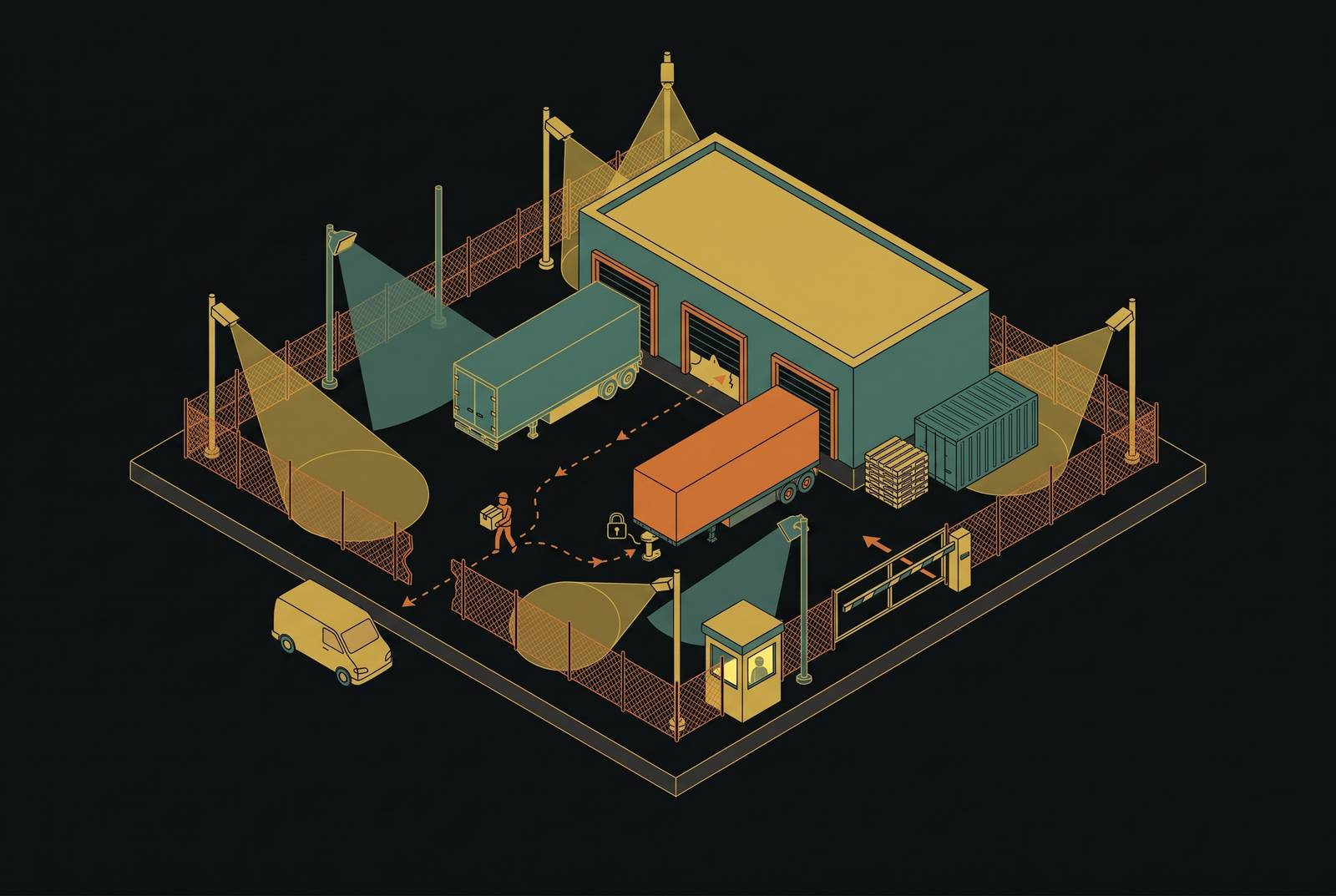
AI-augmented remote video monitoring for truck yards and freight facilities closes the after-hours detection gap when it continuously interprets yard activity and sends contextualized threats to human operators. Passive recording and motion alerts alone do not provide that coverage. For this to work, reasoning-capable surveillance needs usable nighttime footage and people who respond in time, while documentation fraud calls for carrier vetting and process controls.
Why freight terminals become reliable targets after hours
A trailer parked on Friday evening may remain unattended until Monday morning. If freight disappears during that interval, the theft crew can have a 48-to-72-hour head start before anyone notices. A truck yard that serves as an operational hub by day becomes an unguarded storage zone by night, with valuable freight concentrated in stationary trailers that have not yet been offloaded.
Those trailers are the core physical exposure. Their contents remain reachable by anyone who can enter the yard, while variable staffing and frequent vehicle turnover make it difficult to distinguish expected movement from unauthorized activity. An unmanned gate or secondary entrance provides an entry point without anyone watching or verifying access. High asset density makes that gap more consequential because substantial freight sits within the same accessible space.
The transition from active terminal to unattended storage changes the likelihood that someone will notice interference with the assets. Munich Re's 2026 Cargo Theft Report frames cargo theft as a systems-level exposure. The weekend yard shows how that risk grows out of the way the yard normally runs, without an unusual security failure.
The two attack surfaces thieves choose when the yard goes dark
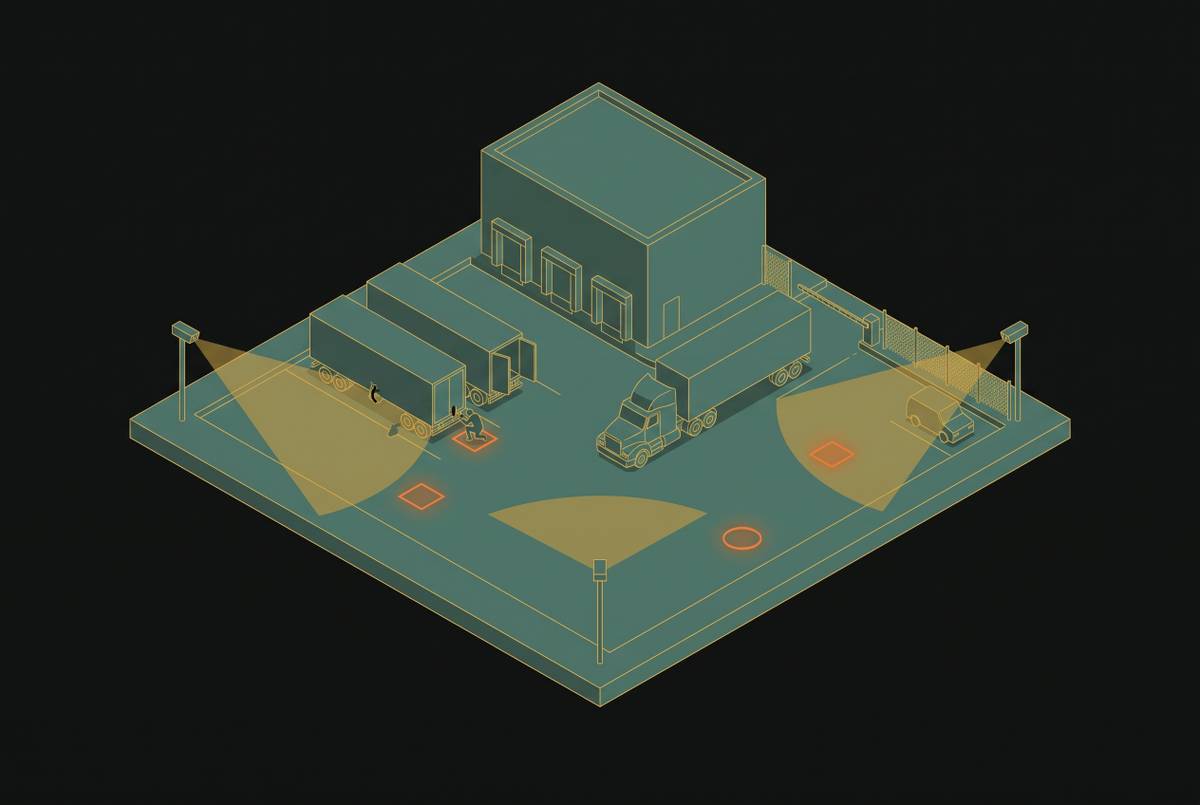
Physical intrusion exploits the absence of a watcher directly. A crew cuts a fence or enters through an unmanned gate, then removes freight from staged trailers. The entry itself may be visibly unauthorized. Whether the crew is opportunistic or organized, the physical sequence gives surveillance something to detect before the theft is complete.
Strategic fraud presents a different problem at the same boundary. A thief may impersonate a legitimate carrier and arrive with fraudulent pickup documentation. The report puts strategic or fraud-driven theft at roughly 30% of US cargo theft incidents in 2025. These schemes can involve phishing, spoofed domains, compromised credentials, and manipulated freight platforms used to arrange fictitious pickups.
Cameras can reveal surveillance walks, after-hours coordination, or equipment staging that precedes a fraudulent pickup, but they cannot establish that the person presenting paperwork is who they claim to be. The report also puts insider participation at roughly a fifth of reported thefts worldwide. Credentialed access is not proof of legitimate intent. Carrier vetting and process controls deal with the paperwork that video cannot check.
Why the losses keep rising even as reported incident counts fall
Falling incident counts can coexist with growing financial exposure when organized crews select fewer, higher-value shipments. Precision changes the economics of theft. A quieter incident log can thus give a false sense of how well a yard is protected.
The goods selected help explain that mismatch. The report identifies food and beverage as the leading global category, with agricultural products and electronics also among the most frequently targeted commodity groups. These goods are portable, in demand for resale, and readily redistributed. The report identifies the US among the highest-exposure geographies and places domestic strategic theft concentration in California, Arizona, Texas, and Illinois.
Incident totals also offer an incomplete national picture. There is no single national cargo theft count, and figures in circulation measure different things. That limits what an operator can infer from a decline in a particular dataset. For yard security, the more useful measures are loss value and dwell-time-before-detection, because they capture both the consequence of a theft and the time available for intervention. A monitoring model judged only by incident frequency can appear successful while leaving its most costly vulnerability untouched.
How passive CCTV and reactive alarm queues fail in a freight yard at 2 a.m.
Passive CCTV preserves footage without necessarily bringing an unfolding theft to anyone's attention. Reactive monitoring adds alerts, but often puts each person or vehicle it detects into a queue for a human to review. In a freight yard, legitimate late arrivals and routine vehicle movement compete with wind and shadows for attention. The queue becomes the bottleneck. A real intrusion can wait behind activity that never required intervention.
That arrangement makes coverage depend on available human attention. A team covering multiple yards receives more footage as deployments expand, but manual review does not scale at the same rate. A single guard also cannot simultaneously watch a dock area, a trailer yard, and a receiving lane. When guards are tired or distracted, or follow predictable patrol patterns, they leave more gaps that experienced crews can study.
Muting a noisy camera removes its alerts by sacrificing coverage, while absorbing overage fees sacrifices budget. Adding lower-cost monitoring seats can introduce response latency and inconsistent judgment on ambiguous nighttime footage. These changes still leave people to decide which activity in the queue calls for a response. Consequently, a crew may finish loading and leave before a response is dispatched, compounding the head start created by the unattended yard.
What security systems can detect cargo theft in real time at unmanned freight yards?
Reasoning-capable surveillance evaluates activity against the conditions in which it occurs rather than treating every detected object as a threat. A yard tractor moving at 3 a.m. is not inherently suspicious. A person loitering behind a trailer row when no movement is scheduled presents a different signal.
This architecture changes the order of work. AI agents keep checking camera feeds, handle routine activity, and pass events to people when they are hard to judge or much is at stake. Relevant signals include restricted-zone vehicle entry, fence and gate intrusion, unscheduled equipment movement, and people lingering in trailer areas outside business hours. The operator receives a contextualized event rather than a raw clip drawn from a large undifferentiated queue.
Human judgment remains part of the system. It is concentrated on events that require interpretation or a consequential response. This also gives physical precursors to fraud, such as surveillance walks and after-hours equipment staging, a route to human attention even when the underlying deception occurs elsewhere.
A verified alarm must reach an operator soon enough for a response to be dispatched while the crew is still in the yard. That is how continuous monitoring can replace delayed discovery with an opportunity to interrupt an active theft.
Why AI on a freight yard camera is only as good as the footage it sees
Wider fields of view reduce pixel density and infrared strength, which constrains reliable human detection in pitch-dark infrared conditions. Software cannot remove those optical limits. A demonstration in daylight therefore says little about whether the same installation can distinguish a person near a distant trailer row at night.
Weather introduces another source of uncertainty. The paper “Occlusion Robustness of CLIP for Military Vehicle Classification” found that dispersed occlusions such as snow and rain caused greater performance degradation than contiguous occlusions. That finding shows why different forms of visual obstruction deserve separate evaluation. A northern yard in winter presents a harder operating environment than a southern California yard in summer.
Camera condition can further restrict what the model receives. Severely compressed streams, damaged lenses, and cameras operating at minimum illumination thresholds can produce inadequate footage before AI analysis begins. The service still depends on the image.
A poorly selected model can produce more noise than a simpler system, especially when actual camera angles, lighting, and traffic differ from its training conditions. AI capability must therefore be judged on the yard's footage.
How to evaluate a continuous monitoring solution for a freight yard specifically
For an operator evaluating a service, those constraints translate into practical tests. Schedule the pilot overnight, in adverse weather, and across the longest unattended weekend interval rather than relying on a clear-sky weekday demonstration. Ask the vendor to quote detection range separately for clear, rain, fog, and low-light conditions. One range figure is not enough.
Ask for false-positive counts across a full weather and operational cycle. The ratio of verified alarms to total alerts is the most informative single metric for assessing how much useful information reaches the response workflow. Look closely at the busiest and noisiest times, including shift changes, early-morning deliveries, and weekend dwell. Confirm whether models can be retrained on local footage and yard-specific terrain, since generic training may not reflect the site's lighting, camera angles, or traffic.
Then examine what happens after detection. Ask how ambiguous events are escalated, how quickly a human receives a verified alarm, and whether the operator sees a raw clip or a contextualized event summary. Review coverage of trailer rows, secondary gates, and perimeter fence lines as well as dock doors. Finally, ask whether unusual after-hours access by credentialed personnel is flagged as well as access by unknown people. The evaluation must test both visibility and judgment.
What an AI-native monitoring model looks like for an unmanned yard and where its limits are
An AI-native monitoring service assigns routine observation and triage to agents while reserving consequential judgment for trained human operators. The agents assess every camera continuously against time of day, expected traffic patterns, and zone permissions. Routine activity is resolved without generating an alert. Ambiguous and high-stakes events reach a human with the context needed to assess them.
This is a monitored operating model. Its defining feature is the division of work between automation and human judgment, rather than the presence of an AI filter somewhere in an otherwise unchanged alarm queue. For buyers, the distinction is whether agents handle the volume before operators become involved.
Speed remains conditional on the complete chain working. Usable footage must support detection, triage must surface the event, and an operator must receive it in time to dispatch a response. When those conditions hold, the detection interval can be measured in minutes, before staff return. The relevant outcome is an opportunity to act while the crew remains on site.
The scope remains specific. This model addresses physical intrusion, loitering, unauthorized yard access, and after-hours behavioral anomalies, and it can surface physical preparation for fraud-based theft. Authenticating someone presenting fraudulent pickup documentation calls for carrier vetting, process controls, and care in how people share information across the supply chain.