After-Hours Cargo Theft Patterns in Distribution Centers
Organized theft rings now target distribution centers during understaffed overnight hours.
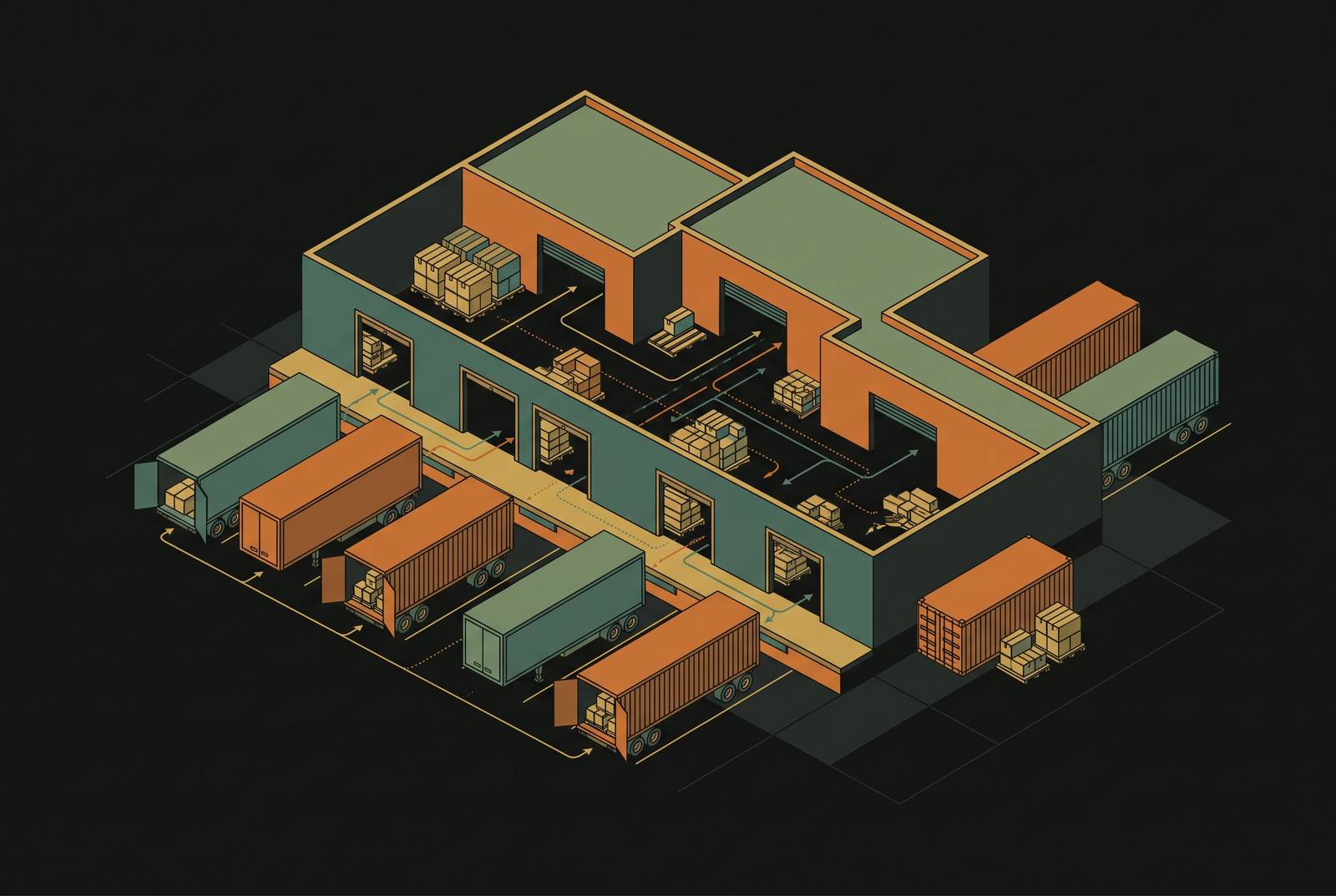
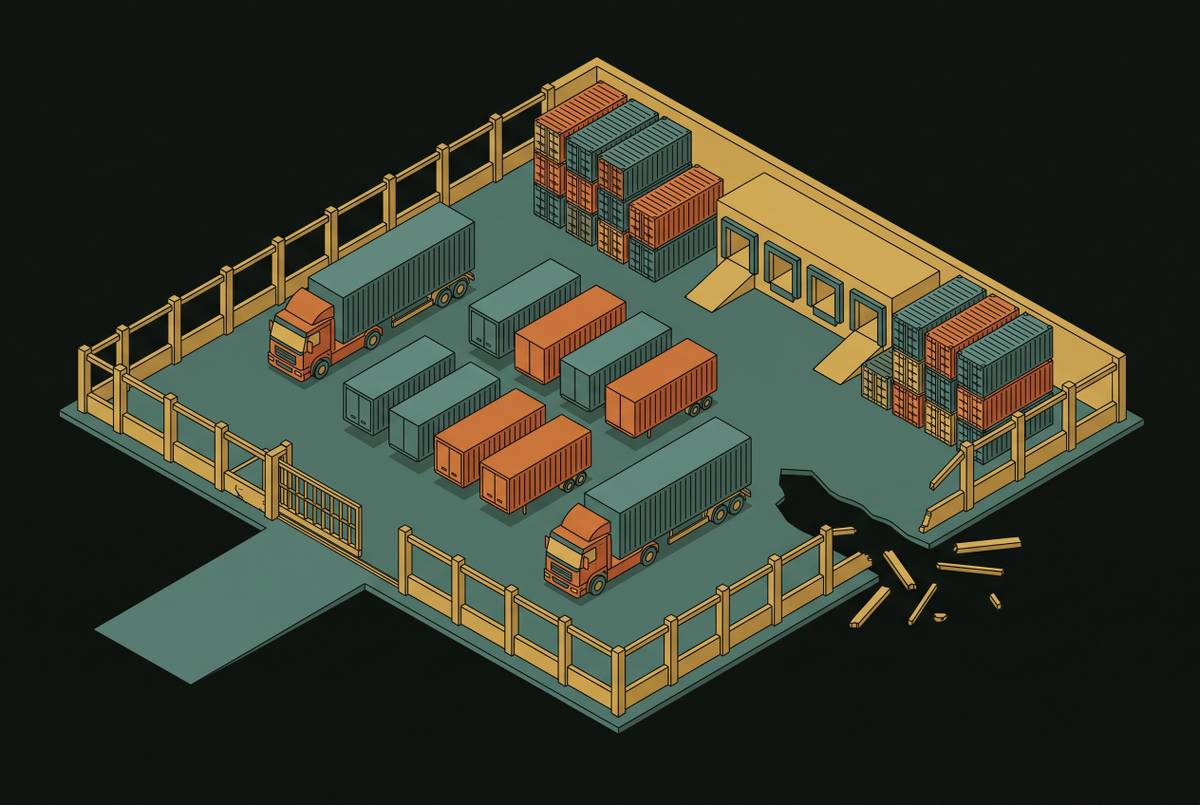
Cargo theft has moved off the highway and into the warehouse. Organized rings now favor distribution centers, cross-dock facilities, and last-mile hubs, because goods sit still there long enough to steal in volume. Suburban industrial parks tend to combine weak perimeter security with minimal overnight staffing, and that combination is close to ideal for anyone planning a theft rather than improvising one. Verisk CargoNet's 2025 annual analysis backs this up directly: among incidents where a location was specified, warehouses and distribution centers were the most frequently targeted location type.
Keith Lewis, vice president of operations at Verisk CargoNet, put the shift in plain terms: "Criminal enterprises are becoming more selective and sophisticated, targeting extremely high value shipments rather than relying on opportunistic theft". That single sentence describes a change in how the crime works. It has gone from smash-and-grab to planned extraction, and the facility itself, not the road, is where that extraction happens.
The timing window in after-hours theft
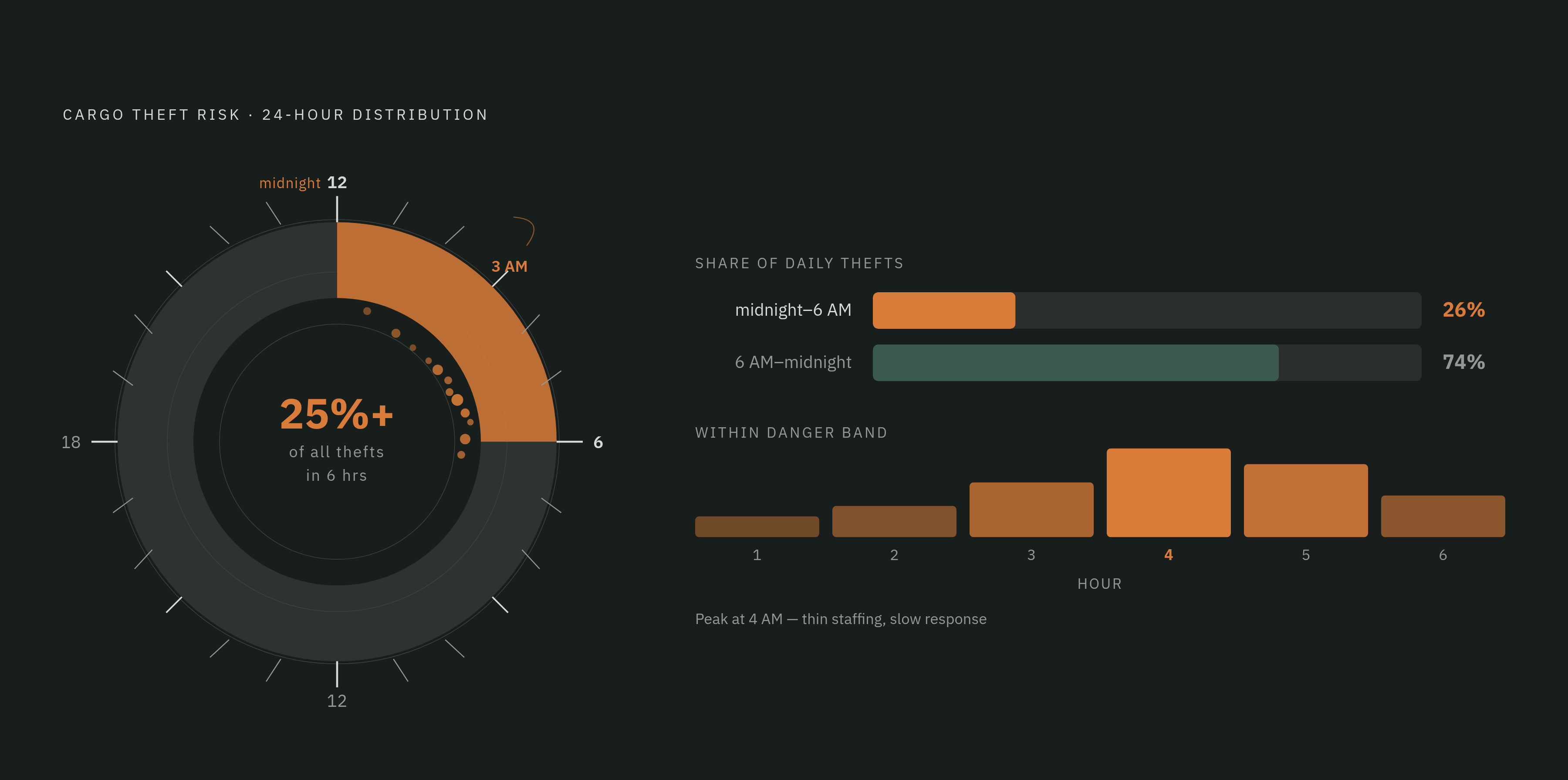
Theft after hours does not spread evenly across the night. It bunches up in the early morning, when staffing thins out and response slows down. Industry data puts midnight to 6 a.m. at more than a quarter of all thefts, a window shaped by shift-change gaps and the simple fact that fewer people are on-site to notice anything wrong.
The fire at the Kimberly-Clark distribution center in Ontario, California, shows what that window makes possible, even though the incident itself was arson rather than cargo theft in the traditional sense. The 1.2-million-square-foot facility, leased by Kimberly-Clark and operated by NFI Industries, first reported the fire at 12:30 a.m., with only a skeleton crew on site. The person responsible was an insider who set multiple pallets ablaze in the early morning hours while a small number of employees were still inside, triggering alarms and forcing an evacuation. The mechanism at work, an insider or unauthorized actor exploiting the gap between full staffing and the low overnight headcount, is the same mechanism that drives cargo theft at that hour. Nobody with the authority or numbers to intervene quickly was there to do it.
That timing concentration is not an accident of criminal habit. Reconnaissance ahead of a theft specifically targets shift-change gaps and the stretch between the last outbound load of the evening and the first inbound crew of the morning. The pattern also moves with the calendar. Q2 2025 saw thefts escalate sharply month over month, with June alone up nearly 22% over May, a trend that lines up with organized groups learning and exploiting seasonal staffing cuts as facilities head into summer.
Which commodities organized rings are targeting
Organized rings do not grab whatever happens to be closest to the dock door. They choose commodities based on illicit-market value and how fast the goods can be resold, and that target list changed in real ways during 2025. Verisk CargoNet's data shows food and beverage thefts up nearly half from 2024, with meat and seafood hit hardest in the Northeast and tree nuts targeted heavily on the West Coast. Perishables of this kind move fast on secondary markets and are hard to trace once they change hands.
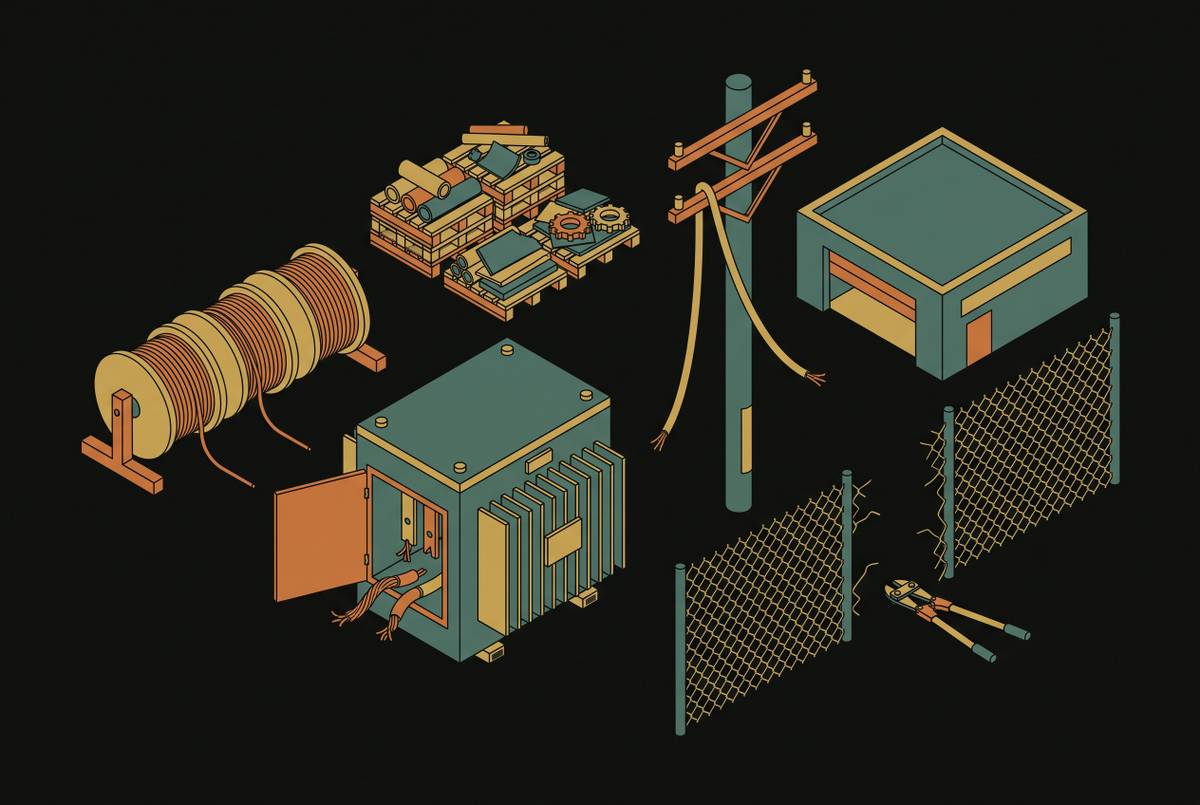
Metal theft climbed as well, pushed by demand for copper, a commodity with a long-established resale network and an easy path to anonymization once it's been processed or melted down. Enterprise computing hardware and cryptocurrency mining equipment have become top-tier targets for organized groups, even as thefts of consumer electronics like televisions and personal computers dropped off. That divergence tracks the margin available in illicit resale. CargoNet expects RAM modules, storage drives, and enterprise computing equipment to stay high-value targets through 2026. Vehicle-related goods, tires, auto parts, motor oil, engines, and components headed to domestic assembly plants, have stayed consistently attractive to thieves across the same period.
None of this is random. A facility holding electronics, computing hardware, or food protein carries a different risk profile than one holding, say, packaged consumer goods with low resale value. Commodity mix is a direct multiplier on exposure, and it belongs in any conversation about which sites need the most attention.
Where theft is concentrating geographically
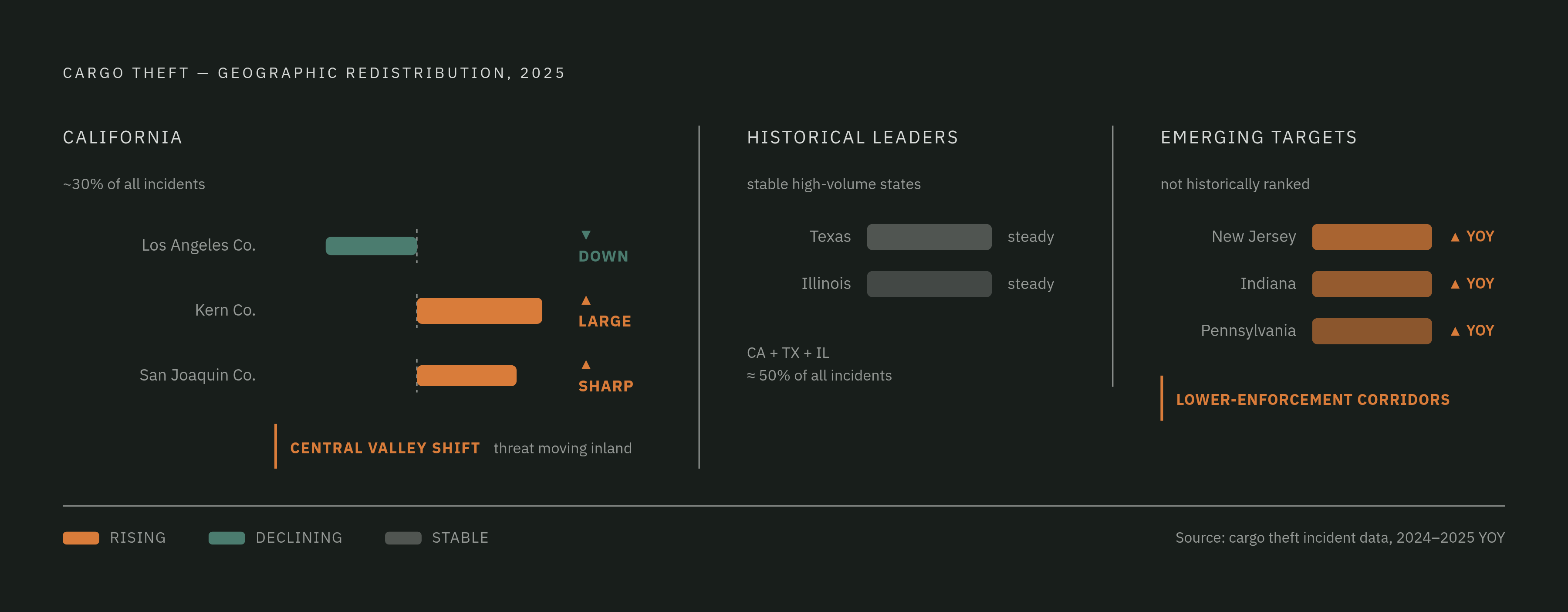
The geography of cargo theft is not fixed, and that is the most counterintuitive part of the pattern. Criminal groups are actively relocating toward corridors with weaker enforcement and less-hardened facilities. A map built on last year's hot spots is already out of date. Verisk CargoNet names California, Texas, and Illinois as the three most affected states, together accounting for roughly half of all cargo theft in 2025.
Inside California, the movement is striking. Los Angeles County, long the highest-density node for this kind of crime, saw a decline, while Kern County posted a large increase and San Joaquin County rose sharply. Activity has shifted toward the Central Valley logistics corridor, a region dense with distribution infrastructure but thinner on enforcement resources than Los Angeles. The pattern isn't confined to California. New Jersey, Indiana, and Pennsylvania each posted large year-over-year increases despite not historically ranking as top-tier targets, which points to organized groups actively scouting for lower-friction environments rather than sticking to familiar territory.
Facilities in regions that once considered themselves outside the theft belt now carry real exposure their security planning never accounted for. A distribution center in Indiana or the Central Valley built its security posture around a threat map that no longer describes where the threat actually is.
How organized theft rings operate
Theft at distribution centers today runs on planning and deception more than force, and that changes what actually needs defending. Perimeter alarms and badge-access systems assume the threat is trying to get past them. Groups now study delivery schedules, employee shift rotations, and camera blind spots well before acting, and the overnight timing pattern described earlier reflects that intelligence gathering rather than luck.
Fraud has grown alongside physical theft, and in some ways it's the sharper problem of the two. Fraudulent carriers use cloned credentials, spoofed emails, and stolen carrier identities to walk goods out the front door carrying what looks like a valid load tender. Keith Lewis describes these as "calculated operations targeting goods with the highest illicit-market value and easiest resale potential". A risk analysis from WTW, cited by IntelliSee, lists identity manipulation, impersonating a legitimate carrier or vendor, as one of eight emerging cargo theft vectors. Once an attacker holds valid-looking credentials, the standard security model has already failed before any camera records a frame.
The Kimberly-Clark fire in Ontario illustrates the insider version of this same problem. The person responsible was an NFI Industries employee present at the facility overnight, not an outsider who breached a fence or a locked door. Whether he was actively on duty at the time has not been officially confirmed, but his presence was authorized. The threat came from inside the access control system, not around it.
Law enforcement has been explicit about how it classifies this activity. In February 2026, a New York man was charged in a multi-state organized cargo theft conspiracy, and in January 2026 six individuals were sentenced for a multimillion-dollar heist operation. Cases like these confirm that the FBI treats this as organized crime, with networks, planning, and resale infrastructure behind it, not petty theft carried out by opportunists. A facility that assumes "we have cameras everywhere" solves the problem misses the point. A camera that only records treats an authorized worker loading an outbound truck the same as someone who looks authorized loading a truck that was never scheduled. The behavior looks the same either way.
Why passive camera coverage fails against known theft patterns
Picture a truck pulling up to a dock at 2:14 a.m. It presents credentials that look legitimate but were cloned. The dock camera records pallets being loaded and the truck driving off. Nobody reviews the footage until an inventory count turns up a discrepancy well over a day later, and by then the goods are already moving through a secondary market. The footage exists, but it's evidence of a crime that already happened rather than a tool that could have stopped it.
The gap here is a design limitation. Most distribution centers already have cameras covering their docks and yards. What those systems lack is any way to act on the patterns they're capable of recording. A traditional system cannot tell a truck arriving outside its scheduled receiving window from one arriving right on time. It has no way of knowing that pallets moving out of a dock at 2 a.m. contradicts that dock's inbound-only schedule, and it carries no memory of whether this vehicle or these credentials showed up the night before.
Camera counts have grown faster than the people watching them. At a large distribution center, the number of cameras multiplies while the number of operators watching monitors stays flat, and IntelliSee's own deployment data shows that as much as 98% of traditional camera alerts turn out to be false positives. That ratio trains security teams to tune out the alert queue rather than treat it as useful information. When a genuine threat arrives, like the cloned-credential truck at 2:14 a.m., it lands in the same queue as hundreds of motion triggers set off by wind, headlights, and passing shadows. An operator who has learned that the queue is mostly noise treats the real alert no differently from the rest.
Adding more people to watch more screens does not fix this, because the limitation is cognitive. Research on sustained attention during monitoring tasks shows that performance drops sharply after only a short stretch of continuous screen-watching, and that even trained, experienced operators run into the same limits everyone else does. This is a structural problem built into how passive monitoring works, not a failure of any individual security team.
What pattern-aware monitoring requires to function
Catching the patterns described throughout this piece takes monitoring that reasons about context, time of day, location, behavior, and each site's own schedule, rather than a system that simply records footage or flags motion. The capability that actually matters is temporal and contextual inference. A truck arriving outside its scheduled receiving window is an anomaly; the same truck at the same dock during its normal window is routine. No passive system, and no single operator watching 40 or more sites at once, can apply that distinction reliably across every camera at two in the morning.
AI-powered video analytics change what happens with that 2:14 a.m. arrival. The system flags the out-of-window arrival, checks the dock activity against the facility's expected inbound schedule, detects that pallets are moving outbound rather than inbound, and sends a real-time alert to a human operator before the truck clears the gate. IntelliSee describes this exact sequence as the practical difference between a system that's AI-augmented and one that's purely passive.
None of this works without rules built for each specific site. A 24-hour cold-chain hub has a completely different legitimate overnight activity profile than a fulfillment center that closes at night, and without those site-specific protocols encoded into the system, no AI layer can tell authorized activity from anomalous activity. The human operator does not disappear from this picture, either. AI filters the alert queue so that what actually reaches a person is a verified anomaly, not the 98th motion trigger of the shift. The operator's judgment gets applied to decisions that matter rather than spent managing noise.
Speed to a verified threat protects a facility, not camera count. A facility with a large number of passive cameras and a review queue that takes hours to work through is, in practical terms, less protected than a facility running continuous AI triage that gets a verified alert to a human operator within moments. Every pattern described in this piece, the overnight timing window, the shift toward high-value commodities, the migration to lower-enforcement geographies, the use of cloned credentials and insider access, exploits the gap between when an event happens and when someone responds to it.
Tidewater Fleet Supply's deployment across three distribution centers and 14 retail sites in the Southeast shows what this looks like in practice: a single cloud dashboard, AI-powered investigation tools that turned reviews that used to take hours into quick lookups, and the same standard of coverage applied across every site in the footprint. That kind of infrastructure is what it takes to apply pattern-aware monitoring to the overnight window, at every facility, at the same time, rather than reconstructing what happened after the goods are already gone.
Sources
- Warehouse, Distribution Centers Top Cargo Theft Targets
- Cargo Theft Is Up 60%. Logistics Facilities Still Run Cameras That Can't Think.
- Verisk: Cargo Theft Losses Reached $725 Million in 2025
- Cargo Theft Surged 60% in 2025, $725M in Estimated Losses - Carrier Management
- 2026 Kimberly-Clark distribution center fire