The Threat Coverage Math for Large Freight Facilities Running Skeleton Night Crews
AI filters alarms by site rules to accelerate verified escalation when skeleton crews cannot.
AI-augmented remote video monitoring for truck yards and freight facilities addresses a structural coverage gap when it filters alarms against site-specific rules before escalating threats to human operators. Large yards running skeleton night crews need more than cameras because detection alone does not establish whether a threat receives attention before cargo leaves. When overnight alarms peak, time to verified escalation has a greater effect on how soon threats receive human attention than camera count or average acknowledgment speed.
Why large freight facilities are structurally exposed after dark
A skeleton night crew sustains essential operations, but it cannot preserve every task performed by a full shift. Physical patrol routes get longer, gate checks take time from other duties, and yard walkthroughs may stop altogether. The perimeter does not shrink with the roster. Nor do the distances between gate lanes, loading docks, and unattended trailers. With fewer staff, some places have no one on the ground and go longer between checks.
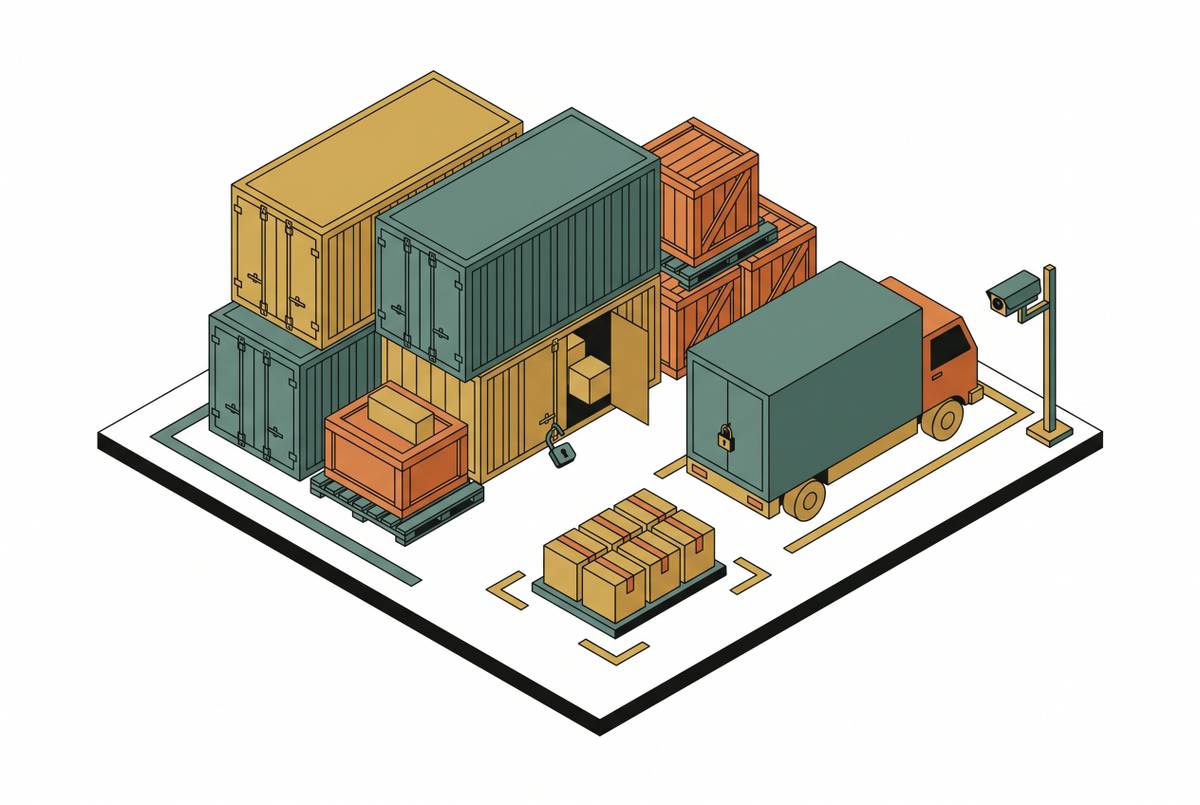
Freight yards hold a lot of valuable cargo in those gaps. Loaded trailers in staging areas, intermodal yards, and overflow lots are hard-to-see targets during the same hours that fewer staff are at work. The exposure also extends beyond an intruder crossing a fence. The Manhattan District Attorney’s Office announced charges against an eight-person organized ring that used forged placards to steal from logistics facilities in Pennsylvania, Virginia, and New Jersey between October 2025 and April 2026. That alleged method exploits a credentialing gap that an additional walk through the yard cannot, by itself, close.
What the perimeter and camera math actually looks like at scale
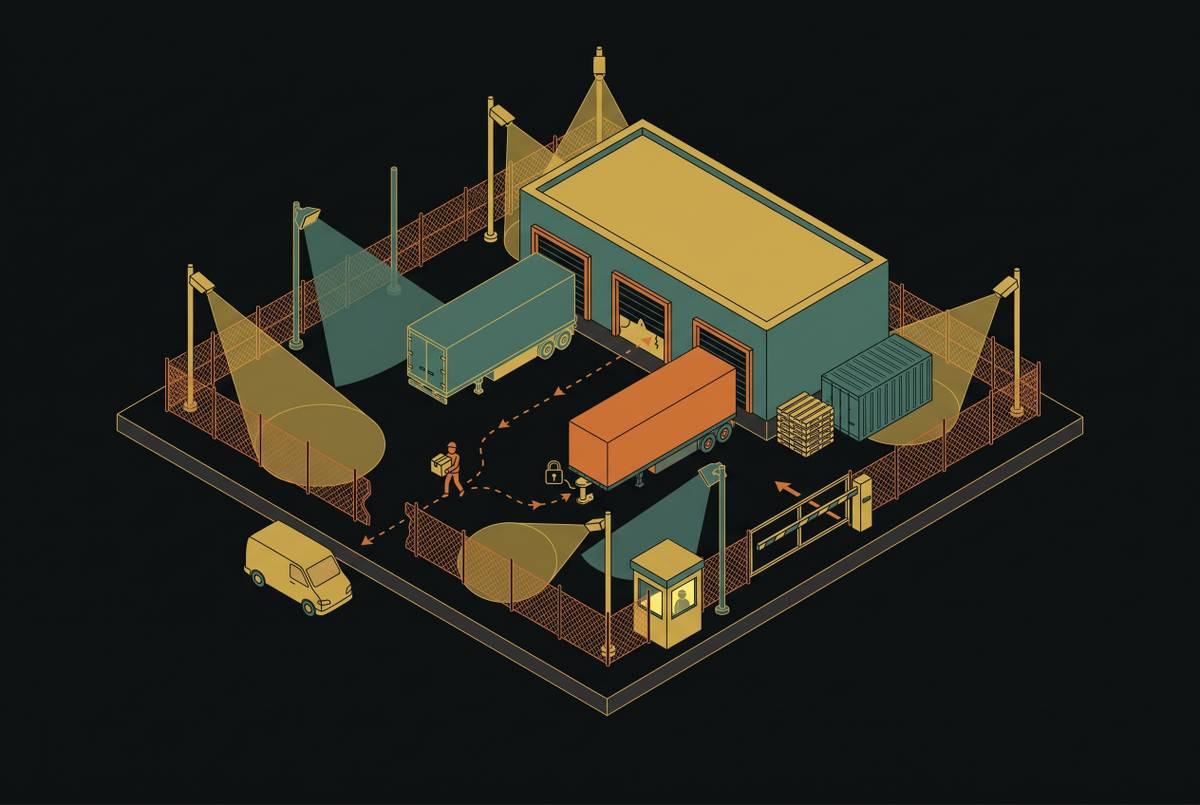
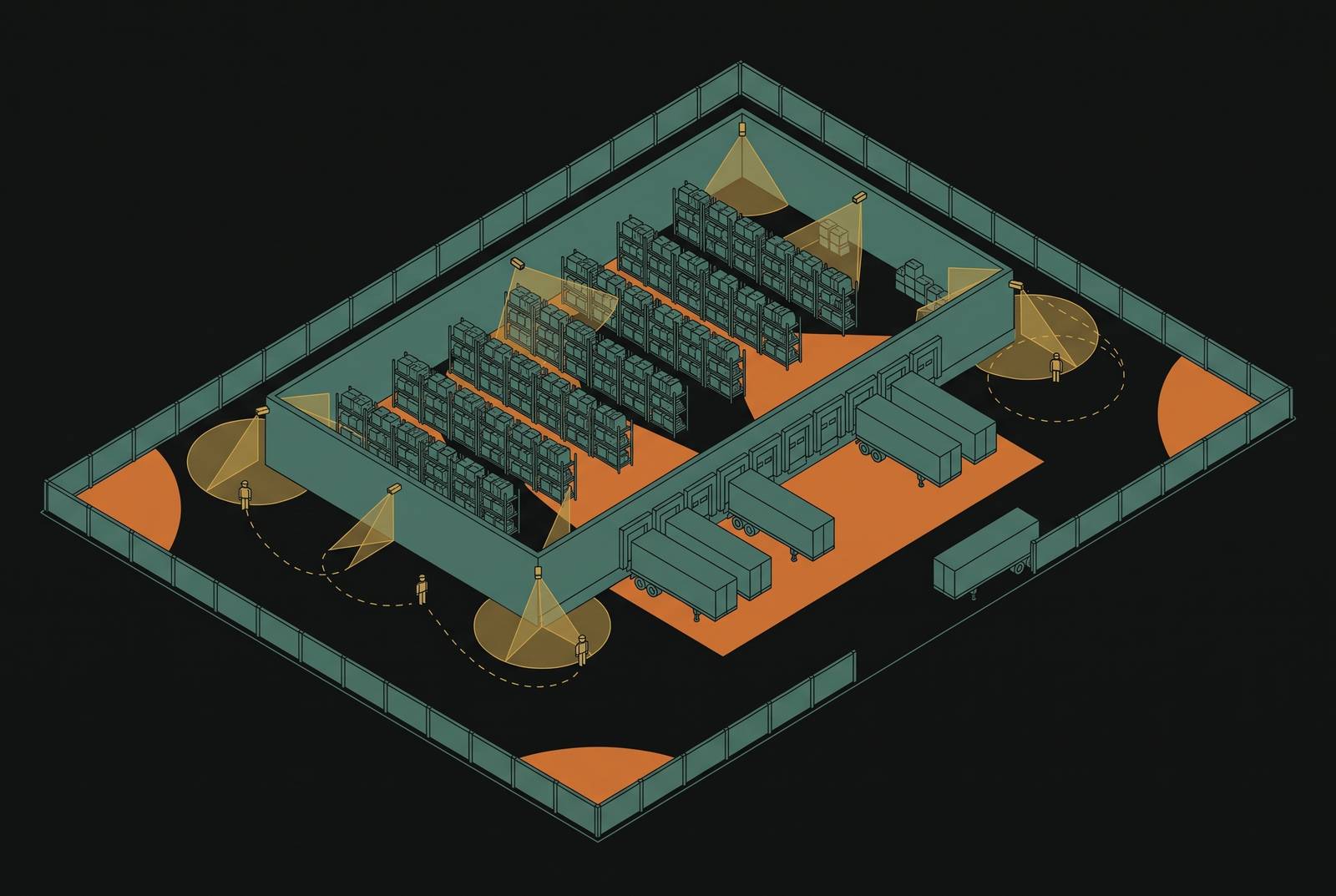
A freight campus is not one observation area. Exterior fencing, gate lanes, trailer staging grids, dock aprons, and overflow lots each have different sightlines and traffic patterns. A camera count combines these zones into a single inventory number, but that number does not describe whether a particular movement is visible. Coverage depends on where cameras can see and when those views are obstructed. A well-instrumented yard can still contain substantial gaps.
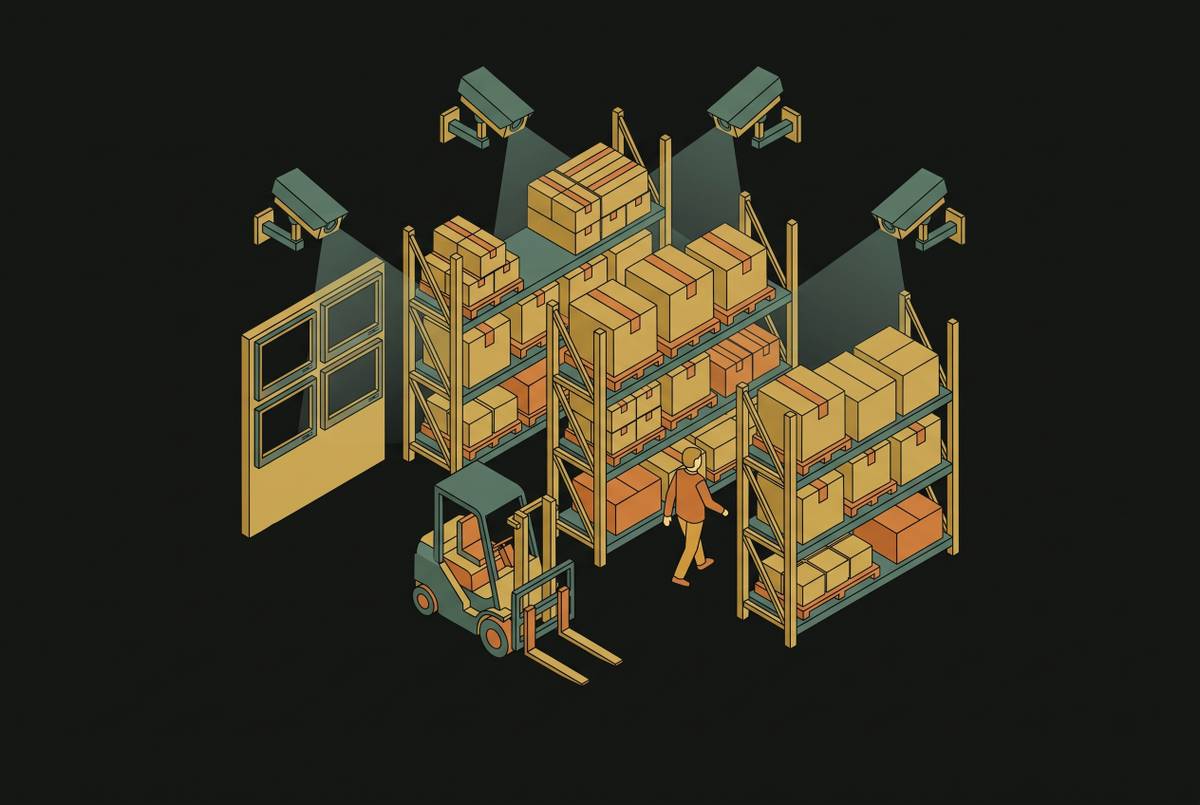
Loading docks make that distinction especially clear. Trucks, trailers, forklifts, containers, and stacked freight can block views as operations change. A camera positioned for daytime traffic may not show the angle needed to understand activity at 2 a.m. Physical patrol adds another way to watch the yard, but one officer cannot cover as much ground as a full shift team. Poor lighting, delays in passing messages, and a lack of backup on hand can slow that officer’s response further.
The useful coverage model therefore has both space and time. One zone may have no clear camera view, while another is visible but goes unobserved between patrol visits. A third may generate an alarm without anyone on the ground available to investigate immediately. These are distinct types of coverage gap. Counting cameras without accounting for patrol intervals and shift availability conceals how the gaps overlap during overnight operations.
How legacy monitoring centers fail when alarm volume meets a skeleton-crew yard
Environmental movement, vehicles, and activity at multiple access points all compete for operator attention. Human review has a finite processing rate. When alarms arrive faster than operators can inspect and clear them, the backlog grows even if every camera and connection is working.
A real threat that arrives behind environmental false positives must wait while the operator reviews those earlier events. During that interval, a loaded trailer may clear the yard gate. Adding cameras can show more of the yard while adding events to the same queue. Unless operators can keep up with the reviews, seeing more of the yard may not lead to earlier action.
Muting noisy cameras cuts the number of alarms by leaving those zones without coverage, which may include exposed perimeter and staging areas. Offshoring operators changes labor cost while leaving the relationship between alarm arrival and review capacity unchanged. Overage pricing changes who pays for volume. It does not accelerate verification of an individual threat.
Consequently, a facility with 100-plus cameras and a legacy monitoring contract may gain no meaningful improvement in time to verified threat during an overloaded overnight window. The cameras can detect activity while the service fails to reach it in time. With fewer people on the ground, there are fewer chances to spot a threat locally, while delays in the queue weaken the remote monitoring meant to fill in.
What does an SLA actually guarantee when the yard is active at 2 a.m.?
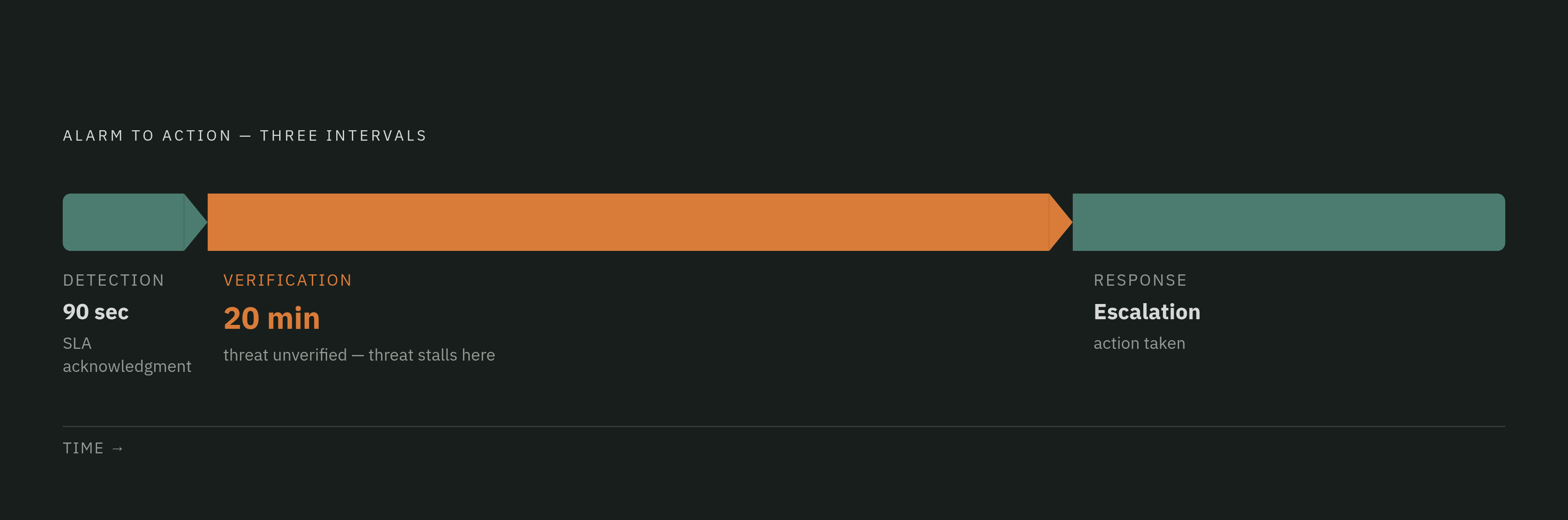
An SLA must distinguish an alarm being acknowledged from a threat being understood and acted upon. Time-to-detection ends when an alarm fires, but that event does not establish that a human has confirmed unauthorized activity. Verification occupies a separate interval. A freight buyer should establish what the contract guarantees during that verification interval when overnight alarms accumulate.
Mean time to respond can obscure this distinction because an average combines events with different consequences. Rapid handling of low-stakes false positives can coexist with a confirmed threat waiting behind a backlog. Bridge Facilities Services identifies three separate performance measures, which are time-to-detection, time-to-verification, and time-to-response. Keeping them separate exposes where delay occurs. In a yard with a lot of different night-shift activity, verification must also check whether an event that looks unusual is unauthorized.
That evidence influences what happens after escalation. TMA developed the AVS-01 Alarm Validation Scoring standard with security industry and public safety participants to convey the information available during an alarm event and support dispatch prioritization. The standard is not a promise of a particular police arrival time. An unverified trigger provides less evidence for prioritization than a substantiated threat, so clearing an event from the monitoring queue is not enough.
A buyer should therefore weigh a promise of quick acknowledgment against proof of how long verification takes when alarms pile up. A hypothetical 90-second acknowledgment and a 20-minute wait for verified escalation describe radically different levels of protection, even if the acknowledgment satisfies the contract.
Why AI agents change the math rather than just speed up the same process
AI-augmented monitoring changes the queue when an agent reviews alarms before they reach a human operator. The agent filters environmental noise and authorized activity, then escalates events identified as threats for human confirmation and action. This changes the operator’s assignment. Instead of starting with every raw alarm, the operator starts with a smaller set of events that have already undergone contextual review.
In a freight yard, that review can use license plate recognition to check plates against expected carrier schedules. An unscheduled vehicle at a gate can then be flagged without requiring an operator to inspect every passing vehicle. Restricted-zone detection applies a different test. A person entering a staging area during a window when no personnel are authorized presents a different event from routine activity during an operating shift.
Other checks depend on information beyond visible presence. After-hours vehicle classification, used with scheduling context, can distinguish a scheduled reefer pickup from an unscheduled arrival. Pickup credential mismatch detection compares a driver’s paperwork with the scheduled load. The usefulness of these authorization checks depends on whether the monitoring system has access to the records needed to make the comparison.
Operators confirm escalated threats, follow response protocols, and work with law enforcement instead of spending their time sorting through environmental noise. This division also reduces dependence on sustained wall-board attention, which is subject to vigilance decrement. Changing which events demand human attention provides the architectural benefit while retaining guards and leaving intervention time dependent on human response.
Why site-specific protocols determine whether AI verification is meaningful
A system cannot determine authorization from movement alone. Commodity type, carrier schedules, credentialing rules, and regulatory requirements shape what a legitimate event looks like at each facility. A scheduled reefer pickup, maintenance visit, or fuel delivery may look like unauthorized access on video. Generic presence rules can generate false escalations or fail to distinguish a theft from permitted activity.
Carrier schedules establish whether an arrival is expected, restricted-zone rules establish where people may be, and credential records establish whether access is authorized. AI can query those records and access logs in parallel rather than leaving an operator to cross-reference paper logs. But speed cannot repair an undefined protocol. The sequence for clearing or escalating an event must be configured for the site.
Regulatory scope requires the same precision. TWIC, the Transportation Worker Identification Credential, applies to unescorted access in secure areas of MTSA-regulated maritime facilities and vessels. It is not a universal requirement for every inland freight yard. Where it applies, credential verification must reflect that requirement. Treating every site alike can therefore misstate both authorized access and the evidence an operator needs.
California SB 652 illustrates another distinction between compliance and operational verification. Effective January 1, 2026, it amends the Private Security Services Act to require that Power to Arrest and Appropriate Use of Force training be delivered in its entirety by a single certified instructor and completed within six months of a Guard Card application. It does not address cargo-theft training, incident-response protocols, or access-control documentation for warehouses or trucking yards. Training compliance is not a substitute for site rules. Context-based monitoring requires a deployment to demonstrate how it checks carrier schedules, restricted zones, and credentials as well as recording activity.
What a monitoring architecture audit actually looks like for a freight facility
A freight buyer should test the proposed program under the overnight conditions that strain how it works. The buyer should first establish the actual time to verified escalation during peak alarm volume, including the worst-case queue position for a confirmed threat at 2 a.m. An average across all events is insufficient. The evaluation should establish whether a threat still waits behind routine alarms when the yard has the fewest people available to intervene.
To assess how the service handles authorized after-hours activity, the buyer should ask whether the carrier schedule, restricted-zone map, and credentialing protocol are encoded for the facility or left to generic operator instructions. Overload handling needs equal scrutiny. When alarm volume exceeds human capacity, the program may allow the queue to grow, reduce coverage, or filter events before they reach an operator. Those outcomes represent different levels of protection despite similar camera inventories.
Verification quality should also be demonstrable. An escalation that includes AI-pre-screened video context gives an operator a different starting point from raw footage requiring review from the beginning. The buyer should ask what evidence accompanies the event and what AVS-01 validation score a typical escalation receives. A fast notification has limited value if the operator still lacks the context needed to confirm the threat.
Traditional continuous live monitoring is priced per operator-hour, so a 50–200 camera facility must either spend a lot on overnight coverage or accept less of it. An AI-first design changes that relationship by routing only filtered threats to human operators. Geographic exposure also affects urgency. NovaGems identifies Southern California, including the LA/Long Beach port complex and Inland Empire, the San Francisco Bay Area, Phoenix metro, Lake Tahoe, Atlanta, Dallas-Fort Worth, Chicago rail intermodal, and Memphis as the highest-risk corridors.
The purchasing decision should turn on demonstrated coverage under those operating conditions. A credible program can show how a threat moves from detection through site-specific verification to human action when the overnight queue is busiest. That is the test a camera count cannot answer.