Threat Exposure Mapping for Overnight Trailer Lots When No Guards Are on the Ground
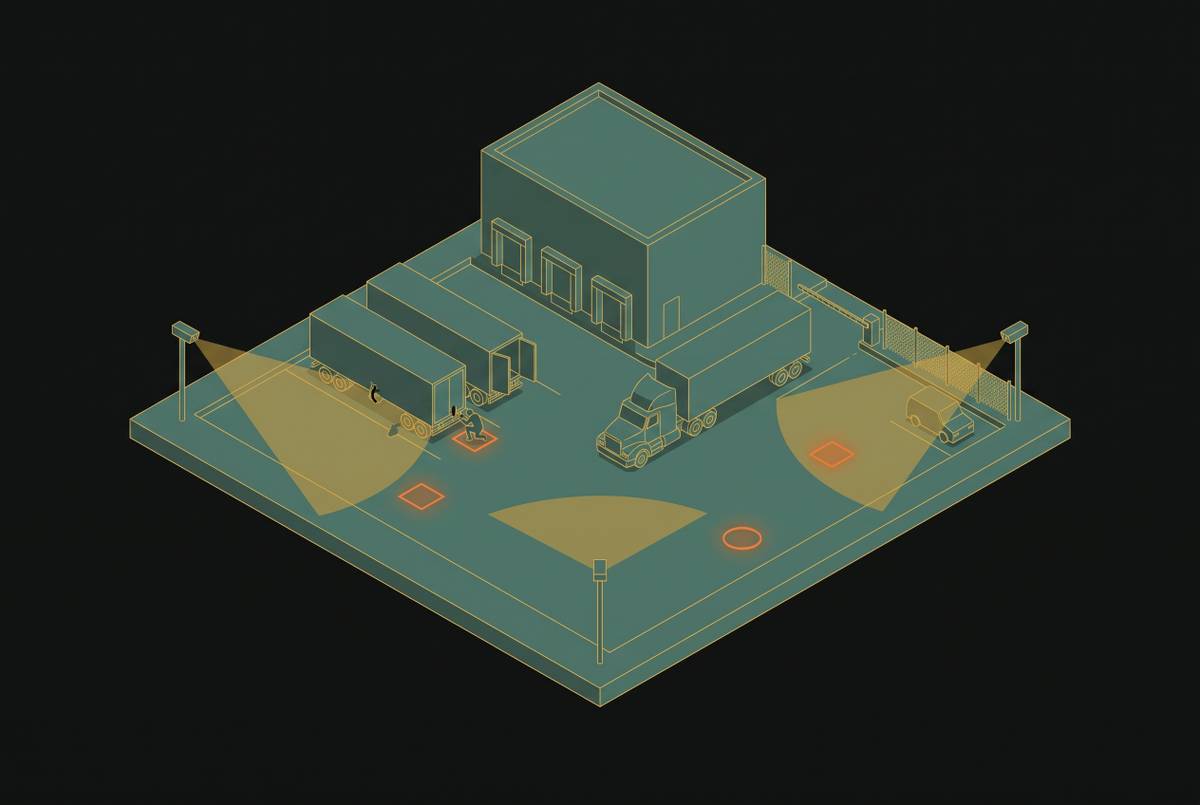
A four-zone exposure map shows where overnight yard theft starts.
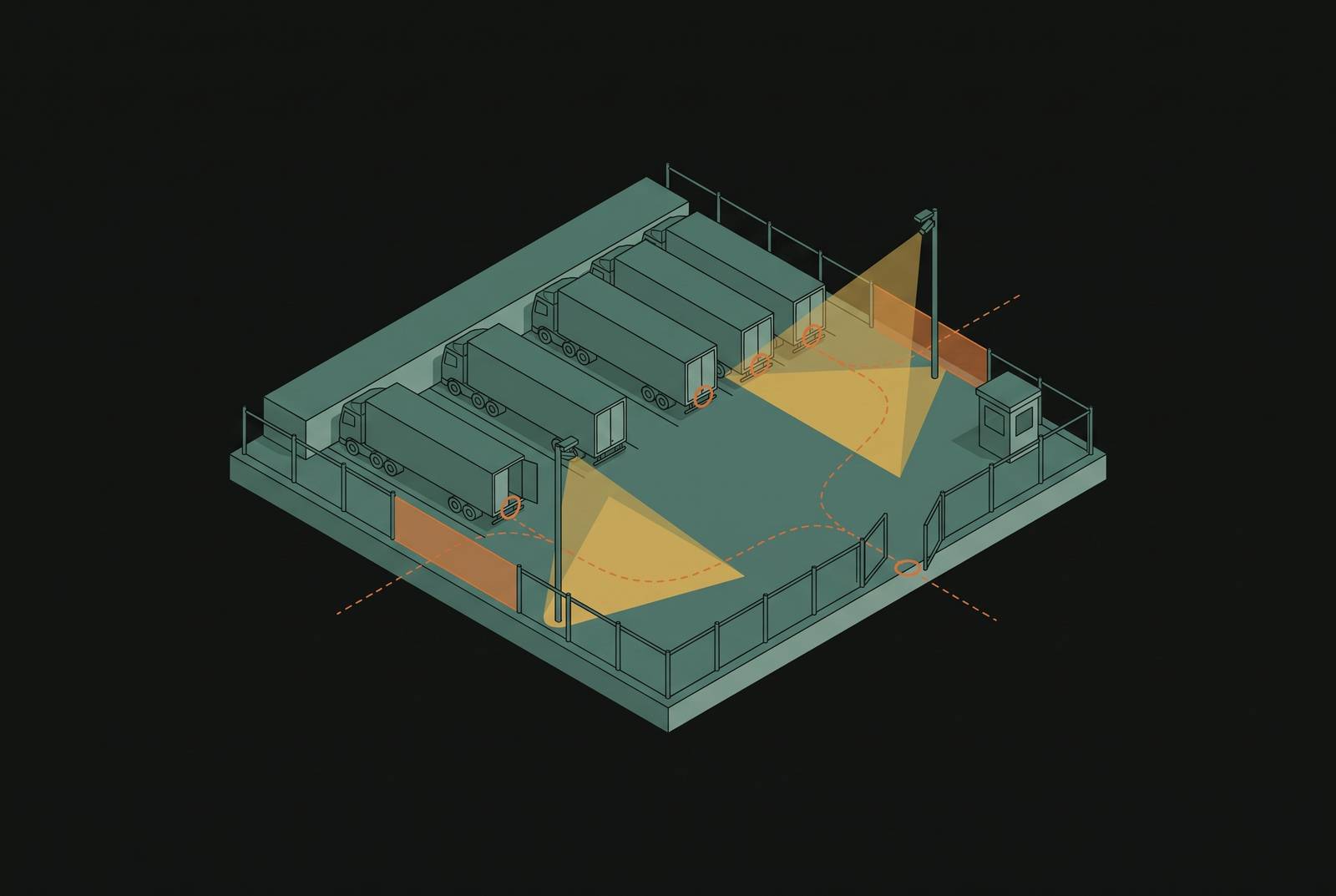
AI-augmented remote video monitoring for truck yards and freight facilities requires a threat exposure map that assigns camera positions, detection rules, alert timing, and escalation paths to four zones. In overnight trailer lots without on-site guards, perimeter intrusion, interior loitering, gate exploitation, and driver-adjacent activity require different responses. Effective monitoring resolves routine activity automatically and brings human judgment to exceptions early enough to intervene.
Why overnight trailer lots are structurally exposed to theft without on-site guards
Loaded trailers are designed to sit unattended, sometimes beyond anyone’s sight for hours. VDS's yard security analysis identifies this static exposure as the root of most yard loss categories. Driver rest creates a predictable window around those assets. Federal hours-of-service rules require drivers to rest for at least 10 consecutive hours before driving again, while sprawling, unlit ground and closely parked trailers limit visibility. Most trailers have no alarm, ignition interlock, or tracking device to provide an independent warning once someone reaches them.
The gate introduces a different weakness into that layout. It serves throughput rather than sustained scrutiny, so legitimate traffic creates cover for a plausible pickup story. Outlaw GPS's 2026 trailer theft analysis reports that confirmed thefts jumped year-over-year in 2025, the average loss rose sharply, and little of what was stolen was recovered. The same analysis identifies California as the leader in incident volume while showing risk spreading into New Jersey, Indiana, and Pennsylvania. These conditions make exposure mapping an operational task, grounded in the yard’s schedules, access patterns, and unattended assets rather than a generic assumption that theft begins at the fence.
The four distinct threat vectors that define the overnight lot's attack surface
Perimeter intrusion bypasses legitimate access infrastructure through a fence, gap, or unmonitored boundary. The signal to watch for is someone entering without permission in a lot where little moves. Internal yard movement presents a separate problem because the person is already inside, where legitimate drivers also move between units. Here, lingering near a loaded trailer or moving between rows without approaching a specific unit is more informative than presence alone.
Gate exploitation does not require a trespass at all. A fictitious pickup uses fraudulent paperwork, a spoofed company name, or a hijacked load number to make a theft resemble an authorized collection. The trailer can leave through the normal exit while the transaction appears routine. Outlaw GPS's analysis reports that deceptive pickups rose sharply year-over-year and were among the fastest-growing methods. This vector calls for checking whether a pickup is expected as well as watching for suspicious movement.
Driver-adjacent blind spots are the fourth exposure and overlap with the others. When a legitimate driver rests near loaded trailers, activity nearby can look like part of the driver's routine. Fuel islands and perimeter areas beside driver parking also provide low-supervision opportunities for siphoning and other low-effort theft. At the more sophisticated end, an embedded crew member acting as a driver can pass visible legitimacy checks. To spot that threat, staff need identity and dispatch details beyond what yard images can show.
Why cameras alone cannot detect cargo theft in real time at unmanned freight yards
A camera can cover an asset without providing a useful monitoring function. A gate camera that records plates for later review illustrates the difference. It preserves evidence but does not identify an unscheduled pickup before departure. Likewise, coverage across every trailer row is insufficient if its workflow treats a driver walking toward a cab and a person casing a load as equivalent events. Coverage establishes visibility.
Motion alerts leave the operator who receives them to work out what the images mean. Vehicles, forklifts, and trailer drop-offs generate routine daytime activity, while wind, shadows, and headlight sweeps create overnight triggers. If every trigger requires a person to reconstruct the schedule, location, and dwell duration, routine events consume attention needed for threats. Each zone needs a defined detection criterion and response window before a camera position can be judged adequate.
Perimeter zone monitoring: detecting intrusion at the boundary before a threat actor reaches the trailer rows
The perimeter has the simplest overnight activity baseline. Where no legitimate foot traffic is scheduled, a person moving along the fence or through a gap is anomalous. Monitoring should therefore use scheduled windows to identify anomalous human presence in motion events. That distinction makes boundary detection useful while the person is still intruding at the boundary, before reaching the trailer rows and becoming active at an asset.
Cameras must cover more than the office and scale house. VDS's analysis identifies the back of the lot and thinly watched perimeter areas as gaps in fixed CCTV coverage. The same analysis describes elevated solar mobile surveillance as an alternative where extending fixed power requires conduit and trenching. Its value in this zone is the ability to establish wide-area visibility where infrastructure otherwise constrains placement. Physical coverage still has to support the boundary rule.
Road headlights, moving vegetation, and weather events can make a motion-based perimeter feed noisy despite the absence of legitimate people. Camera quality and analytics calibration must separate those environmental changes from human activity. Correctly calibrated, this zone should produce fewer false positives than zones where drivers routinely occupy the scene. The alert should identify a person in a restricted overnight area.
Interior yard zone monitoring: distinguishing loitering near high-value trailers from purposeful movement
Interior presence is not sufficient evidence of suspicious activity. Drivers can legitimately walk through the rows toward their cabs during overnight parking. Someone moving slowly between units, pausing near sealed loads, and never heading toward a specific unit is following a different pattern, though the images may look similar at first. VDS's analysis identifies loitering detection as a specific requirement for overnight and driver-rest parking. The operative criterion is dwell behavior near loaded trailers outside expected activity windows.
That criterion depends on useful sightlines between parked units. Elevated coverage looking down multiple rows provides the movement context that a camera at trailer height may miss. Schedule context is equally necessary because routine daytime work and the same activity at 1 a.m. do not have the same meaning. Applying one rule throughout the day creates noise that can erode attention to overnight alerts. Interior monitoring therefore needs both geometry and timing to distinguish a journey toward a cab from lingering around a load.
Hitch-and-go theft can execute in under a minute once the actor has selected the target. Detection that waits for trailer movement misses the earlier casing period, when an audio challenge or escalation can interrupt the attempt. A dwell threshold must allow time to act during that earlier window instead of just recording how long someone stayed after the chance to act has passed.
Gate zone monitoring: closing the fictitious pickup gap with LPR cross-referenced against dispatch
The gate concentrates both legitimate movements and deceptive pickups. VDS's analysis calls it the highest-value single camera position because every tractor and trailer must pass through it. License plate recognition, or LPR, should log each entry and exit by plate and timestamp independently of the paperwork presented. Cross-referencing those reads against dispatch can expose an unlisted plate, an unscheduled arrival, or a hotlisted vehicle. Recording a plate without that comparison leaves the transaction’s legitimacy unresolved.
A plate match is not proof of driver identity. An insider driver scam or hijacked load number can pass plate-level checks, so matching the vehicle cannot constitute clearance by itself. The architecture must bring identity or booking discrepancies to human review. This is especially important under gate-volume pressure, when a plausible presentation is designed to pass quickly through routine checks. Automated cross-checking should flag exceptions so people can review them without having to check every legitimate movement by hand.
The deadline is before the trailer clears the gate. VDS's analysis distinguishes passive recording from live security operations center verification on that basis. A clip reviewed after freight is reported missing helps establish what happened, while an operator reviewing an unscheduled pickup before departure can change the outcome. Gate monitoring therefore depends on live verification.
Driver-adjacent blind spot monitoring: managing the rest-window overlap between legitimate presence and threat cover
Driver rest creates the yard’s hardest classification problem. A person waiting outside a cab may stand still long enough to look like a loiterer, while someone heading toward the next trailer may use normal driver activity as cover. Presence and dwell duration cannot resolve that overlap alone. Zone rules need to consider proximity to the driver’s registered unit against proximity to other loaded trailers. Fuel islands and nearby perimeter areas also need their own coverage, even when people nearby seem to be legitimate drivers.
Even that context cannot make every judgment automatic. An embedded crew member acting as a driver may behave like any other driver, so staff at the gate must cross-reference plate and identity details against dispatch. For less sophisticated activity near adjacent trailers, a live operator can use an audio challenge before police dispatch. That provides a way to interrupt suspicious movement without treating every driver outside a cab as an intruder. Human judgment is integral here because recognizing legitimate presence or threat cover requires context that a behavioral threshold cannot fully encode.
Assigning monitoring logic to each zone: how detection thresholds, alert timing, and escalation paths differ by zone
A practical monitoring plan must specify more than detection. Each zone needs a threshold, an alert deadline, an escalation path, and responsibility for reviewing exceptions. At the perimeter, the low legitimate-activity baseline supports alerts on overnight presence, followed by operator verification and audio challenge before dispatch. Interior alerts need a faster response once dwell behavior points to someone casing a loaded trailer. Their timing must preserve the chance to intervene before the hitch, ahead of evidence of departure.
Gate exceptions require human review before clearance because the consequence of a missed deceptive pickup is a loaded trailer leaving the site. Entry and exit logging also creates a searchable record for insurance and law enforcement, whether or not the live alert resulted in intervention. Driver-adjacent events need a different first response. Operators should review how close the person is to each trailer and which unit is registered to the driver, with an audio challenge before dispatch, while fuel-island and perimeter sub-zones are monitored on their own. A uniform escalation rule would discard these operational differences.
AI agents earn their place by reducing routine interpretation. They can watch camera feeds simultaneously, apply schedule and dwell rules, and route ambiguous or high-consequence events to human operators. The required output is a context-annotated event with a recommended escalation path. Confirmed threats should not wait behind false alarms from adjacent zones. This division of work leaves operators responsible for residual judgment rather than forcing them to reconstruct every routine event across the yard.
What a completed exposure map looks like in practice and how to maintain it as the yard changes
The completed map is a zone-annotated yard diagram tied to monitoring responsibilities. It records the detection criterion, alert timing requirement, escalation path, and exception reviewer for each area. Those assignments make the plan auditable against actual operations. They also expose whether a camera has a defined monitoring purpose or merely adds footage. The document should reflect the yard as it operates, including scheduled activity and the locations of high-value loads.
That configuration cannot remain fixed as conditions change. Cargo value and customer mix shift, so interior priorities and loitering sensitivity should track the rows holding the highest-value loads as the layout changes. Scheduled reviews should also examine coverage gaps from the perspective of a trespasser who has observed the yard for a week. When camera coverage and audio challenges follow a predictable pattern, a trespasser can learn their limits.
Gate logs also give staff information to use in those reviews. Unscheduled arrivals, plates that show up repeatedly around high-value drop events, and patterns in when fictitious pickup attempts happen can help staff decide which zones need the most attention. Feeding that information back into the map connects recorded activity to future detection decisions. Exposure mapping is a continuing process. Treating the map as a living document keeps monitoring logic responsive to a threat actor who has learned the previous configuration.