Insider Threat Indicators in Warehouse Video Surveillance
Behavioral anomalies on video reveal insider threats that perimeter security cannot detect.
Insider threats in warehouses are hard to catch because the person causing harm has already cleared the front door. They carry a badge, a schedule, and a job description, so the very systems built to keep bad actors out have nothing to say about them. The security question that matters most in a freight facility is not who got in, but what an authenticated person is doing with the access they already hold, and that distinction is the subject of this piece.
Why warehouse insiders evade perimeter-based detection
Perimeter security answers one question: is this person authenticated? A badge reader, a gate, a keypad, all of them check credentials against a list and stop there. They have nothing to say about what an authenticated person does once they're past the checkpoint, which is exactly the gap an insider operates in. Insider threats fall into three categories, and each one leaves a different trail. A malicious insider misuses access on purpose, for profit, grievance, or coercion. A negligent insider causes damage without intent, through a shortcut around policy or a door propped open out of convenience. A compromised insider is neither of those in any meaningful sense: an outside threat actor has taken over a real employee's credentials and is now operating through that identity, making a stolen login behave exactly like an authorized one. Avatier's 2026 insider threat guide treats this sorting as foundational, because the trail a malicious insider leaves looks nothing like the trail a compromised one leaves, and a detection system built for one will miss the other.
The compromised category deserves particular attention, because it shows how hard outsiders will work to get insider access instead of trying to beat a perimeter directly. Flashpoint's 2026 Global Threat Intelligence Report found 91,321 instances of insider recruiting, advertising, and threat actor discussion on illicit forums in 2025. That volume of forum chatter indicates that breaching a warehouse from the outside is harder and less reliable than buying or coercing access to someone already inside it. A stolen badge and a stolen password pass every perimeter check a real employee's would, because to an authentication system, they are the same thing.
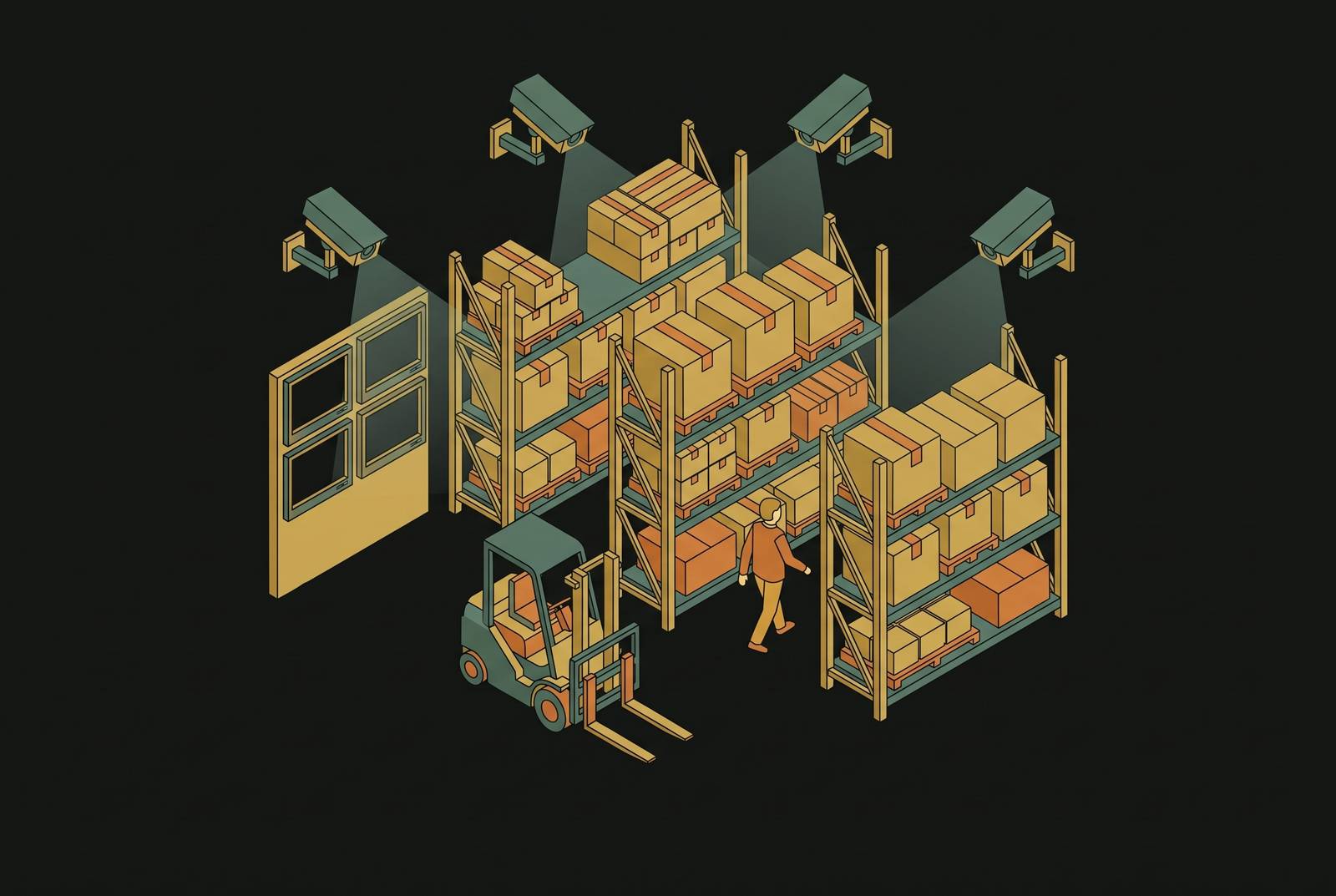
In a warehouse, the cover for insider activity is built into the job itself. A picker walking an aisle, a loader at a dock door, a supervisor stepping into a restricted zone: each of these is unremarkable until the context changes it, and that context is rarely visible to a system that only logs entry and exit. The practical consequence is that catching an insider requires watching what people do with access, not simply confirming that they have it. In a warehouse, what people do is overwhelmingly physical: they walk, they linger, they open doors, they handle pallets, they move vehicles. That behavior is observable on camera. The right monitoring setup, with the right eyes on the right footage, is positioned to catch what perimeter security cannot.
The physical signals insiders leave on camera before a loss compounds
Insider activity produces physical behavior before it produces a loss, and you can see that behavior take shape. The signals fall into a few recognizable categories, each with a direct expression a camera can capture.
Movement pattern deviations are the most basic of these. If an employee whose normal route covers picking aisles 4 through 7 repeatedly turns up in the receiving dock or a high-value storage zone, that is a spatial anomaly. The signal is the deviation from a known movement baseline, not the presence itself, since the same employee walking the same aisle a hundred times is unremarkable and the hundred-and-first trip to an unrelated zone is not. Dwell time works the same way: lingering near a staging area, a loading door, or inventory shelving with no task driving that presence is a flag that a system watching only for motion or intrusion will never register.
Off-hours access and unusual timing carry some of the highest-signal weight of any insider indicator. An employee badging in during a shift they aren't scheduled for, or staying well past a recorded clock-out, is choosing a window specifically because oversight is thinner then. On camera, this looks like a person present in a warehouse zone during a period when site protocol says no authorized activity should be happening there, and that fact only registers if the monitoring system knows the site's operating schedule.
Credential and access anomalies often have a physical correlate that access logs alone can't show. Tailgating, where someone follows an authorized employee through a controlled door without badging in themselves, is visible on video as two bodies entering on a single credential event: the access log records one entry, the camera shows two people. Credential sharing works in reverse, with one badge admitting multiple people across a short window, and it's only detectable when access timestamps are checked against footage of how many people actually walked through. Repeated attempts to enter areas outside an employee's role, especially clustered around shift changes or quiet periods, is a pattern that access logs miss on their own but that video paired with access data can surface. This is what "unexplained access creep" and unusual privilege requests look like in practice: not a judgment about someone's personality, but a pattern visible in logs and on camera alike.
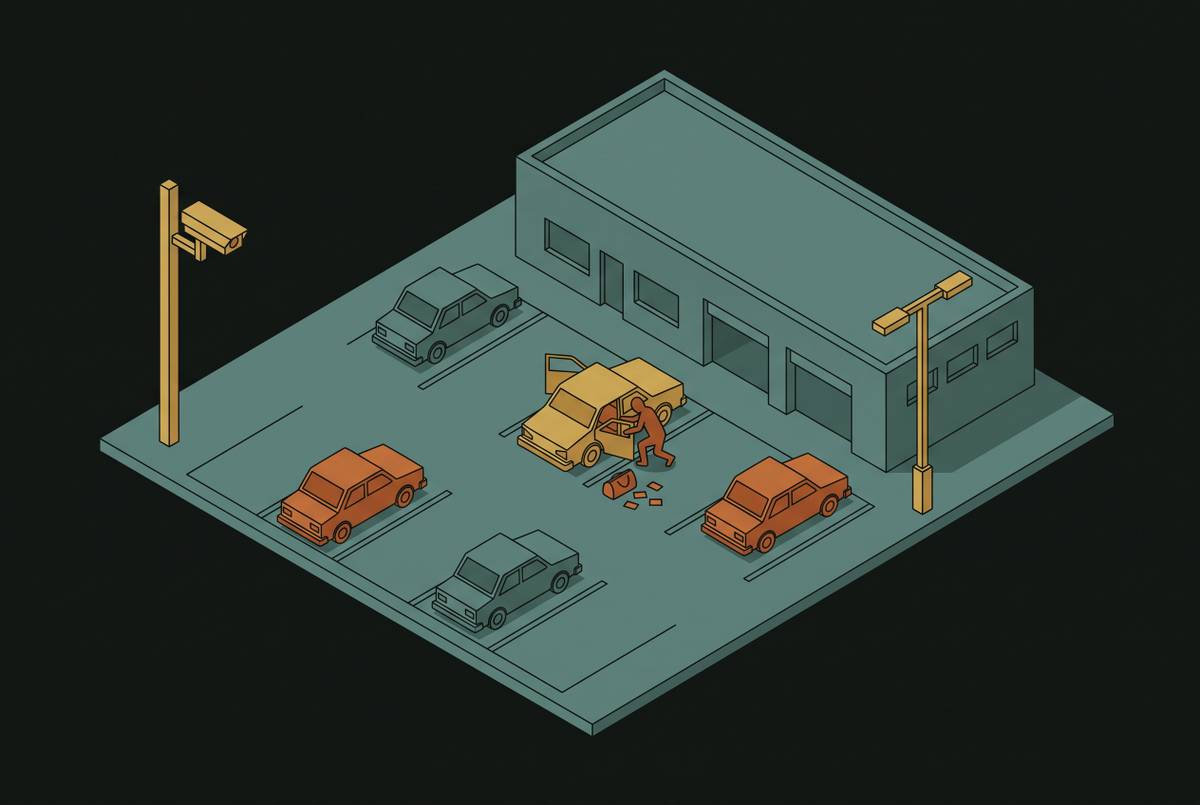
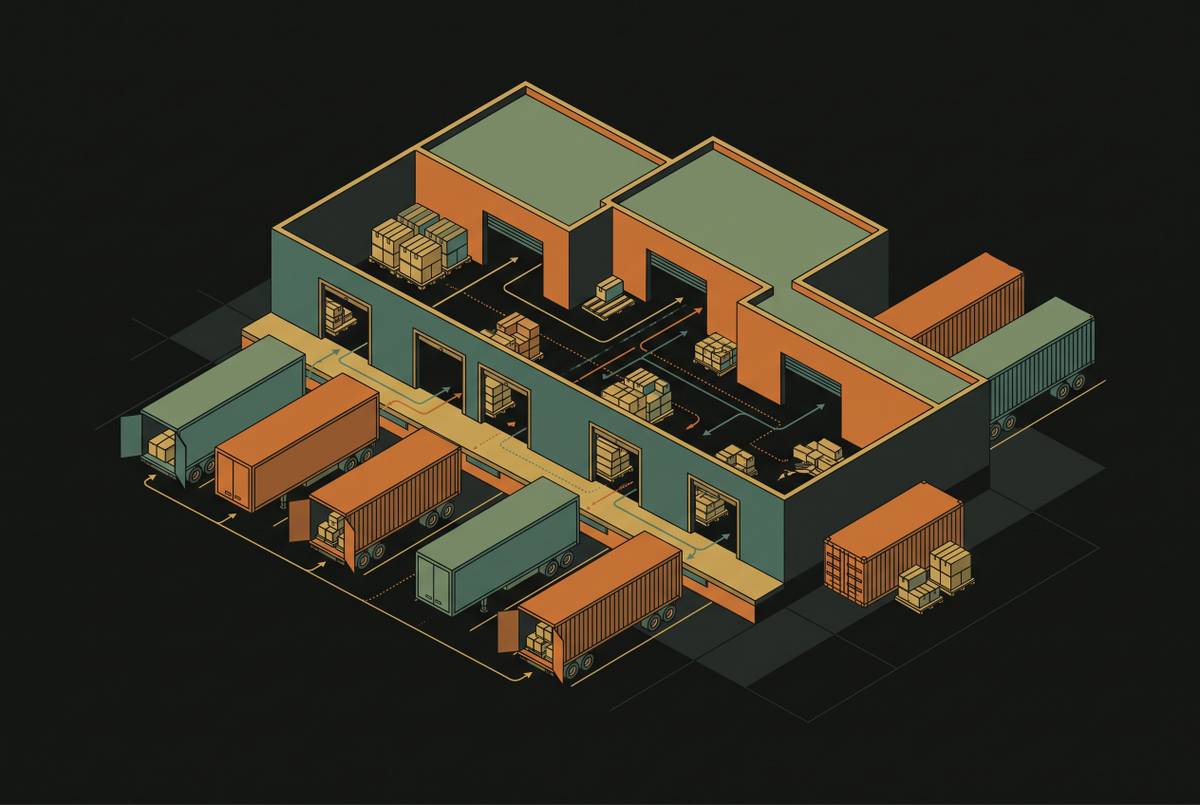
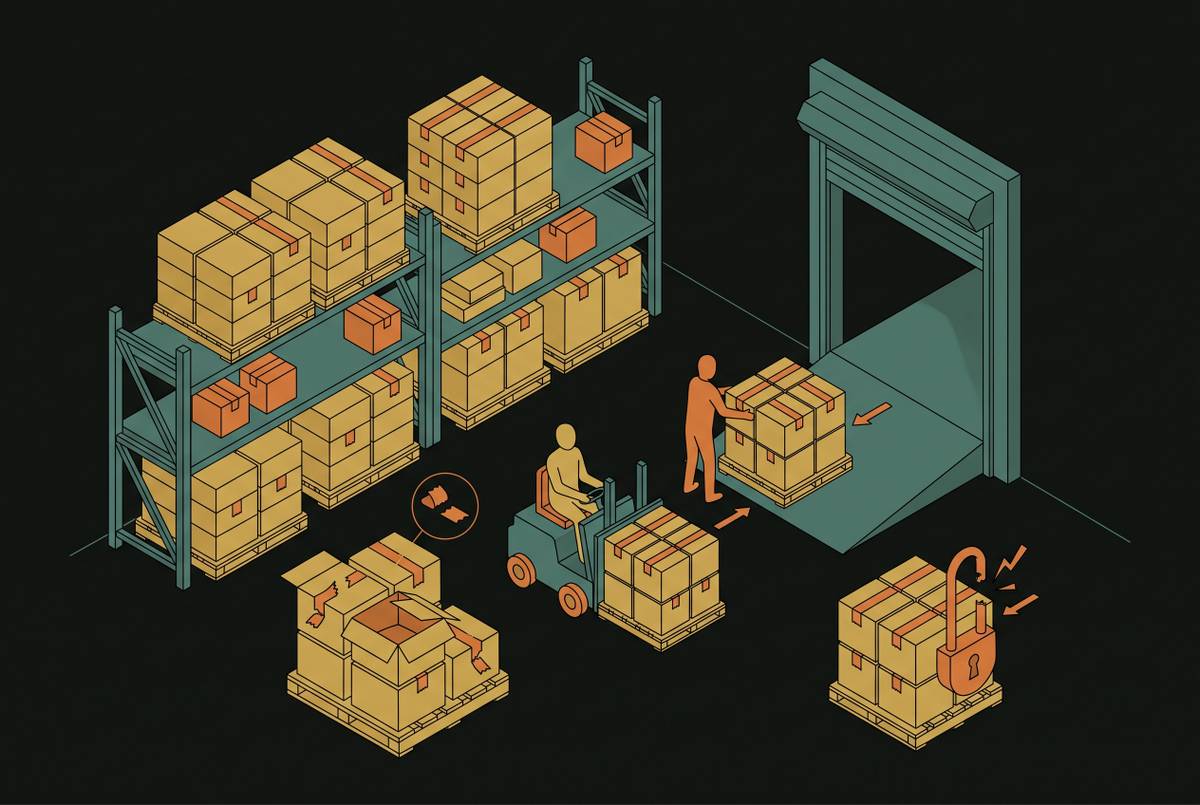
Concealment and diversion behaviors sit closer to the moment of loss itself. Items placed in a personal bag, tucked under clothing, or hidden inside other packaging during an otherwise ordinary pick operation require attention at the item level, not just a system that registers a person's presence. Cargo diversion during staging looks like a load redirected or pulled from a trailer in the gap between dock-in and manifest scan, a physical sequence that doesn't match the expected workflow and that a camera watching the dock would catch in real time.
Much of this behavior escalates before the actual theft event. Reconnaissance of a target area, time spent near exits with hands occupied, contact with a vehicle that has no business at a loading dock: these precede the loss. Behavioral precursors described in security training material, such as attempting to access information without a need-to-know, removing sensitive material without authorization, or a sudden shift in how someone behaves at work, all have physical versions in a warehouse: a door propped open, a path chosen to avoid a camera, a scan point bypassed on the way to somewhere else. Catching an insider means watching what people do with the access they already have, not simply confirming that access exists. Services such as Verdun pair AI agents that filter routine activity with trained human operators who verify deviations, and they are built to surface this kind of behavioral anomaly before it gets buried in the ordinary noise of a working warehouse, so a departure from a known baseline reaches a person before the loss compounds.
Every one of these signals, though, only means something against a backdrop of what's normal for that specific site. A loader near a dock at midnight could be a thief or could be three hours into a routine overnight shift, and the footage alone doesn't say which.
Site-specific context as the precondition for distinguishing normal from anomalous
A camera can record every frame of an insider event and still miss the point of it if the system reviewing that footage has no idea what authorized activity at that site is supposed to look like. The signal only becomes visible once it's measured against a baseline, and the baseline has to be built from the specific site, not a generic model of what a warehouse does.
Consider the employee standing in a high-value storage zone at 11 p.m. That single frame is either a serious problem or a routine part of the night shift, and the camera has no way to tell the difference on its own. Neither does a monitoring operator reviewing the clip without knowledge of that site's schedule. The contextual layer behind the footage converts it into something meaningful: who is supposed to be where, during which hours, doing what.
Site context, in practice, breaks down into a handful of concrete layers. Shift schedules establish which employees are authorized in which zones during which hours, so a presence that contradicts the schedule becomes a flag and a presence that matches it does not. Role-to-zone mapping establishes that a picker has no legitimate reason to be at the dock manager's station, and a loader has no legitimate reason inside a pharmaceutical cold-storage unit, facts that come straight from the site's own protocol. Authorized vehicle assignments establish which trucks belong at which docks during which windows, so a vehicle parked at the wrong dock, or present outside its authorized window, becomes detectable only because that assignment list exists somewhere a monitoring system can check it. Integration with warehouse management system data lets a monitoring operation cross-reference physical activity against transaction logs: a scan recorded at a pick station with no matching body on camera should be flagged, and so should a body at a pick station with no matching scan.
Without that context, every motion event is ambiguous, and a monitoring system is stuck choosing between two bad options: flag everything, which buries real threats in alert volume, or flag almost nothing, which leaves coverage gaps exactly where insider activity happens. A system running on generic person-detection logic will miss the insider who is doing nothing unusual except being in the wrong place at the wrong time, which happens to be the most common insider pattern there is. The fix scales with how much detail the protocol carries: a site protocol specifying that a given dock door should be closed by 10 p.m. turns any open door after that hour into a verified anomaly rather than an open question an operator has to guess at. Off-hours access combined with unusual dwell time ranks among the clearest insider indicators available, but it only functions as a signal if the monitoring system knows the site's schedule and can act on a deviation as it happens. Continuous monitoring that ties access logs to camera footage, and that has site-specific protocol built into the review process, is what makes that signal usable; a monitoring center running AI agents that dismiss routine, authorized activity and escalate only genuine deviations can surface a pattern like this well before the next shift starts.
How traditional monitoring centers structurally fail at insider detection
Even with the right context loaded in, a monitoring center still has to get a human being to look at the right clip at the right time, and that's where conventional setups tend to break down. Traditional monitoring centers aren't simply short-staffed for insider threat work. Their structure is mismatched to the problem, because the indicators that matter most, dwell time, off-hours presence, repeated access attempts, are individually low-urgency and easy to lose in a high-volume alarm queue.
A human operator covering dozens of camera feeds during a busy shift cannot realistically hold a mental baseline for every employee's normal movement across every camera. The cognitive load involved makes pattern recognition across time close to impossible for one person to sustain, no matter how experienced they are. When alarm volume exceeds what an operator can reasonably evaluate, real signals stop getting judged on their merits. They get skipped, deprioritized, or lost somewhere in a queue that never stops growing.
Attention itself degrades fast under this kind of load. Sustained vigilance across many live feeds produces a measurable drop in detection accuracy over time. The busiest periods and the latest shifts, the windows when insider activity tends to occur, are also the ones most likely to go under-watched. That timing is not a coincidence. Insider threats are often, consciously or not, timed to land during precisely these low-vigilance windows: off-hours, shift transitions, stretches when general activity is high enough that one more person moving through a dock blends into the background.
That blending effect is a documented tactic, not just a side effect of a busy warehouse. The 2025 Unit 42 Global Incident Response Report noted that sophisticated threat actors treat alert volume itself as a concealment strategy, generating enough noise that real signals get lost in it. Insider behavior in a crowded warehouse produces the same effect passively, without anyone engineering it: the noise of ordinary operations does the concealing on its own.
Context failures compound the problem at the point of review. An operator at a remote monitoring center looking at a clip of someone near a dock door at midnight has no way of knowing, from the clip alone, whether that person is on an authorized late shift, whether that door is supposed to be closed by then, or whether the vehicle behind them matches the manifest. Without site context built into the review process, the operator can see motion but not what it means. This is a large part of why insider theft in warehouses often only becomes visible when inventory reconciliation turns up a discrepancy days or weeks later: the footage existed, a system was pointed at it, and nothing in the setup made the anomaly legible at the moment it happened.
The common fixes for alarm overload make insider detection harder, not easier. Muting cameras with high nuisance-alarm rates strips coverage from exactly the places, loading docks, staging areas, high-value storage, where insider activity concentrates. Shifting the work to lower-cost operators elsewhere reduces expense without reducing how deep the alarm queue runs or how much site-specific protocol each operator actually knows. Neither approach touches the structural issue: insider detection depends on a system that can tell routine activity from a genuine deviation and can keep that judgment accurate at 2 a.m. on a Tuesday as reliably as at 2 p.m. on a Monday, something a queue-driven, context-blind monitoring setup isn't built to do.