Multifamily Property Security Threats After Hours
Real-time monitoring gaps leave parking and common areas vulnerable to preventable crime.
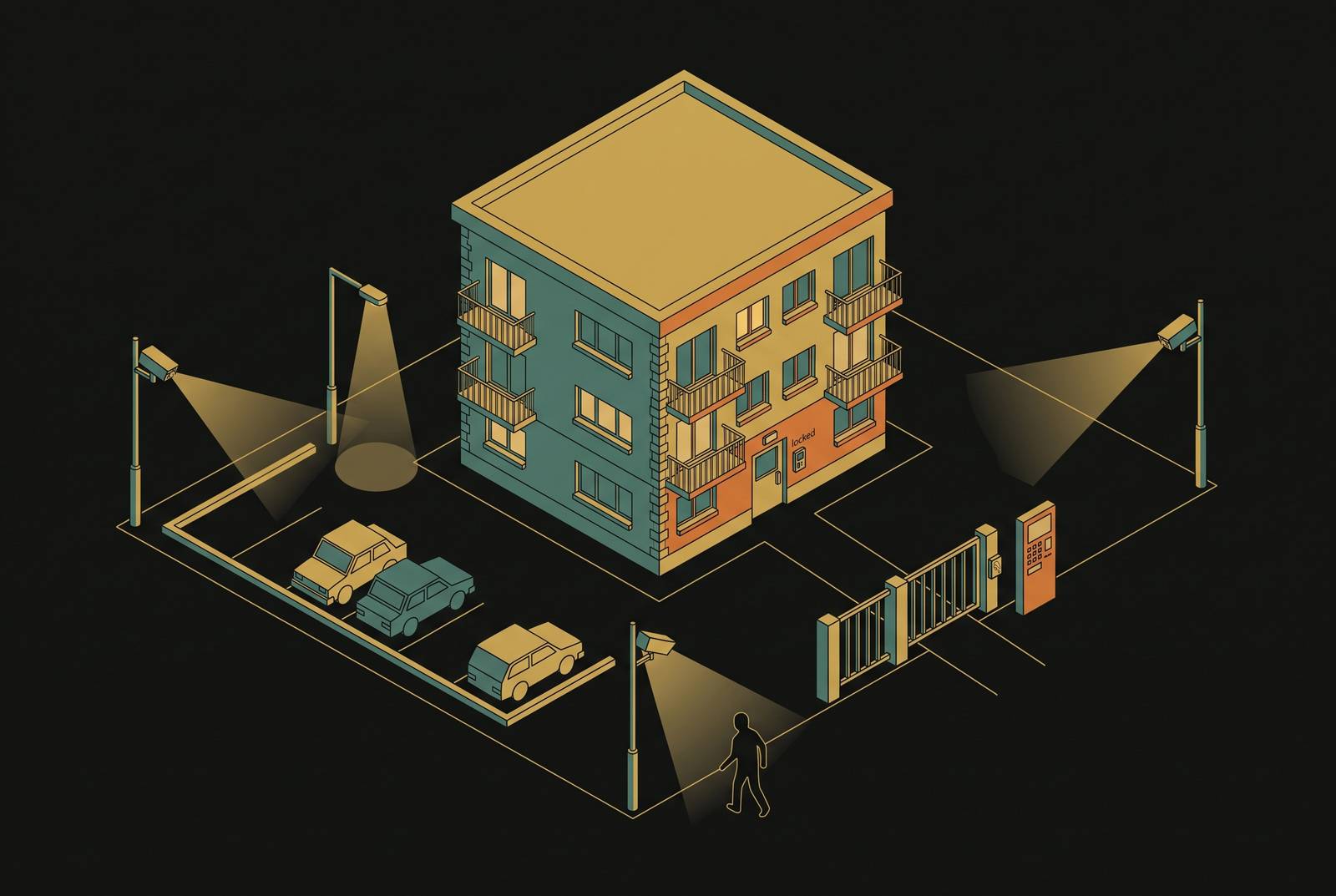
Multifamily properties face an after-hours threat that you can predict, but standard security setups handle it badly. Crime concentrates in exterior common areas, parking structures, pool decks, perimeter walkways, package rooms, at hours when almost nobody is watching the camera feed in real time, and the monitoring infrastructure behind most of those cameras is too slow and too overloaded to catch it while it's happening. Understanding where the threat actually sits and why response lags behind it is the groundwork for any security plan that does more than document what already went wrong.
Why multifamily properties are structurally different from other property types when it comes to after-hours risk
A single 200-unit apartment complex can have a dozen entry points, three stairwells, one or two parking structures, an amenity building, and a leasing office, all strung together by outdoor pathways that anyone can walk at 3 a.m., resident or not. That layout is the starting condition for everything else in this piece. No other property type asks so many strangers, residents, guests, delivery drivers, maintenance contractors, to move freely through spaces that are legally private but functionally open to the public at any hour.
Parking structures and pool areas work as semi-public zones, and a leasing office simply can't staff them around the clock. Maintenance crews working in mechanical rooms and unlit garages after dark carry the same exposure as residents, but often get less attention paid to their safety. High turnover means constant move-ins and move-outs require credential updates on a near-weekly basis at a large property, which makes an old-fashioned lock-and-key system impractical at any real scale. When you add the daily churn of residents, guests, and delivery drivers, a guard-only verification model starts to strain well before the sun goes down.
This threat profile sets multifamily apart from commercial real estate in a way that matters. Hospital systems and school districts have spent the last decade hardening their perimeters with access control, credentialing, and active monitoring. The average apartment complex, by contrast, still runs on magnetic-stripe keycards and analog CCTV that nobody watches in real time. That gap in hardening, not the number of units or the square footage, is why apartment communities carry a different risk profile than an office park or a retail center ever will.
Where after-hours incidents actually concentrate on multifamily properties
Crime at multifamily properties concentrates in exterior common areas: parking structures, pool decks, trash enclosures, mail kiosks, and perimeter fencing. It rarely originates inside a residential unit. A property that points its cameras only at lobbies and building entrances is watching the wrong zones after dark, because the incidents that eventually reach a unit almost always start somewhere else first, as a failure of access control or lighting at the perimeter or in a common area. That earlier point is where the real detection opportunity sits, well upstream of the unit door.
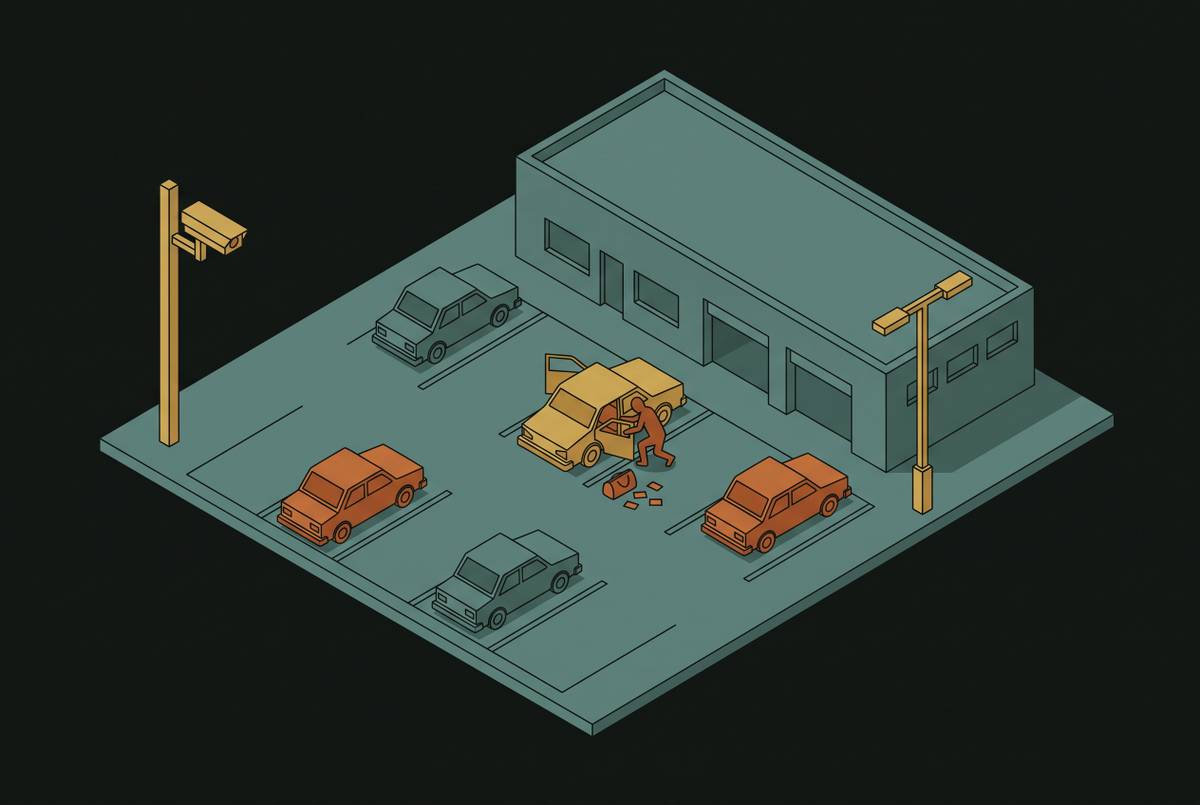
Vehicle crime, break-ins and catalytic converter theft, clusters in surface lots and parking garages, frequently in the darkest corners or in gaps the cameras don't cover, where someone can work fast and a resident won't notice until morning. Online shopping has pushed more deliveries into mailrooms and vestibules since 2020, so boxes sit unattended for hours, and package theft has become its own category of loss. Loitering and unauthorized entry into amenity spaces, pools, fitness centers, stairwells, occurs repeatedly and goes underreported in incident logs, because an individual lingering near a garage entrance or a stairwell doesn't always register as an emergency even when the pattern repeats night after night and steadily erodes how safe residents feel on their own property.
Lobbies, parking structures, package rooms, side gates, stairwells, elevators, and vacant units are the zones where legitimate activity and unauthorized activity are most likely to overlap, and they deserve attention in direct proportion to that overlap. None of this is random. The pattern is concentrated and recurring enough to be mapped in advance. A monitoring system aimed at the right zones at the right hours has a real chance of catching an incident before it escalates.
Why residents, operators, and insurers all have more at stake than they did five years ago
The cost of a security failure in these zones now runs straight into the income statement. It raises resident turnover, insurance premiums, and the liability exposure that follows a negligent security claim. Security has stopped being a purely operational line item, and it has become a revenue and asset protection question with a direct line to NOI.
Residents notice when a property treats security as a real function instead of installing cameras mainly for appearances, and that perception follows the property into tours, online reviews, and renewal decisions. Vacancy and turnover already hit NOI harder than almost any other line on the operating statement, and security is one of the few categories an operator can tighten without cutting the service residents actually experience day to day.
The insurance market has moved against operators who treat security passively. The National Multifamily Housing Council's 2024 State of Multifamily Risk Survey found that liability coverage faces rising litigation costs, nuclear verdicts, and increasingly restrictive underwriting, including a shrinking pool of guaranteed-cost and zero-deductible programs. A property with a documented history of incidents pays more at every renewal, and that curve does not bend back down on its own. Legal exposure compounds the same way: when an injury or an assault occurs at a property where security was demonstrably reactive rather than proactive, the resulting litigation drives the next insurance cycle even higher. Vandalism, theft, and property damage add a more mundane but steady cost on top of all that, in repair bills, disrupted amenities, and extra hours for on-site staff, and a recurring pattern of incidents shapes how both current and prospective residents see the property long after any single event is resolved.
How the conventional camera-and-alarm setup fails specifically during overnight hours
The standard multifamily setup, fixed cameras, motion-triggered alarms, an on-call operator somewhere off-site, was built for deterrence and for reconstructing what happened after the fact, not for catching anything while it's still in progress. Its weaknesses are most visible overnight, exactly when threat volume and operator attention line up worst.
The failure modes are well documented. A camera records an incident, but nobody is watching the feed live. An alert fires, but the on-call operator already has 80 other camera queues to get through. A trespass happens at 2:15 a.m. and sits undiscovered until a maintenance worker stumbles on the evidence at 7 a.m. It's an attention problem: research across surveillance and air traffic control work consistently finds that a human watching live video feeds holds meaningful attention for roughly 20 minutes before fatigue sets in and detection rates drop off sharply. A property running dozens of cameras generates more footage per hour than any single operator can actually process, which leaves a system with the legal paper trail of surveillance but none of the real-time protection it's supposed to deliver.
Motion-triggered alarms make the problem worse. They fire on flags snapping in the wind, tree branches, a passing headlight, and they bury real signals under constant noise. Recording-only setups are especially exposed here: a burglary is typically over in eight to ten minutes, so footage reviewed the next morning after a resident complaint does nothing to stop the loss that already happened. The deterrent value of a visible camera has eroded too, because criminals have figured out that nobody is actually watching that feed at 2:47 a.m. Recording is the floor of what a camera should deliver, not the ceiling. Add in the smaller operational gaps, landscaping blocking a camera's view, exterior lighting left broken for weeks, confusion over who's actually responsible for reviewing footage, and the picture overnight is a system quietly failing in ways nobody notices until something happens.
The clearest sign that this model has hit a structural wall is what police departments have started doing about it. Seattle now requires supporting evidence, audio, video, a panic alarm, an eyewitness, before officers will respond to an alarm call. Houston revokes permits and stops responding after the seventh false alarm from the same address. Baltimore dropped its allowable false-alarm threshold, and now it keeps an active registry of addresses that trigger too often. Once a property lands on one of those lists, the alarm system stops summoning police altogether, and the operator is left paying for monitoring infrastructure that has lost the one function it existed to perform.
What a monitoring infrastructure that can actually catch after-hours threats looks like
Catching threats after hours requires two things the legacy model doesn't have: a filtering layer that reasons about behavior instead of just reacting to motion, and a human review step that takes seconds to reach, not minutes. That's the architectural shift at the center of every system built to solve this problem.
The underlying move is from raw signal to actual inference. Instead of flagging every object that moves, AI analytics classify people and vehicles, track loitering, and flag movement patterns that don't fit the hour or the location, turning a passive recording system into something closer to active monitoring. A resident pacing briefly while carrying out the trash looks nothing like someone pacing the same parking structure for twenty minutes without any clear purpose, and a behavioral model can tell the two apart in a way a simple motion sensor never could.
That distinction only works with calibration specific to the site. A camera in a parking structure might alert after a person stays stationary or paces a defined area for a set period overnight, but use a longer threshold in the early evening, when residents are actually coming home from work. Skip that calibration and the AI just reproduces the same noise problem as the old motion-trigger alarms, flooding operators with activity that technically matches a rule but means nothing on the ground.
The alert should route to a trained human for review in every case. The filtering layer's job is to make sure only verified threats reach that person, not to replace their judgment. For a mid-market multifamily community, the detection work generally breaks into five categories: loitering in parking structures and exterior common areas, perimeter intrusion at fence lines and pool gates and other restricted zones, behavioral escalation analysis for verbal or physical confrontations, package and property monitoring at mail rooms and lockers, and weapon detection sitting at the top of the alert hierarchy given the stakes involved.
Because exterior crime is concentrated and predictable, parking structures, package rooms, stairwells, detection is possible when a monitoring system is actually watching those zones in real time. Pairing AI agents that filter routine activity with trained human operators who can escalate fast lets a property flag unauthorized access or theft while it's happening. Verdun is one provider built around that pairing, using AI agents to separate ordinary activity from genuine threats before a human operator ever gets involved.
Verified dispatch changes how police respond, too. When an operator calls in a verified, documented alarm, law enforcement tends to treat it as a priority call, which cuts down on false alarms, speeds up response when it actually matters, and keeps the address off the blacklists described earlier. The timestamped event log that these systems generate, recording when a threat pattern was detected, when it reached a human reviewer, and what response followed, goes straight to the question at the heart of every negligent security case: did the property owner take reasonable steps to catch a foreseeable threat before it caused harm.
Why speed from detection to verified response is the metric that determines whether any of this works
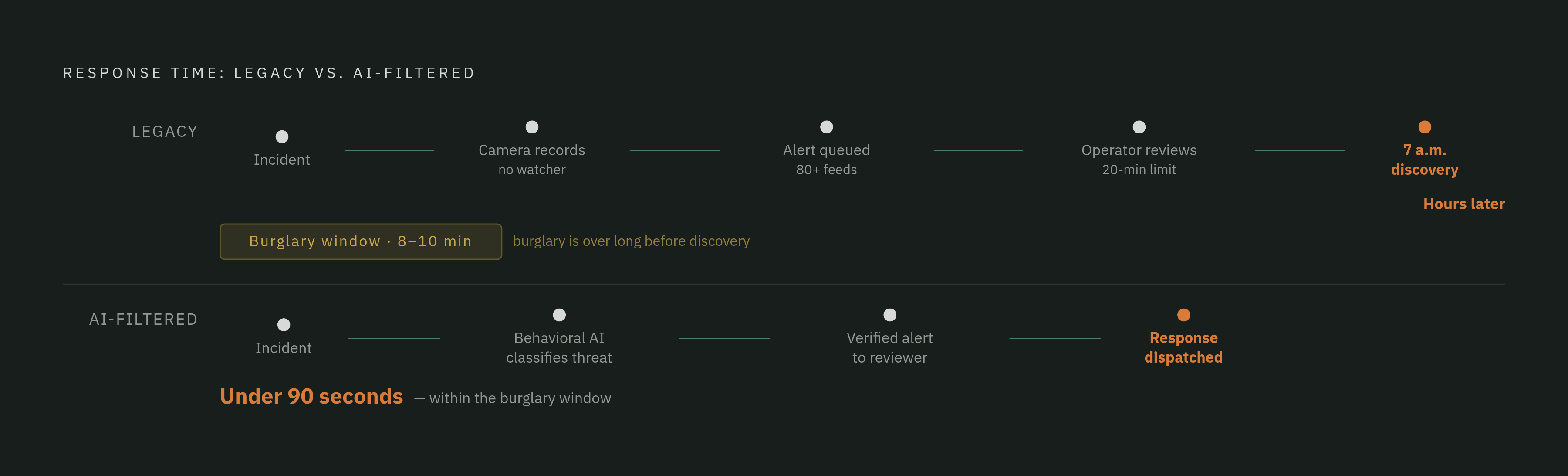
Every piece of this system comes down to one number: the time between a threat appearing on camera and a verified response reaching a human being. Measured against the eight-to-ten-minute span of an average burglary, that window is where after-hours security succeeds or fails.
If nothing happens inside that window, no detection, no escalation, no live response, the camera has produced evidence for an insurance claim. If a service-level agreement only promises a fast signal receipt but still dumps an unverified trigger into a police queue, it doesn't hold up operationally. The clock that matters starts the moment the threat becomes visible on camera, not the moment an alarm reaches a dispatcher.
Most operators still measure their security spending by inputs: camera count, guard hours, whether the alarm panel shows active. The operators getting ahead of the problem have switched to measuring outcomes: what was actually caught and stopped. That shift carries a practical implication for anyone buying a monitoring contract: ask for a response-time guarantee measured from the camera frame to a verified human action, not from alarm receipt to signal dispatch, and ask directly what the provider's false-alarm rate runs. A high false-alarm rate predicts police non-response faster than any other single variable you can check.
Insurers now treat response speed as a material factor in coverage and claims. A property that can verify and document a threat within minutes holds a stronger position with carriers and incident investigators than one that only has footage to review after the fact. Modern monitoring centers built on AI-filtered alarm escalation, Verdun among them, have pushed the gap between detection and human response down from 20-plus minutes to under 90 seconds, and insurers increasingly treat that difference as relevant to both liability and loss prevention. Properties that build their security strategy around that single metric, verified, fast, calibrated to the specific site, are the ones turning camera infrastructure into something that actually protects residents, rather than a system that only tells them, after the fact, what they already lost.