Copper and Metal Theft Exposure at Manufacturing and Utility Sites
Rising copper prices are making theft a rational business decision that outpaces security upgrades.
Copper theft has stopped being a crime of opportunity and become a rational business decision. The metal now trades at prices that make an hour of cutting and hauling worth more than many weekly wages. Manufacturing and utility sites are where that math gets paid out, because they concentrate the most accessible copper behind perimeters that are comparatively easy to approach. This article traces how commodity pricing created that exposure, what a completed theft actually costs, and why closing the response-time window is the only intervention that changes the outcome.
Why copper prices have made manufacturing and utility sites the primary theft target
Structural demand keeps the incentive to steal copper rising faster than any security budget. Data center construction, electrification, and AI infrastructure all pull the same commodity through their supply chains, and that sustained demand keeps upward pressure on prices. The criminal calculus scales with the market, not with any particular site's defenses. A thief doesn't know what fencing a utility yard installed last quarter, and doesn't need to care. He knows what copper is worth this week.
The theft statistics now track that market movement closely. Industry trackers report jobsite theft nearly doubled between 2024 and 2025, with the trend continuing into 2026. That is not a law-enforcement failure. It is what happens when the payoff for a given risk rises while the risk itself stays roughly constant.
Legislatures have noticed because the damage has crossed into public infrastructure. California enacted new scrap-metal legislation in 2026 specifically targeting the resale of stolen wire, copper, and other infrastructure metals. When a state writes law around a specific commodity's black market, the problem has left the realm of petty property crime. It has become a systemic drain on utilities, manufacturers, and the grid itself.
What makes manufacturing and utility sites structurally exposed, independent of any security decision
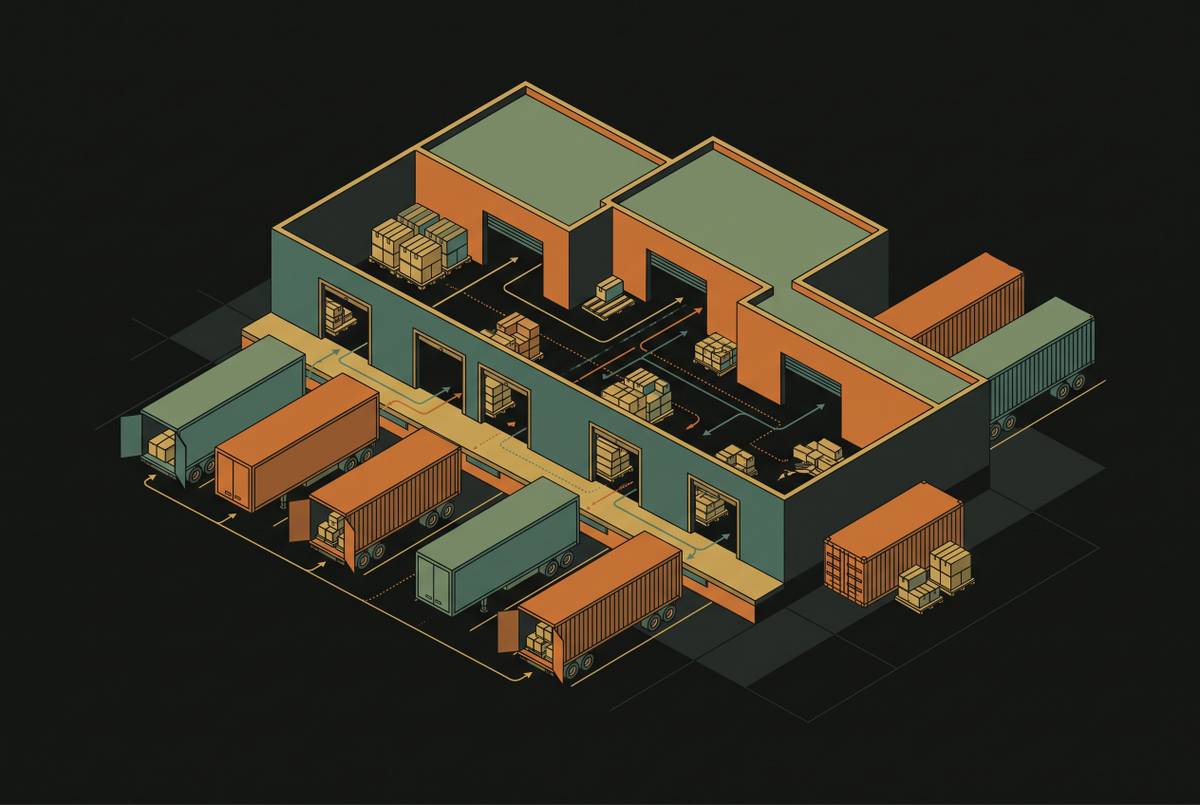
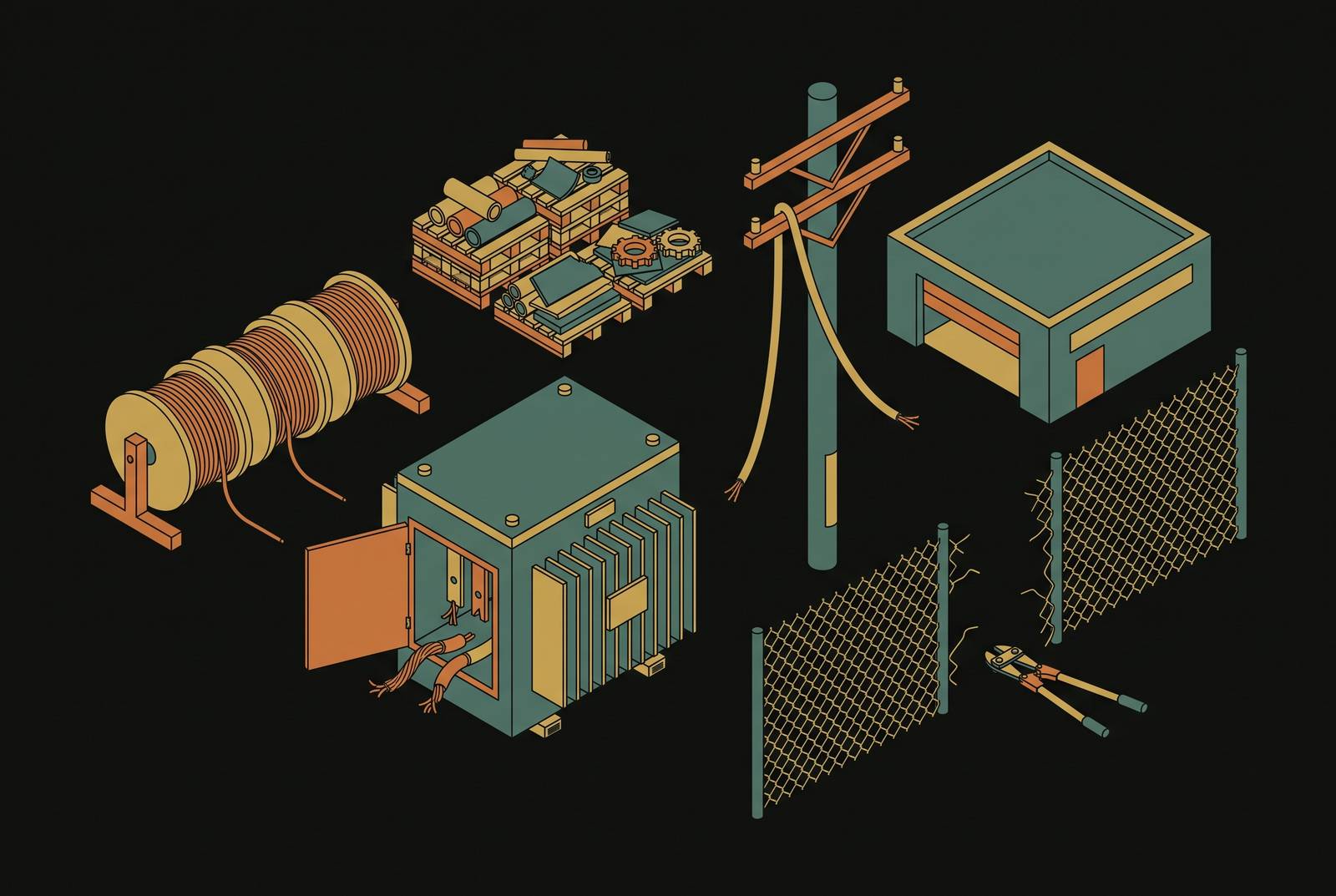
These sites share physical characteristics that no single security decision created and no single decision can remove. The categories with the highest theft risk are construction sites, telecommunication installations, utility infrastructure yards, vacant commercial buildings, and transit, industrial, and manufacturing facilities. All of them tend to be large outdoor areas with open perimeters, minimal or no overnight security presence, and exposed wiring, piping, machinery, or other equipment containing copper. The exposure is baked into how the sites operate.
Unmanned substations are the archetype of that vulnerability. They are large, spread across wide areas, full of accessible copper, and rarely staffed overnight. That combination of exposure and isolation makes them repeat targets. A crew that strikes one substation and gets away clean will almost certainly return to another, because the same conditions exist across the entire network.
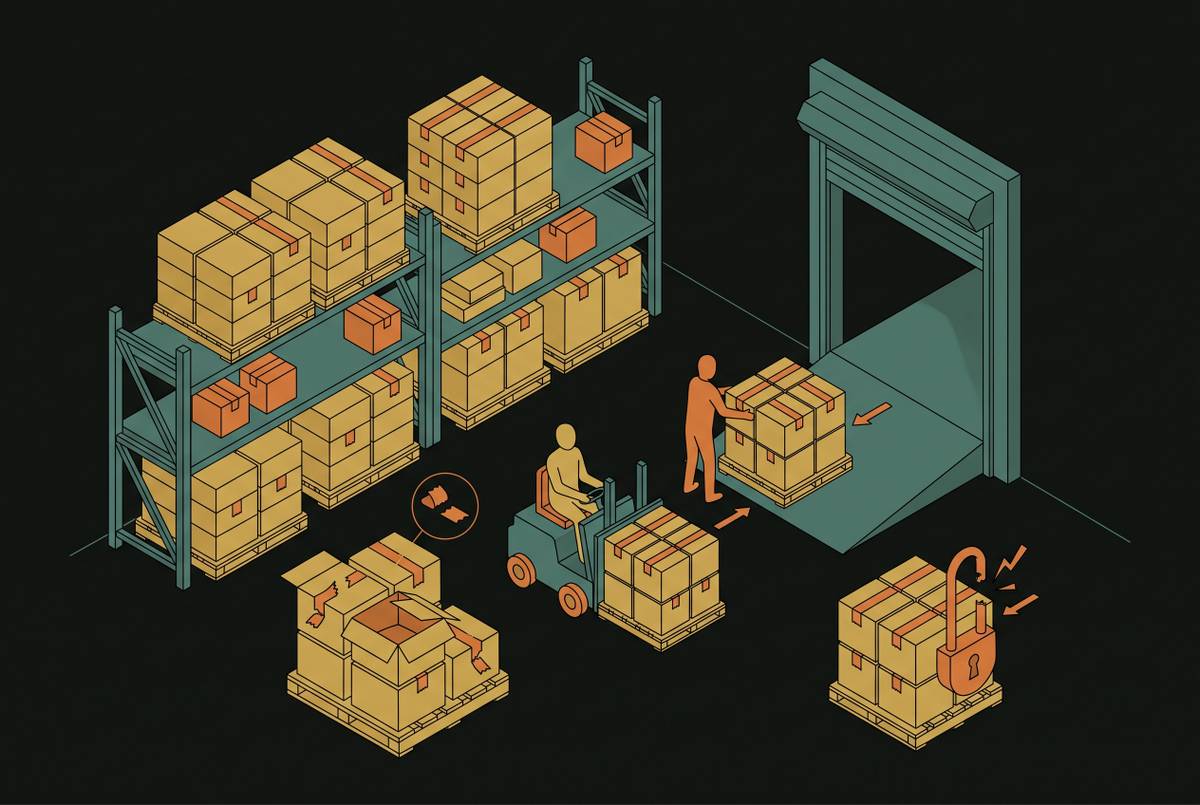
The material itself makes theft easier than it should be. Staged copper at construction laydown yards is rarely tracked or serialized, so thieves treat it as inventory that has already been abandoned. The scrap market doesn't ask for provenance, and the metal doesn't carry identifying marks. What can't be traced can be sold, and what can be sold fast enough is as good as cash.
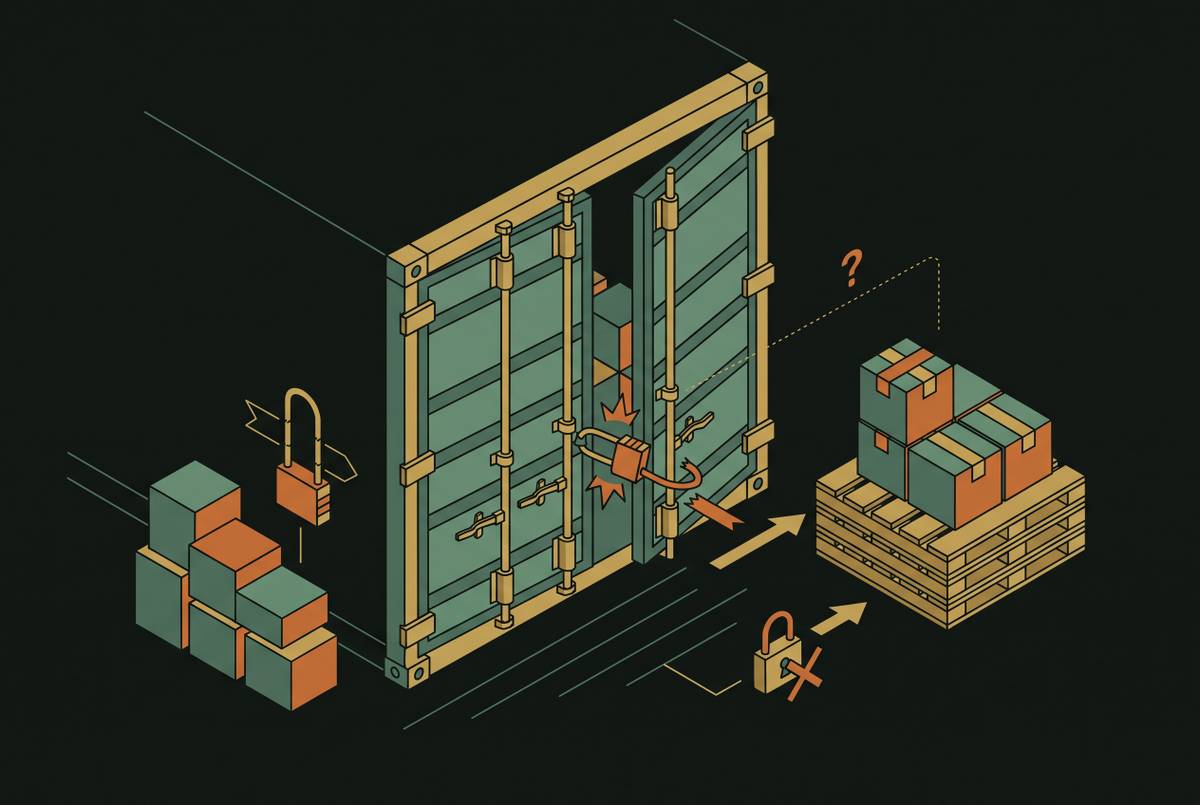
Access failures compound the exposure. Unlocked or unsecured gates remain the single most common enabler of a successful theft. A site can run cameras on every corner and still be vulnerable at one entry point a crew finds open. The overnight and weekend window is where all of this concentrates, since supervision drops exactly when staged material sits longest without observation. That is the primary attack vector, not because thieves are sophisticated, but because nobody is watching.
The cascading damage a single theft event produces beyond the scrap value of the metal
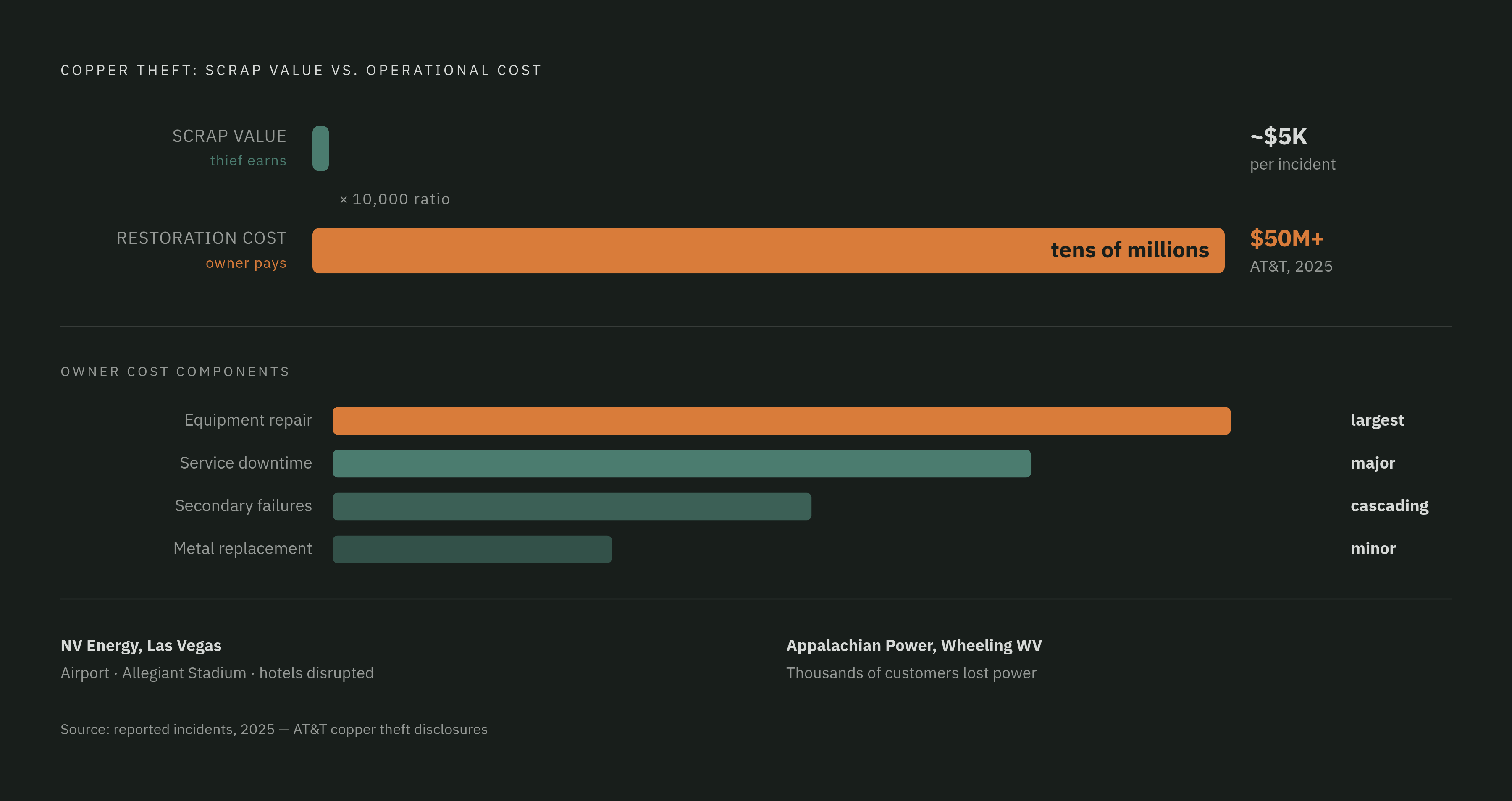
The true cost of copper theft has almost nothing to do with the value of the stolen metal. Removing copper from infrastructure destroys the system it was part of, and the repair bill dwarfs whatever the thief earned. A theft that nets a few thousand dollars in scrap can generate hundreds of thousands in restoration, downtime, and secondary failures.
The named incidents make that ratio concrete. An attempted theft at an NV Energy substation near the Las Vegas Strip caused outages affecting the airport, Allegiant Stadium, and a number of hotels. A single perimeter breach cascaded from a utility yard into public infrastructure disruption. In March 2026, a copper theft at an Appalachian Power substation in Wheeling, West Virginia cut power to thousands of customers. Neither incident required unusual sophistication. Both required only that a crew reach copper before anyone could stop them.
The economic burden falls disproportionately on the organization that owns the site. Copper removed from an electrical installation or telecommunications network may generate little revenue for the thief while leaving the utility provider, business, municipality, or homeowner facing substantial replacement costs. Damage often extends beyond the missing metal to equipment repairs, service restoration, and additional expenditures to prevent future incidents. AT&T's California state president stated the company spent tens of millions of dollars in 2025 on copper theft alone. That figure reflects not just stolen material but the organizational cost of repeated breach-and-repair cycles. The thief sees scrap value. The owner sees a standing operational wound.
Why traditional security responses address the perimeter without closing the time window
Physical hardening and patrol-based security reduce access friction at the perimeter, and that matters. A fence without detection only delays an experienced crew, but it does delay them. Anti-climb fencing with 358-style tight-mesh specification, fully welded construction, and high-tensile steel raises the time and tool requirement for a breach, so it needs powered cutting tools rather than bolt cutters and creates a longer window for detection. That is a real gain. But it does not eliminate the window.
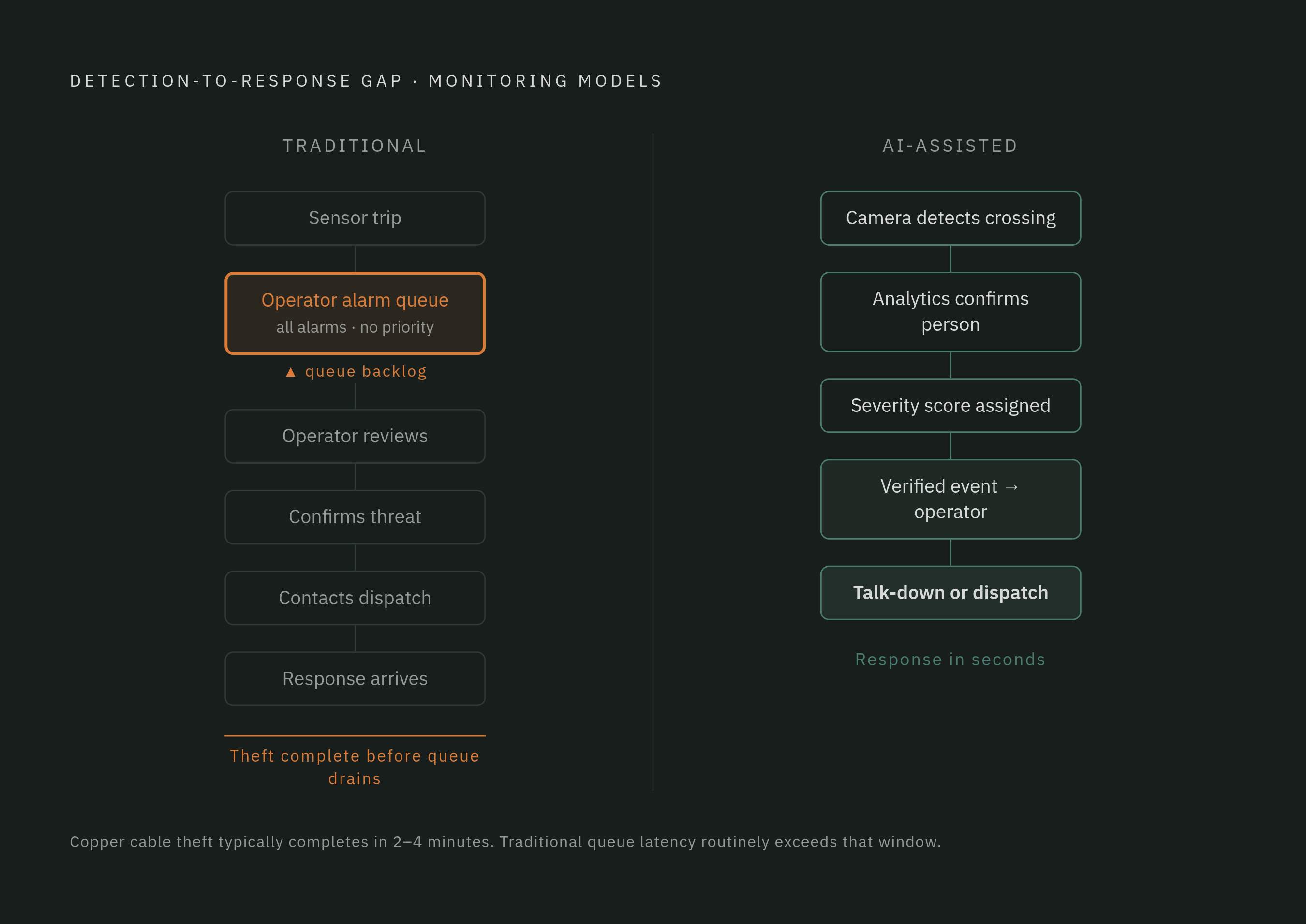
The gap sits between detection and response. Traditional alarm systems send a sensor trip to a monitoring center, starting a serial queue. By the time a human operator reviews the event, confirms it is real, and contacts law enforcement, a crew working quickly may have completed the theft and left the site. Detection without climb- and cut-resistant fencing generates alerts for breaches that have already succeeded. Physical hardening and monitoring are not alternatives. They are layers that only work together.
Patrol-based security concentrates coverage on a schedule, and thieves know the schedule. They exploit the gaps between patrols, and weekend overnight windows align with the lowest patrol density. The common objection, that adding more guards or more cameras closes the gap, fails on its own logic. The bottleneck is not camera count or guard headcount. It is the time between detection and verified response. More cameras without faster verification only produces more footage of completed thefts.
How alarm queue dynamics in traditional monitoring centers compound the response-time problem
The response-time problem is not a staffing problem. It is an architectural one. Traditional monitoring routes every alarm, including environmental noise and false triggers, through the same human queue as a real in-progress theft. A manufacturing or utility site with perimeter sensors, motion detectors, and camera triggers generates a high volume of alarms daily. Most are wind, vehicle passes, or authorized activity, but every one enters the same queue and waits its turn.
That queue volume has a predictable cognitive effect. Operators receiving hundreds of low-confidence alerts per shift develop response desensitization. The cognitive load of distinguishing real from routine degrades exactly when it matters most. A real threat waiting behind routine alarms gets the same attention as a raccoon crossing a fence line, because the system offers no way to sort them before they reach a human.
Adding operators does not change the architecture. Each alarm still waits its turn in a serial queue. Legacy monitoring panels compound the problem, since some older control panels transmit alarm information in formats modern monitoring stations may not support, which can cause failure to dispatch first responders or alarm events going unreported. That risk is acute at remote substations running aging infrastructure.
The consequence specific to copper theft is unforgiving. These thefts complete in minutes. Even a short queue delay means the theft is finished, the crew is gone, and the monitoring center is still processing the event. No operator, however skilled, can outrun a queue that gives every alarm the same priority.
What active AI-assisted monitoring actually does differently at a utility or manufacturing site
AI-assisted monitoring resolves the queue problem by filtering out noise before it reaches a human. AI-equipped cameras can detect unusual patterns of activity and differentiate between people, vehicles, animals, and environmental movements. That filtering alone removes most of what clogs a traditional queue, ensuring security teams receive alerts only for genuine threats.
The verification architecture goes further. In a cascading model, a camera detects a line crossing and raises an alarm, but that alarm does not go directly to an operator. It goes to a more powerful analytics layer that checks the camera's work. If the layer confirms a person, the alarm proceeds. If it does not, the alarm is dismissed without consuming any human attention. This pattern repeats until only verified events reach a person.
Severity scoring controls access to human attention. The AI assigns each event a score, and events below threshold resolve autonomously. Events above threshold reach a human operator already tagged as probable threats, not raw sensor trips. Verdun applies this model directly, with AI agents reviewing every alarm first, dismissing noise, and escalating only verified threats to trained operators rapidly. The same operator headcount can maintain continuous attention on a high-value site without drowning in false-positive volume.
Context is what lets the agent reason instead of merely flag. Shift schedules, authorized vendor access windows, known vehicle plates, and perimeter zone definitions together allow an AI agent to distinguish a legitimate overnight delivery from an unauthorized perimeter breach. Without that context, the agent has no way to know which events matter.
Why site-specific protocol coverage determines whether monitoring actually works at these sites
The right architecture fails at the wrong site if it lacks site-specific context. A warehouse in Fresno will not have the same threat profile as a condominium community in Sacramento. Copper theft prevention fails when managers copy a generic checklist without matching it to the property. Cameras must be placed correctly, alerts tuned properly, and the response workflow clear before an event occurs. None of that transfers from one site to another.
At a utility substation, authorized maintenance crews may arrive at 3 a.m. A monitoring system without schedule data treats that as a perimeter breach. One with it does not generate an alert at all. The difference is not camera quality or AI sophistication. It is whether anyone configured the system to know what normal looks like at that site on that night.
At a manufacturing laydown yard, copper staged on Friday afternoon sits at its highest exposure over the weekend. A monitoring protocol that intensifies coverage on the Friday-to-Monday window reflects the actual exposure. A flat patrol schedule does not. Autonomy tiering follows the same logic. A perimeter strobe activation outside business hours might be handled autonomously within protocol. The same activation during a shift change might require human approval before action. The platform should enforce that boundary in code, and the buyer should be able to see the enforcement.
Effective copper theft prevention integrates visible deterrence, perimeter detection, live verification, and directed response. Each layer depends on the others, and the verification layer is where protocol coverage determines speed. A site-specific protocol is not a premium feature. It is the prerequisite for the system to work at all. The questions to ask a monitoring vendor follow directly: what site data does the system consume, how is normal defined, and what happens to an alarm that falls outside that definition.
What a monitoring program for a high-exposure manufacturing or utility site should actually look like
The evaluation framework is simple. Every security layer should be judged by what it does to the time window thieves exploit. Physical hardening, including anti-climb fencing with tight mesh aperture, welded construction, and razor wire topper, raises the time required to breach the perimeter. Paired with fence-mounted intrusion detection, it generates the earliest possible signal before a crew reaches the copper. That is the first layer, and it exists entirely to buy time.
Camera placement determines whether the system watches what matters. Coverage must target laydown areas, storage containers, and perimeter access points, not just building entrances. Coverage that misses the laydown yard misses the primary target. Copper sits outside, in the open, in specific places. The cameras have to see those places.
Continuous AI-assisted monitoring turns camera feeds into action. It reviews every camera event against site protocol, filters environmental noise autonomously, and escalates verified perimeter breaches to human operators in the time window where a talk-down or dispatch can still interrupt a theft in progress. Verdun closes the detection-to-verification gap that traditional queues leave open, routing a confirmed threat to a trained human within seconds rather than after a serial queue drains. That speed changes what law enforcement receives. Officers responding to a confirmed, operator-verified intrusion in progress treat the call differently than a generic alarm signal. Speed of verification determines the quality of the response.
The review cadence has to track the commodity market. Security posture should be re-evaluated each time copper pricing hits a new high. The incentive to steal scales with commodity price, so exposure assessments tied to the project calendar rather than the commodity market leave a gap. A site that was adequately protected at one price point may not be at the next. The monitoring layer is what makes every other measure actionable, because it is the only layer that operates inside the minutes a theft actually takes.