The Real Cost of Delayed Alarm Response for Warehouse and Retail Properties
Every hour of delay costs warehouses thousands in stolen inventory and liability exposure.
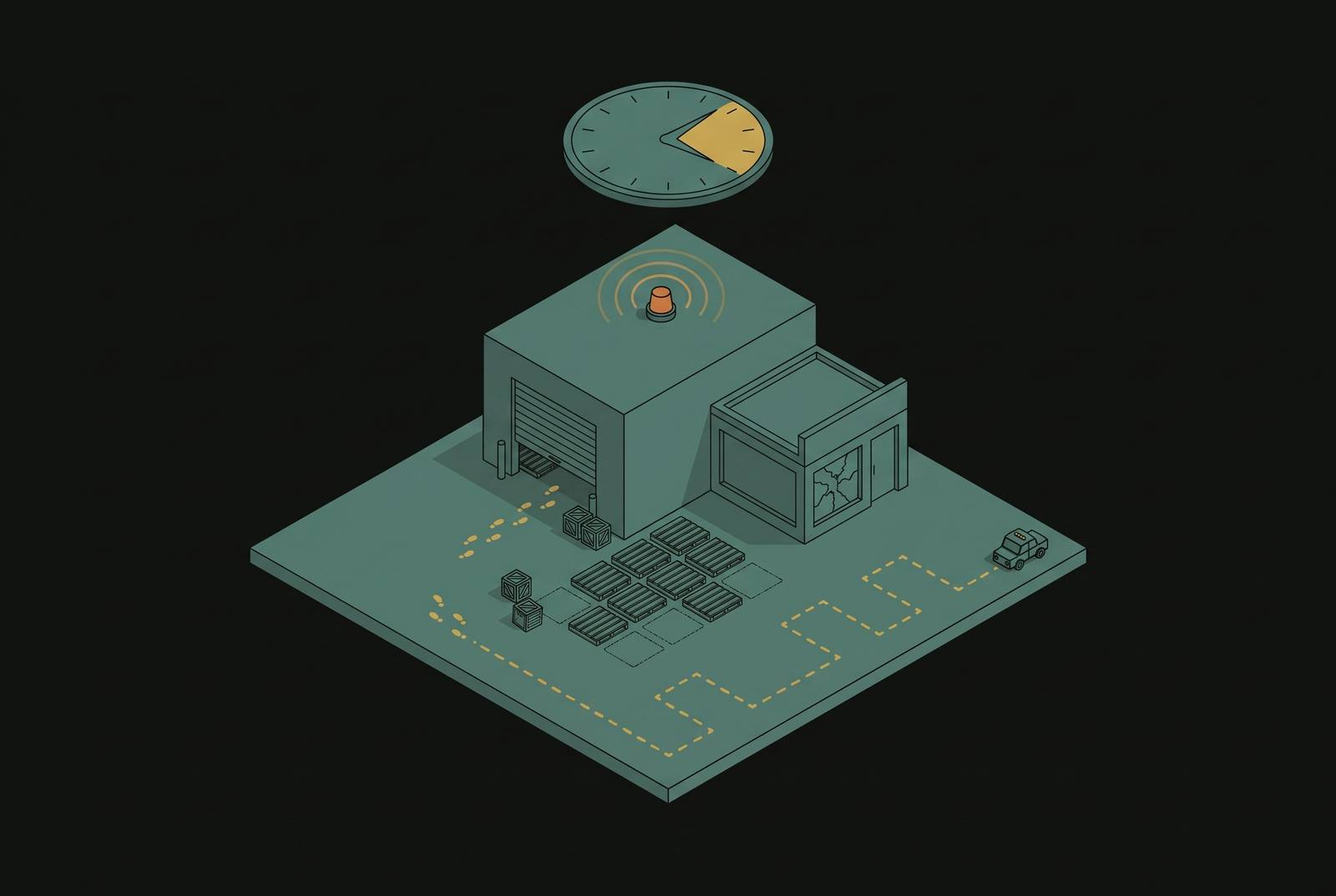
Alarm response time failure in traditional video monitoring centers begins before an operator acts, as programmed delays, crowded queues, callback loops, and undetected communication failures postpone a verified response. For warehouse and retail properties, the cost includes stolen inventory, intruders getting farther inside, gaps in incident records, and the risk of liability. To lower that cost, the monitoring architecture and service agreement must cover each handoff as well as how fast an alarm is acknowledged.
Why warehouse and retail properties are uniquely exposed to alarm response delay
Warehouse and retail properties combine high-value inventory with large footprints, multiple entry points, and long periods without staff present. Those conditions leave little room for delay. Property crimes that reach a facility typically run their course quickly, with the highest-value assets targeted early. A response can therefore arrive while an incident is still underway yet be too late to prevent its most valuable loss. The relevant window is the time available to interrupt the threat.
The threat also reaches beyond the building itself. Organized criminal groups have shifted from complex logistics fraud toward direct physical theft, including taking unattended loaded trailers and targeting distribution yards. At the same time, normal warehouse work keeps people moving through multiple access points, while the number of staff changes throughout the day. That activity complicates the distinction between authorized access and intrusion. A signal alone provides little help with that distinction.
Retail stores and employee lots face the same risks after hours, often with no staff there overnight to spot smaller incidents. An event that someone might notice during business hours can go unnoticed while the monitoring process runs. Consequently, these properties depend on both detection and the decisions that follow it. Their vulnerability lies in the gap between an alarm registering activity and someone establishing what that activity means.
The structural relay chain that sits between an alarm trigger and a verified response
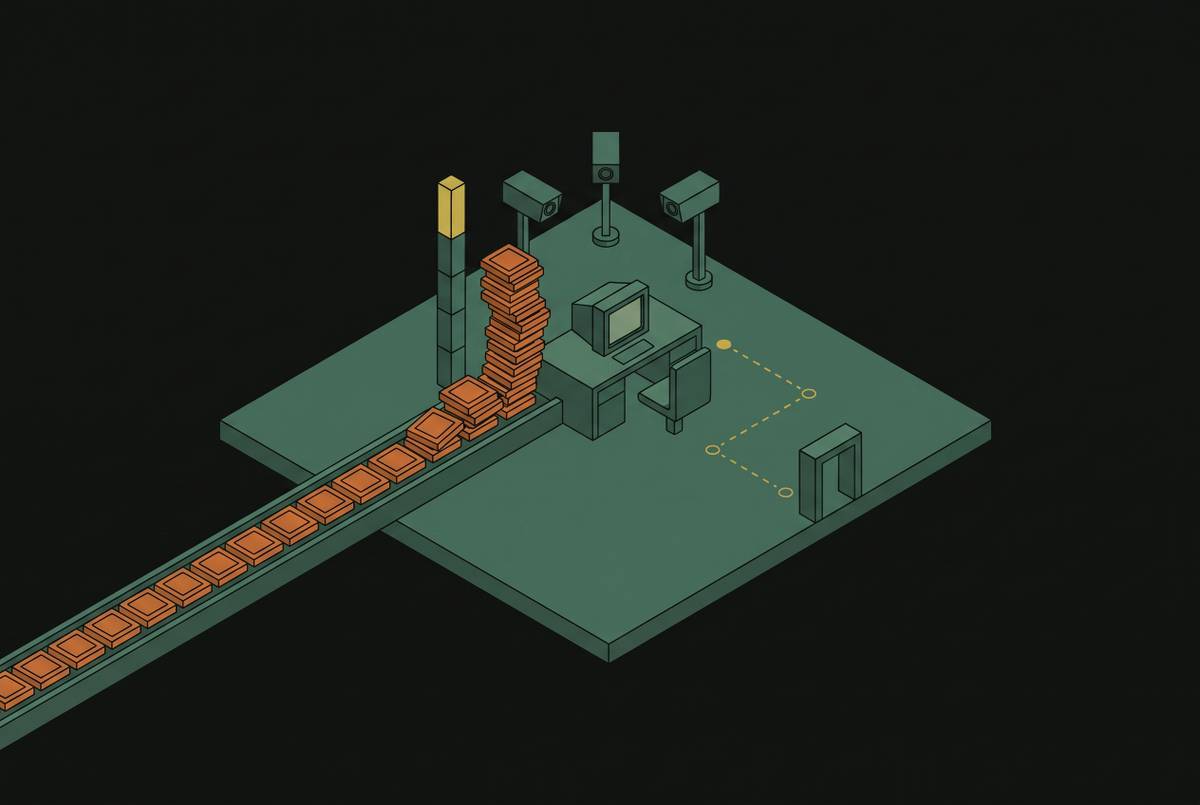
In traditional alarm monitoring, the process starts when a sensor trips. If the system has a programmed entry delay, it waits before transmitting the signal to the central station. The signal then travels to the station and enters a queue, where it waits for an operator. Receipt is the point at which the alarm becomes available for review.
Once an operator takes the alarm, the next step is to call the premises contact. If that call does not resolve the event, the operator moves to a second contact and then a third. The operator uses the information available through this process to reach a dispatch decision. Dispatch itself comes after that decision. Where manager approval is required, that approval sits between investigation and action.
In this standard signal-based relay, no human necessarily sees what is happening at the property. The operator knows that a sensor has tripped, but must establish whether it represents a threat through subsequent contact. Each stage supplies an input to the next. A video monitoring workflow that leaves investigation until an operator takes an alert retains the queue before that investigation can begin. The distinction is between receiving an indication of activity and obtaining enough evidence to authorize a response.
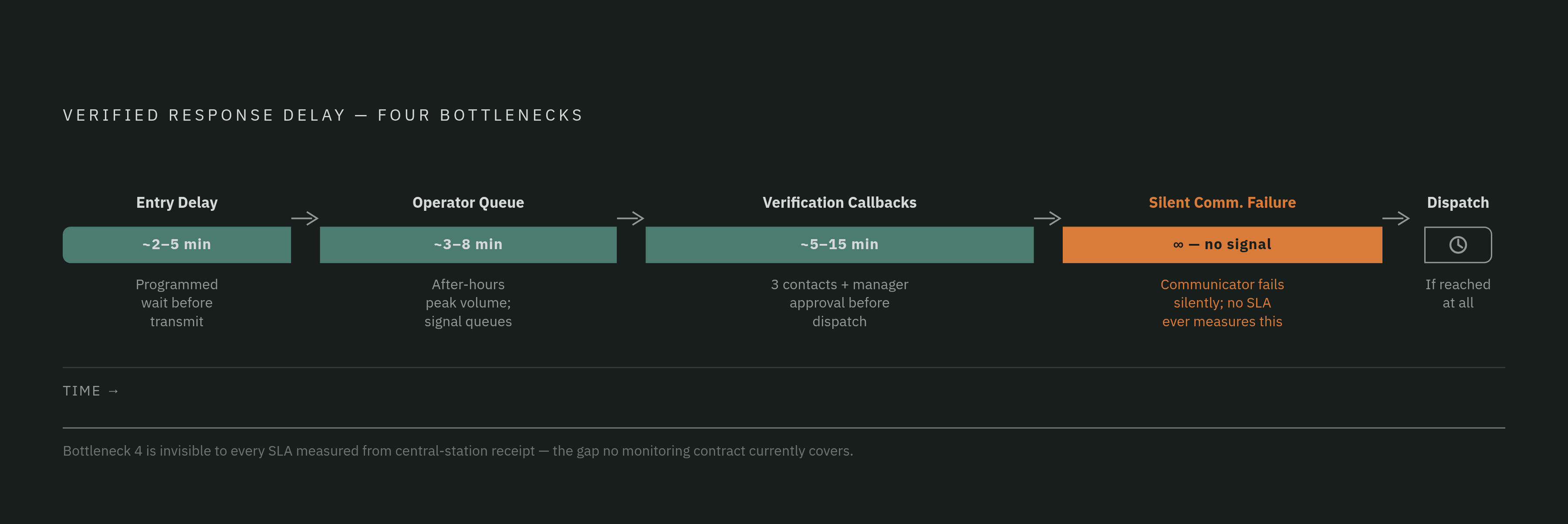
Why do monitoring centers fall behind on alerts during high-volume periods? The four bottlenecks
The first bottleneck is the programmed entry delay. Systems may wait as long as several minutes before transmitting a signal, using that interval to reduce nuisance calls. The trade is deliberate. It spends response time before the monitoring center knows that an event exists. For an unattended retail store or a warehouse facing direct physical theft, that interval comes out of an already narrow opportunity to interrupt loss.
The second bottleneck is operator queue saturation. When a signal reaches a central station, it joins others in line and waits for an operator to take it. During high-volume periods, the queue grows because incoming alerts compete for sequential human attention. After-hours events at retail and warehouse properties cluster when operator-to-alarm ratios are worst. Additional operators can slow that growth, but they do not remove the queue as a structural dependency. Without a structured interface and clear escalation rules, high alert volumes also increase the risk of review errors.
The third bottleneck is verification latency through callbacks. After taking the alarm, an operator must call, wait for an answer, and assess whether the answer can be trusted. An unanswered call starts another attempt. Calls to the second and third contacts take more time, and if the site manager must approve dispatch, the operator has to wait for that too. An unverified commercial alarm can then enter a lower police priority tier, and in understaffed jurisdictions it may receive no response.
The fourth bottleneck is an undetected communication failure. When the communicator between the alarm panel and monitoring center fails, no signal reaches the station at all. This is a break in the relay that can leave the property unaware that monitoring has stopped. The resulting exposure remains invisible to any response metric that begins only when the center receives an alarm.
How loss exposure compounds as each bottleneck adds time
The first consequence of delay is continued access. An unauthorized person who remains on the property can move beyond the perimeter and farther into the interior before trained personnel arrive. Because the highest-value assets are often targeted first, a later response may interrupt the remainder of an event without recovering what was taken at its outset.
The same window allows disturbances to escalate, access control gaps to widen, and emergency conditions to worsen. People on the property remain exposed while the response is unresolved. These consequences do not require every bottleneck to occur in every incident. A programmed delay followed by a callback loop is enough to extend the period before intervention. If verification remains incomplete, lower police priority can add a further wait after the monitoring center has finished its own work.
Documentation and liability follow the physical consequences. When the response is late, so is the documentation, and gaps in incident records can leave property managers at risk of liability long after the damage has been repaired. Tenant and employee trust in the property’s management and security arrangements can also weaken when a response appears slow or disorganized.
Insurance introduces a further contractual consequence. Underwriters are adding more response-time clauses that affect premiums and whether a claim can be paid, while slow response protocols can make it hard to meet those terms. For warehouses, verification also influences how police classify the event. A verified crime-in-progress receives priority dispatch, while an unverified alarm waits in a lower tier.
Why site-specific context is the variable that most monitoring architectures ignore
A warehouse with overnight maintenance staff does not have the same after-hours activity as a retail store with staggered closing shifts. A truck yard that lets drivers in around the clock has a different pattern again. Normal activity is specific to the property. Applying the same alarm logic across all three can generate nuisance alerts where legitimate access is expected and miss threats where the rule is too permissive. The system needs more than a broad distinction between open and closed.
That missing context explains much of the callback loop. An operator without the site’s schedule, authorized personnel list, or normal access patterns cannot use those facts to assess an alarm. Calling the premises becomes a substitute for knowledge that was never supplied to the monitoring process. With each new event, the operator has to try to get that knowledge again.
Warehouse complexity makes this distinction especially important. With multiple access points, changing numbers of staff, and constant movement, intelligent algorithms need to cross-reference multiple sensor inputs so that each signal is checked alongside the others. Context gives those inputs a useful frame of reference. Context helps tell activity that fits the site’s operating pattern from activity that needs to be checked. Without it, verification can become a way to clear alerts without finding out whether there is a threat.
Pre-authorized dispatch protocols let the center act on that knowledge. When the monitoring center has written permission to dispatch without manager approval, it can respond without having to reach that manager during an incident. This permission is an agreed site-specific rule about when action is justified. The necessary context includes both what is normal and what the center is authorized to do when activity is not.
What changes structurally when AI agents filter before the queue, not after
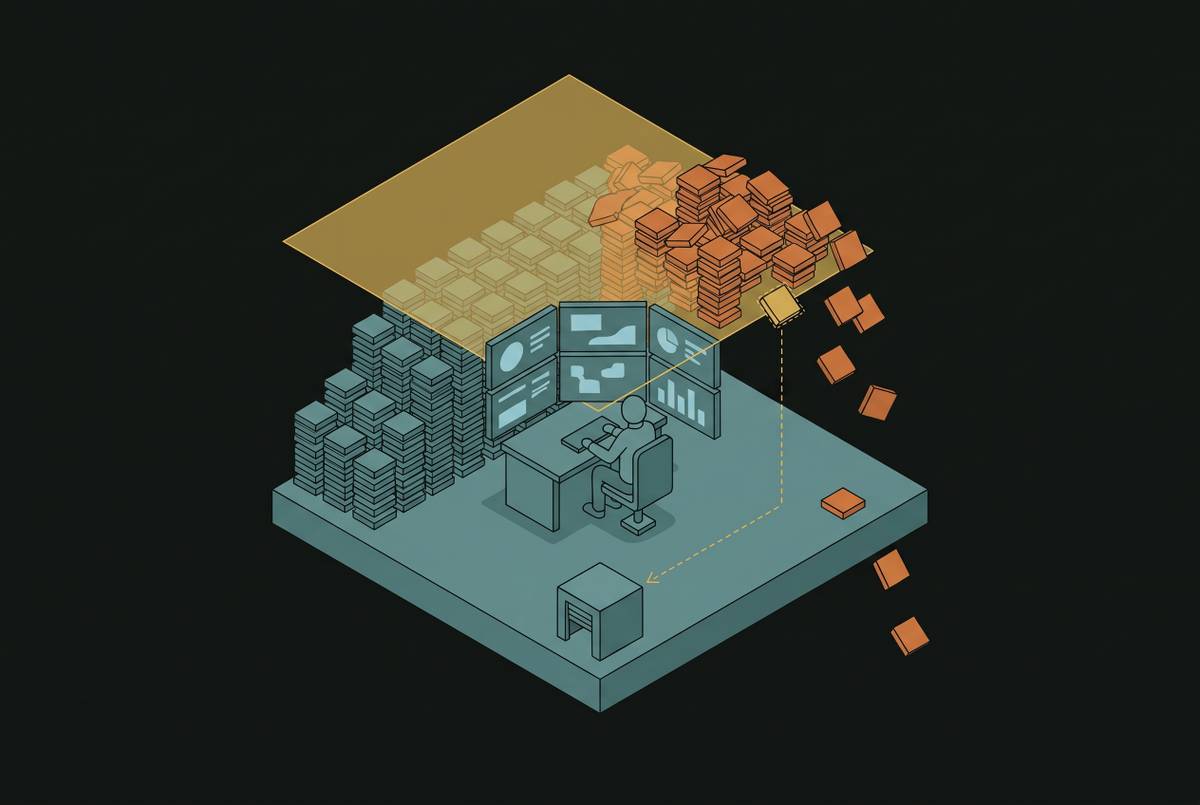
Filtering before the operator queue changes the work that reaches a human. AI agents use site-specific context to classify incoming events before raw signals join the line for a person to investigate. The agents can process events in parallel. Humans deal only with threats that need a response. This addresses queue saturation at its source rather than merely increasing the number of people working through it.
Verification also starts from a different position. AI-driven video verification can operate continuously against the site’s schedule, authorized personnel, and normal activity patterns, rather than rebuilding that context through calls after every alarm. What reaches the operator is a verified threat with a recommended action. Where pre-authorized dispatch rules apply, the callback loop can be removed. Verification and authority must both be present for that change to work.
AI agents filter and verify, while humans respond to the threats presented to them. Putting AI after the operator queue would leave alarms waiting in that queue just as long, even if it sped up the investigation that followed. Placement is therefore a substantive architectural distinction.
A programmed entry delay occurs before a signal is transmitted, and a failed communicator prevents the event from reaching the filtering layer at all. An architecture intended to address the whole relay must also account for those upstream gaps. Faster classification cannot compensate for an event the monitoring center has not received.
What to demand from a monitoring SLA once you understand where the time goes
For buyers evaluating a monitoring contract, the practical next step is to require timing definitions at each handoff. The service-level agreement must state when its clock begins and ends. A clock that starts at central-station receipt excludes the programmed entry delay and cannot describe a signal that never arrived. A clock that stops at a callback tracks the time to that call but leaves out the wait until dispatch initiation. Verified threat escalation to an operator is another distinct endpoint.
Average acknowledgment time is insufficient on its own. Dealing with easy alarms quickly can make the average look good while real incidents still wait in the tail of the distribution. Buyers should ask for that distribution. The reporting must also distinguish acknowledgment from verification and action. Otherwise, a quick indication that the center received an alarm can obscure a much slower process for deciding what to do.
Site-specific protocol documentation should be a contractual deliverable. It must include schedules, authorized personnel lists, escalation contacts, and dispatch rules, with versions maintained and updates made when the site changes. Those records provide the context that makes AI-augmented verification meaningful. They also define when the monitoring center can act without manager approval. Treating them as a setup assumption leaves a central part of the response workflow outside the service commitment.
Performance reporting should be monthly and site-specific. A buyer responsible for a truck yard, retail store, and distribution center needs to see each property’s results, rather than an aggregate that blends a well-served site with an underserved one. That visibility connects the contract to actual operating conditions. A strong SLA closes the gap between alarm detection, decision-making, and dispatch by making the timing and responsibility at each handoff explicit.