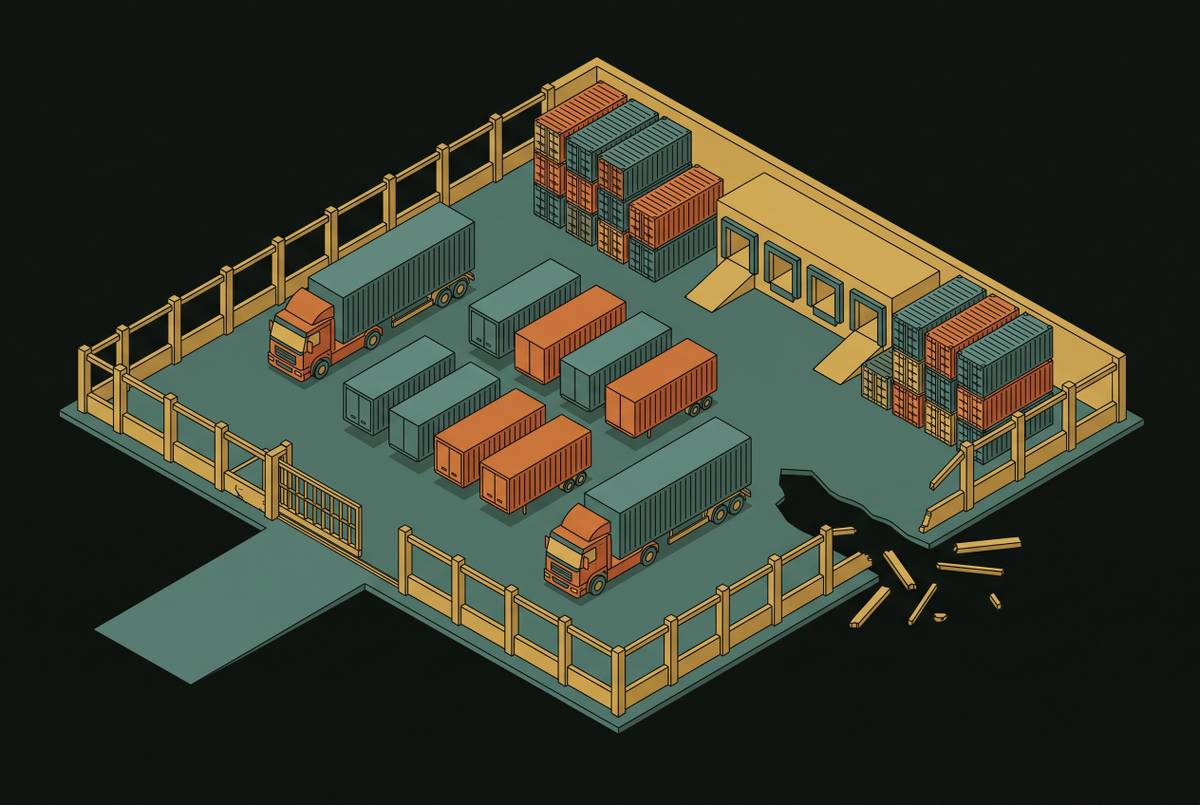
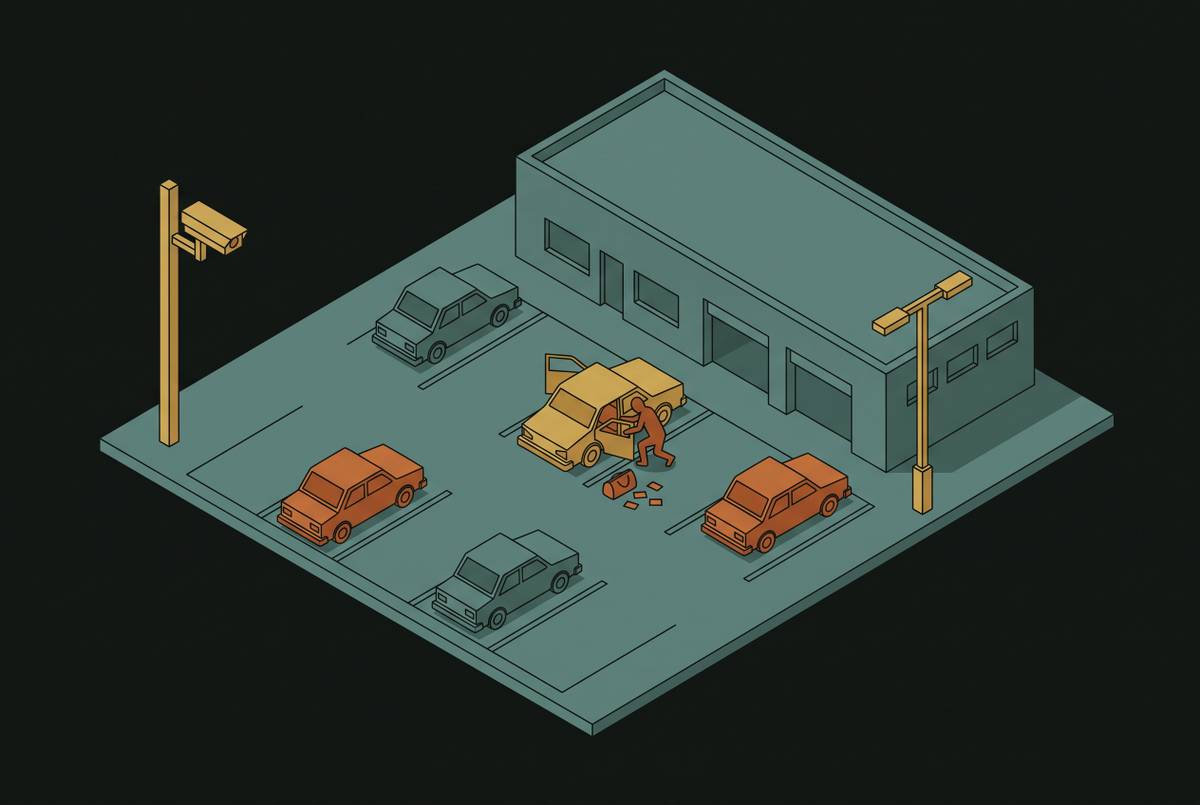
Organized Retail Crime Tactics in Commercial Warehouses
Thieves now target warehouses and supply chains using credential fraud and insider help.
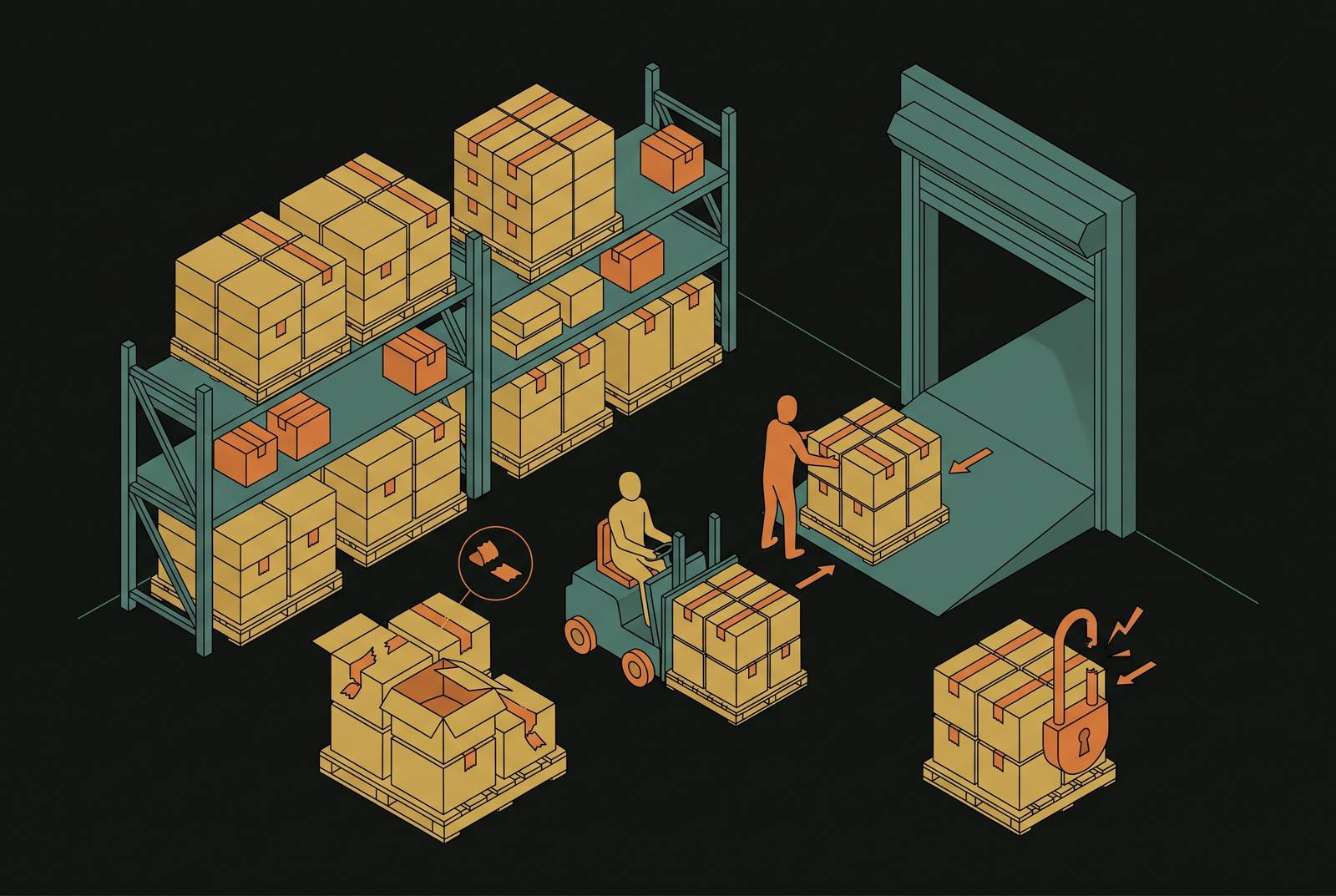
Organized retail crime no longer stops at the storefront. It has moved into the warehouse and the supply chain behind it, where cargo theft, impersonation, and coordinated distribution of stolen goods have become standard operating procedure for groups that once relied on boosters working store aisles.
Organized retail crime in the warehouse
The Combating Organized Retail Crime Act of 2025 (H.R. 2853, reported January 30, 2026) lays out in its congressional findings what law enforcement and retailers have been documenting for years: organized theft groups have built real hierarchies, they cross jurisdictions freely, and they now work across the full retail supply chain, including cargo, distribution points, and digital channels, not just the sales floor. That finding matters because it changes where a retailer or logistics operator needs to look for risk. These groups function like structured enterprises. Boosters, lookouts, fencers, and organizers each hold a defined role, and leadership stays insulated from the criminal exposure that falls on the people doing the physical work. Once goods leave a warehouse, they move through online marketplaces, pawn shops, flea markets, and resellers willing to look the other way, which makes the warehouse the extraction point rather than the final target. Everything downstream of that dock door depends on what happens at it.
The financial and operational scale of warehouse-targeted ORC
Cargo theft now costs the retail industry a substantial sum every year, and losses tied to organized cargo theft across the United States and Canada climbed sharply in 2025, with the average value stolen per incident rising as groups grow more selective about which loads they target. The Deeley Insurance Group's 2026 retail trends report cites CargoNet data showing that the average stolen shipment value in the third quarter of 2025 nearly doubled the prior year's figure, a trend that points to deliberate targeting of higher-value freight rather than opportunistic theft. The crimes themselves have also grown more dangerous. Deeley's 2026 report documents rising levels of violence and aggression during these incidents, and the congressional findings behind H.R. 2853 record that more than four in five retailers now view violence and aggression tied to ORC as a bigger concern than they did in 2022. Numbers at this scale don't call for a few more guards at the dock. They call for a different architecture of detection and response, because the groups generating these losses are not improvising. They are coordinating, and the next question is how.
Division of labor and coordinated roles in warehouse ORC operations
Warehouse ORC works because the labor is split in ways that spread out legal exposure, speed up execution, and create more pressure points than a single security presence can watch at once. Ground-level operatives move fast and absorb the direct criminal risk. Lookouts watch entrances and track where staff are standing. Distractors pull employee attention away from what matters. Sweepers clear merchandise in a matter of minutes, and fencers take the goods and move them back into resale channels. Separating these roles limits what any one person can be charged with and speeds up the whole operation. Eufy's January 2026 overview of organized retail crime describes how a coordinated sweep by a large group can produce significant losses in minutes, a pace fast enough to exhaust human response options before a monitoring operator even registers what's happening. The organizers who plan these operations rarely appear at the scene. They manage distribution from a distance, which keeps them insulated from arrest and makes the groups resilient even when a single sweep gets interrupted. That same division appears at the digital layer of these operations: one set of actors gathers shipment intelligence, another runs social engineering campaigns, and a third executes fictitious pickup scams using falsified credentials, mirroring the same separation between the people who take the risk and the people who profit from it. Multiple coordinated actions hit at once, while on the other side of the fence, a single monitoring operator watches a queue built to handle one incident at a time.
Credential fraud and fictitious pickup scams at the dock door
Fictitious pickup fraud has become one of the most effective ways into a warehouse because it doesn't require breaking anything. It relies on falsified or stolen carrier and broker credentials that convince warehouse staff to hand freight over voluntarily. It bypasses physical security altogether. Deeley's 2026 retail trends report describes the mechanism: fraudsters pose as legitimate carriers or brokers using credentials that were either stolen or fabricated, and warehouse staff release the freight believing the pickup is legitimate. By the time a fraudulent driver shows up at the dock, the group behind the scheme has often already gathered shipment intelligence and intercepted internal communications, so they may know the load manifest, the expected pickup window, and the names of the staff working that shift. None of this trips a camera or an alarm. There's no broken lock, no forced door, no motion anomaly, because the systems built to catch physical intrusion have nothing to flag when someone walks up, presents credentials, and drives away with a trailer full of freight. The tactic has also been evolving under pressure. Some ORC groups pulled back from complex fraud schemes in 2024 and 2025 as logistics platforms rolled out anti-fraud countermeasures, while other groups pushed further into credential theft and carrier impersonation, and some shifted back toward direct physical theft of unattended loaded trailers. Both paths exploit the same opening: warehouses that cannot verify identity against a delivery schedule in real time have no way to catch either version of the scam before the freight is gone.
Insider exploitation: how ORC groups recruit or compromise warehouse employees
An insider inside a warehouse operation hands an ORC group an intelligence advantage that no amount of external security fully offsets on its own, because access schedules, alarm codes, delivery timing, and camera blind spots all flow from one compromised employee. Eufy's January 2026 overview names insider collusion as among the hardest threats to catch: a compromised employee can hand over floor plans, tip off a group to delivery schedules, or disable alarms outright, which gives the operation a structural edge that standard security measures were never built to counter. Deeley's 2026 retail trends article points to economic pressure as a factor likely to raise internal theft risk, and recommends that retailers revisit their crime insurance policies for updated definitions, sublimits, and employee dishonesty provisions. The pattern isn't hypothetical. A CHP investigation that led to a February 2026 search warrant at a Merced residence, documented in the California Governor's March 2026 ORC enforcement announcement, involved a former Kohl's loss prevention employee and resulted in one arrest along with charges against an accomplice. That case reframes what an authorized badge actually guarantees. A recognized employee walking in, or a door held open for a familiar face, is not automatically safe. It may be the exact vector the operation was built around. Catching that requires monitoring that checks behavior against what's expected for that employee, that schedule, that door, at that hour, rather than relying only on whether the badge scanned correctly. An access log will tell you the badge was valid. It won't tell you that the person behind it wasn't supposed to be there.
Rapid sweep tactics and strategic timing designed to outrun human response
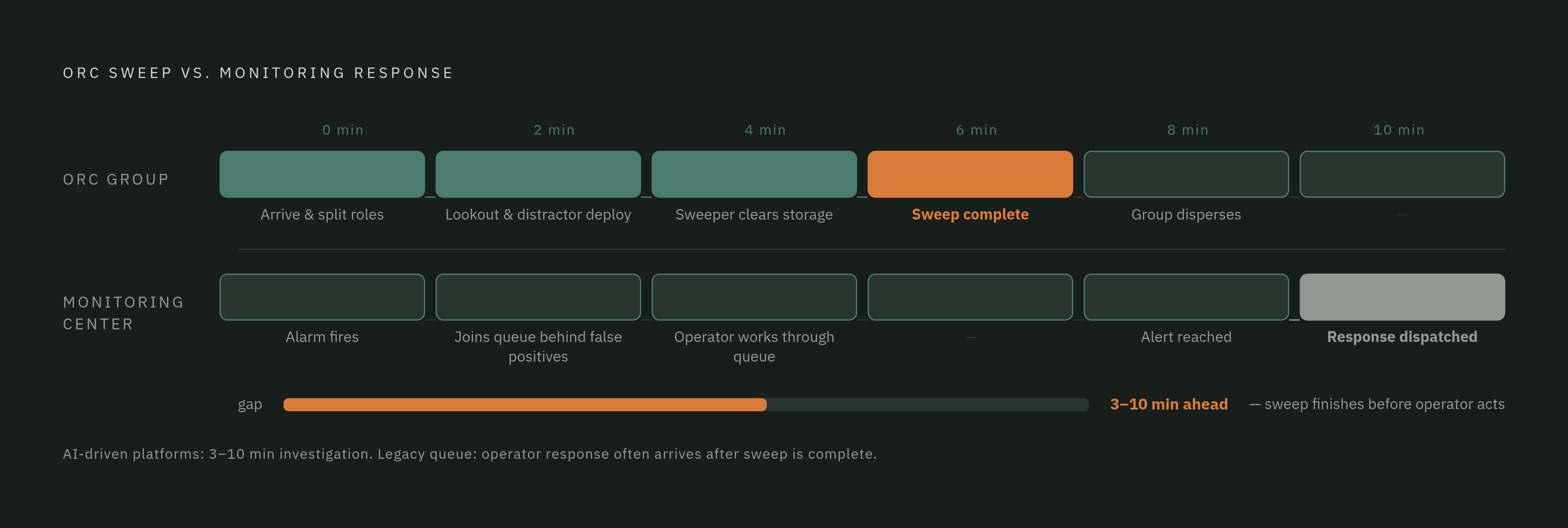
ORC groups pick their timing with the same deliberateness they apply to role division, targeting the hours when monitoring is thinnest and a physical response is furthest away, which makes response speed the single factor that decides whether a sweep gets stopped or completed. After-hours windows and shift changes are favored for a reason: staffing drops, operator attention thins out, law enforcement takes longer to arrive, and missing inventory can go unnoticed for hours. Eufy's January 2026 overview describes large-scale grab-and-run tactics in which a group rushes a location all at once, overwhelming any staff present before they can safely intervene, with high-value targets like electronics, designer goods, and cosmetics chosen in advance for how fast they can be grabbed and how easily they resell. The warehouse version of this looks like a caged storage area, a loading dock, or a staged pallet cleared out before a monitoring operator even works through the alarm queue the sweep itself triggered. The logic behind it is straightforward: if an alarm typically takes several minutes to reach a human reviewer in a busy monitoring center, a group that finishes its sweep inside that window will already be gone before anyone dispatches a response. Technology sharpens the timing further. Eufy's overview notes that some groups use signal jammers to disable RFID tags or coordination apps to run simultaneous thefts across multiple locations at once. It's planned around the known limits of how fast a monitoring center can act.
Structural failures that let legacy monitoring centers miss these tactics
ORC tactics succeed against commercial warehouses less because the groups running them are unusually sophisticated and more because legacy monitoring centers are structurally unable to review alarms fast enough to interrupt an operation already underway. A single operator in a legacy setup typically covers dozens of sites and thousands of events in a shift, which turns the job into triage rather than review. Alarms pile up in a queue, and a genuine threat waits in line behind a stack of false positives with no way to jump ahead. The false alarm rate is the core structural failure here: when the overwhelming majority of alerts a center receives turn out to be nothing, operators adapt by treating every alert with less urgency, a rational response to a signal that's mostly noise, but one that degrades detection of the rare alert that actually matters. Human fatigue makes it worse. Research on video monitoring operators shows detection rates drop measurably as a shift goes on, with error rates climbing after extended stretches of watching screens, and a coordinated ORC sweep that hits late in a shift lands on an operator at their least reliable point. The documented outcome is a center where nearly every alarm is a false positive can let a real breach go unnoticed long enough for a sweep to finish and the group to disperse. The industry's usual fixes, muting noisy cameras, offshoring operators, charging overage fees, trade one cost for another without touching the actual problem. None of them shrink the queue. Human attention does not scale on demand to meet a peak alarm volume, and any fix that doesn't address queue depth directly treats a symptom while leaving the queue itself, the structural failure, unaddressed.
Effective warehouse monitoring against each ORC tactic
Closing the vulnerabilities these groups depend on requires monitoring that reasons against the specific context of a site rather than just reacting to motion, and that gets a verified threat to a human operator fast enough for an actual response to still be possible. Against credential fraud and fictitious pickup scams, that means cross-referencing a dock-door event against the active delivery schedule rather than just flagging that a door opened. The Cobalt AI dock-door example from the research shows the pattern: the system detected an open door, checked the delivery schedule, found nothing scheduled, recognized the after-hours context, and flagged the event for a human to review. Against rapid sweep tactics, AI agents that review an alarm the moment it fires, instead of letting it sit in a queue, cut the time between trigger and a verified human escalation dramatically. AI-driven platforms complete alert investigation in 3 to 10 minutes per industry analysis, a fundamentally different intervention window than one that waits behind routine false positives. Against insider exploitation, continuous monitoring measured against behavioral and schedule-based baselines, not just access control logs, catches activity that looks authorized but doesn't match the pattern. A badge scan alone can't tell you an employee is holding a dock door open outside any scheduled delivery window, but a system checking that door against the schedule can. Against role-divided, simultaneous operations, AI agents can handle multiple alarm streams at once without the fatigue or queue backup that limits a single human operator, so every alarm gets reviewed instead of triaged away. None of this works without site-specific protocol knowledge built in from the start. A system that doesn't know a facility's delivery schedule, its authorized access patterns, its after-hours zones, and its normal behavioral baselines has no way to tell a real threat from routine noise, and generic motion detection supplies none of that context on its own. The field is moving toward license plate recognition checked against driver and shipment manifests at the gate, AI video analytics that flag loitering and weapons, checkpoint scanning, and direct integration with Warehouse Management Systems, all working from the same facility-specific data that lets a system tell a scheduled delivery apart from a sweep in progress.