Employee Lot Theft and Vehicle Crime at Commercial Properties
FBI data compiled by USAFacts shows motor vehicle theft fell faster than any other crime category tracked nationally between 2024 and 2025. NICB data that LiveViewGPS compiled puts the cumulative decline from the 2023 peak at 35.4% through 2025, and that is the fastest two-year drop in modern record-keeping. Those numbers are genuine, and any property owner reading them has reason to feel the overall climate has improved. But the same NICB analysis that documents the decline also notes that organized crime groups have "increasingly shifted away from traditional vehicle theft" into other vehicle-related crimes and fraud. A falling count of stolen vehicles does not mean the underlying risk at any given site has fallen with it, particularly at sites built around the exact conditions that remain attractive to thieves. Employee and commercial parking lots are one of those sites, and the rest of this piece works through why.
What makes employee and commercial lots structurally attractive targets
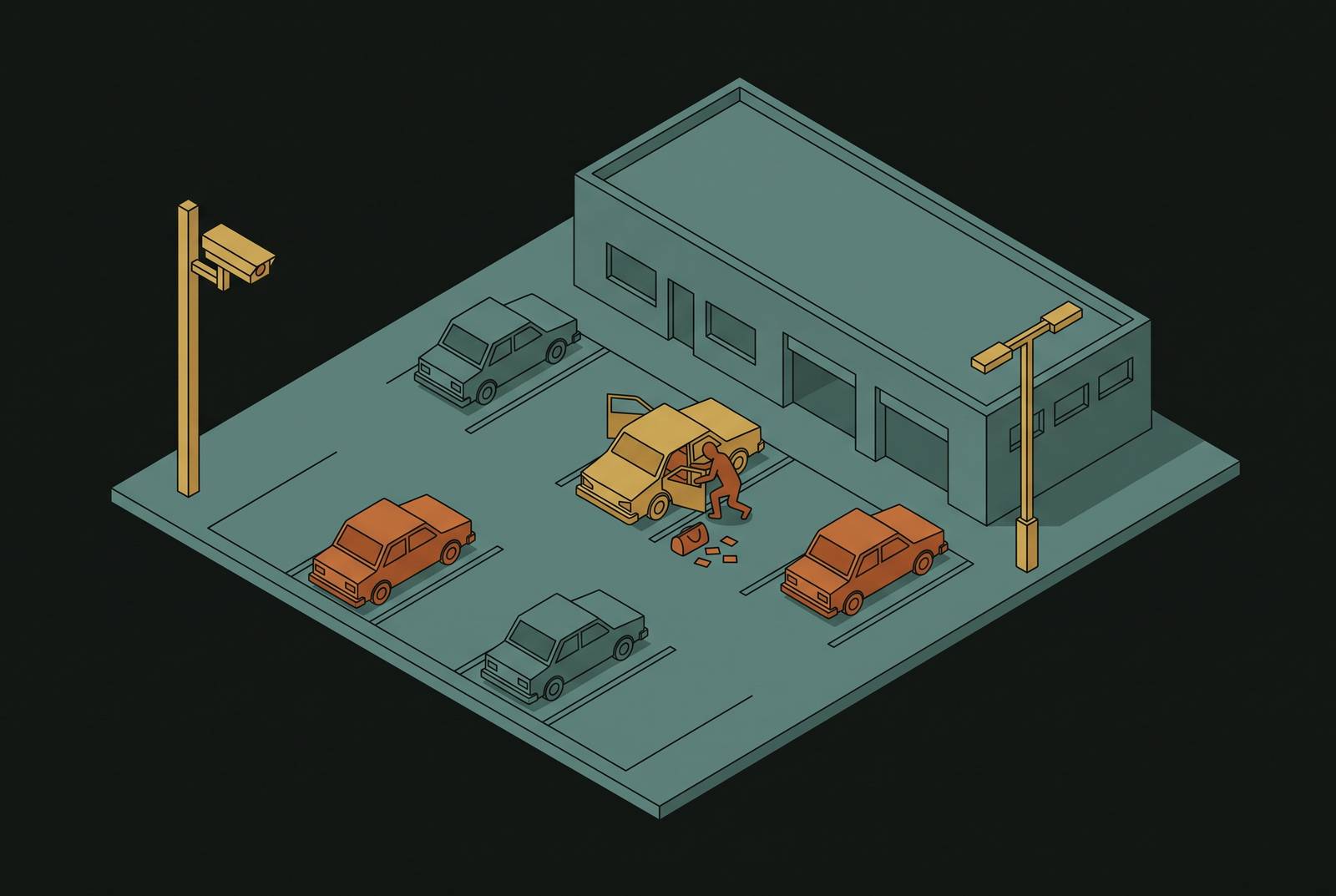
A national decline in whole-vehicle theft says very little about what happens in a lot where the same trucks sit in the same spots every night, watched by nobody in particular. AMAROK's 2026 analysis describes how criminals scout a facility before acting, and they look for weak lighting, missing cameras, and staffing patterns they can set a watch by. An employee lot offers all three without much effort: the same shift ends at the same time, the same vehicles stay parked until morning, and the fencing, where it exists, is often chain-link that a bolt cutter handles in seconds. Workers leave vehicles unlocked or running because convenience wins out over caution, and that habit, repeated across a lot full of similar vehicles, turns a single lapse into a standing opportunity.
The parts resale market gives organized theft a reason to target these lots even as whole-vehicle numbers drop. Catalytic converters, wheels, airbags, and GPS units sell fast, carry little traceability, and don't require driving a truck off the property. Work trucks make especially good targets for this kind of theft: the Chevrolet Silverado 1500 and the Ford F-150 rank among the most-stolen models in NICB data, and both sit overnight in fleet and employee lots, loaded with visible equipment and sometimes left running by a driver stepping away for a few minutes. Electronic security hasn't closed this gap either. Relay attacks on key fobs, key cloning, and CAN bus injection all bypass the protections built into modern vehicles, so a factory-fresh security system means little if the lot around the vehicle is unwatched. The shift NICB describes, away from opportunistic whole-vehicle theft and toward this more targeted, more technical activity, means the threat left behind at a site like this is more capable, not less.
Cameras without active monitoring and the conditions they fail to address
Most commercial lots already have cameras, and most owners treat that as proof the lot is secure. It isn't, because a camera alone only answers for what happened, not for what's happening. A camera records the moment a catalytic converter gets cut out from underneath a parked truck, but it does nothing to interrupt the act while it's in progress, and by the time anyone reviews the footage, the thief is gone and the equipment is sold. Footage after the fact is evidence. It is not deterrence, and the two are not the same thing.
Deterrence requires a credible chance that something will respond while the crime is still happening, and a camera feeding into an unmonitored recording system carries no such chance. Experienced thieves can tell a site that watches from a site that only records, and they plan around it. A smash-and-grab or a converter theft runs its course in a few minutes. A video clip reviewed the next morning cannot close a window that narrow, no matter how clear the picture is. You need someone, or something, watching in real time to close that window, which is what active monitoring promises and what the next section shows traditional monitoring centers struggle to deliver at scale.
How legacy monitoring centers fail under high alarm volume
Active monitoring sounds like the fix, and it would be, if the architecture behind it could keep pace with its own alarm volume. It generally can't. The overwhelming majority of alarm triggers that a monitoring center receives are false: wind, wildlife, a delivery driver, a shadow crossing a sensor. The operator working through that queue at any given moment is sorting through noise far more often than signal, and that imbalance shapes everything downstream.
Human attention degrades under this kind of load. Vigilance decrement, the well-documented drop in a person's ability to detect real events during sustained monitoring, sets in within tens of minutes regardless of how experienced or well-trained the operator is. A genuine threat that arrives during a peak alarm period doesn't get pulled to the front of the line. It waits behind everything else in the queue, and every minute it waits is a minute the response window shrinks. High false-alarm rates make this worse over time, because operators exposed to constant noise become desensitized to it, and desensitization measurably slows detection and response. Adding more staff doesn't fix a queue that is structural rather than numerical, and muting alarms or adjusting pricing for overage calls doesn't fix it either. These are cost adjustments layered onto an architecture that still treats every alarm the same way, whether or not it matters.
For an employee lot, this architecture collapses exactly where it matters most. A team cutting a catalytic converter at 2 a.m. finishes in minutes. If the alert describing that activity reaches a human operator only after it has cleared the queue, the operator is looking at a crime that already happened.
Filtering Logic Before Human Review
The fix for a queue problem is making sure only verified threats enter the queue at all, which requires software that can reason about what an alarm means. Agentic AI systems differ from older motion-based detection in exactly this respect: they act with a degree of autonomy and goal-directed reasoning, evaluating context rather than flagging every trigger as equally worth a human's time.
Applied to an employee lot, that reasoning looks straightforward in practice. A delivery driver moving through the lot at 11 p.m. on a scheduled route is authorized activity, and the system should recognize it as such. A person loitering near a row of parked trucks at 2 a.m., with no scheduled reason to be there, is a different pattern entirely, and recognizing that distinction resolves most false alarms before a human ever gets involved. AI agents review every alarm first, clear out the environmental noise and the routine activity, and escalate only what still looks like a genuine threat after that filtering. By the time a human operator sees anything, the sorting work is already finished, and the alert waiting for them is worth acting on quickly.
This is a layered system rather than a replacement of one layer by another: continuous AI attention handles the volume, and trained human judgment handles the verified escalations that need a person's decision. Neither layer does the other's job well on its own. The monitoring market is already restructuring around this division of labor. The remote video guarding segment, the video-verified, AI-assisted end of the industry, is growing faster than the reactive monitoring core it's displacing, a sign that buyers and providers alike are recognizing the old all-human queue model as insufficient for the volume modern camera deployments generate.
Site-specific protocols and meaningful AI filtering
An AI agent that filters against a generic behavioral baseline still beats a plain motion sensor, but if the filtering is generic, it doesn't fit a given property. A commercial lot owner needs a system calibrated to how that specific site operates, not to an average of every site the vendor has ever installed at.
Shift changes, authorized after-hours access, delivery schedules, and approved vendor visits all define what counts as normal at a particular location, and without that definition built in, a third-shift maintenance worker walking the lot looks no different to the system than an intruder would. Site-specific protocol coverage ties the AI's reasoning to the real threat profile of the property: a truck yard where overnight movement is routine needs parameters tuned differently than an employee lot that empties out completely by 6 p.m. Without that configuration, the system still guesses at context even when it looks sophisticated. With it, the same system can tell a vendor with a scheduled delivery apart from an unscheduled visitor standing at the same gate at the same hour, which is the distinction that actually matters to a lot owner trying to prevent a loss.
If you're evaluating a monitoring provider, ask directly whether the AI's filtering is tuned to your site's schedules, entry points, and authorized personnel, or whether it runs the same baseline logic across every property the provider covers. If a system offers AI filtering without that site-specific configuration, it just offers a faster version of generic coverage, not a structural improvement on what came before it. Coverage itself should extend across every zone that matters on a commercial lot: perimeter fence lines, entry and exit gates, vehicle parking and storage areas, sections holding higher-value vehicles, loading docks, and the dark corners and blind spots a camera plan often leaves out. Each of those zones carries its own version of "normal," and the protocol built for one doesn't automatically transfer to another.
Faster verified-threat response for commercial lots in practice
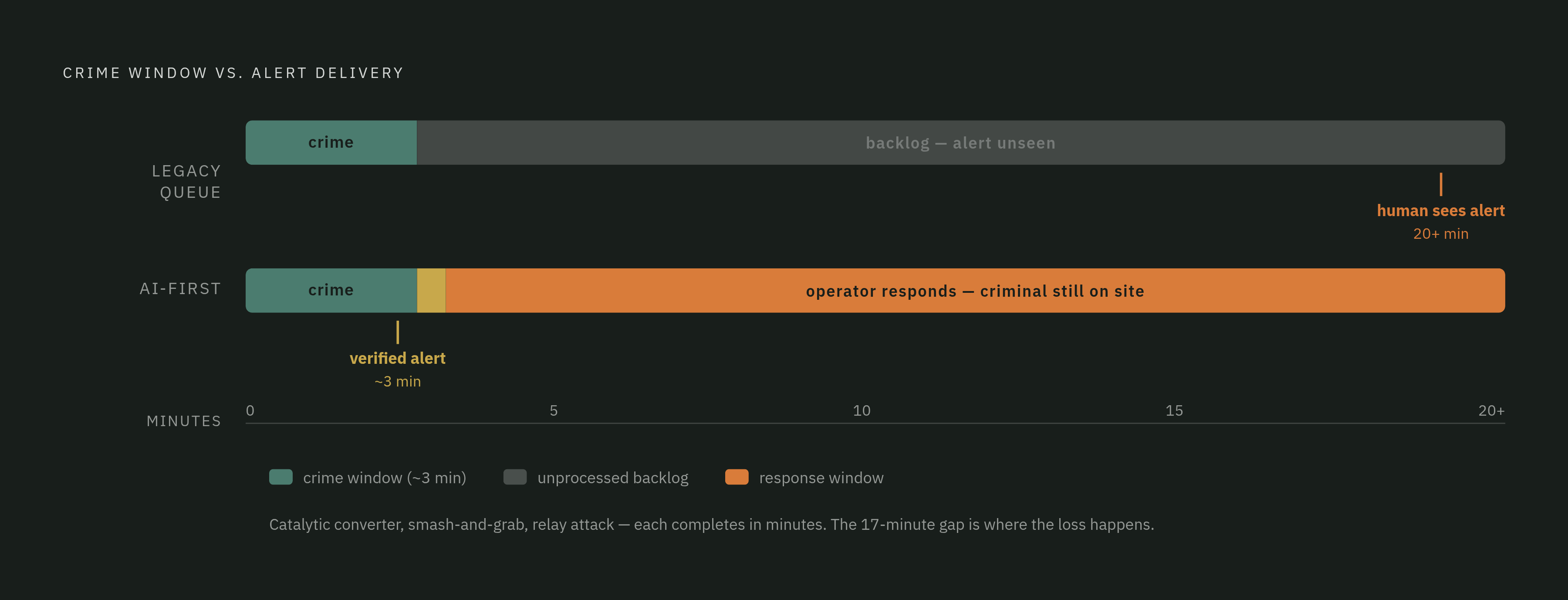
Everything in this argument comes down to one variable: how fast a verified threat reaches someone able to respond, measured against how long the crime itself actually takes. A catalytic converter removal, a smash-and-grab, or a relay attack on a parked truck runs its course in minutes, not in the twenty-plus minutes a threat might otherwise sit behind a legacy alarm queue waiting for a human to notice it. An AI-first system that produces a verified alert within that narrow window is still operating inside the time the criminal is physically on site. A human-reviewed alert that only reaches an operator after the queue has cleared is still a crime that already happened.
The question a buyer should bring to a monitoring provider is when the provider's clock starts, not what its response time is. In a legacy center, the clock starts when a human operator happens to notice the alarm, after it has worked its way through everything ahead of it. In an AI-first workflow, the clock starts at the moment of detection, because the filtering that would otherwise delay a human's attention has already happened by machine. For fleet operators, dealerships, and any commercial property storing valuable vehicles overnight, that difference decides whether a response arrives while the threat is still on the property or after it has left.
Clearance rates for motor vehicle theft remain low, which makes prosecution an unreliable way to recover a loss once it has occurred, and puts the real weight of prevention on the minutes while the criminal is still there. A lot owner ultimately has to choose between two different kinds of system. One documents what happened after the fact, through passive cameras paired with a legacy monitoring queue. The other is built to interrupt the crime while it's still in progress, through AI-first detection, protocols tuned to the specific site, and human escalation only when it's actually needed. For an employee lot, where the entire structure of the property, predictable hours, parked trucks, limited supervision, invites exactly the kind of theft this piece has described, only the system built to interrupt actually prevents the loss.