Cargo Theft Risks During Peak Shipping Seasons
Organized theft networks exploit staffing gaps and longer cargo dwell times during peak seasons.
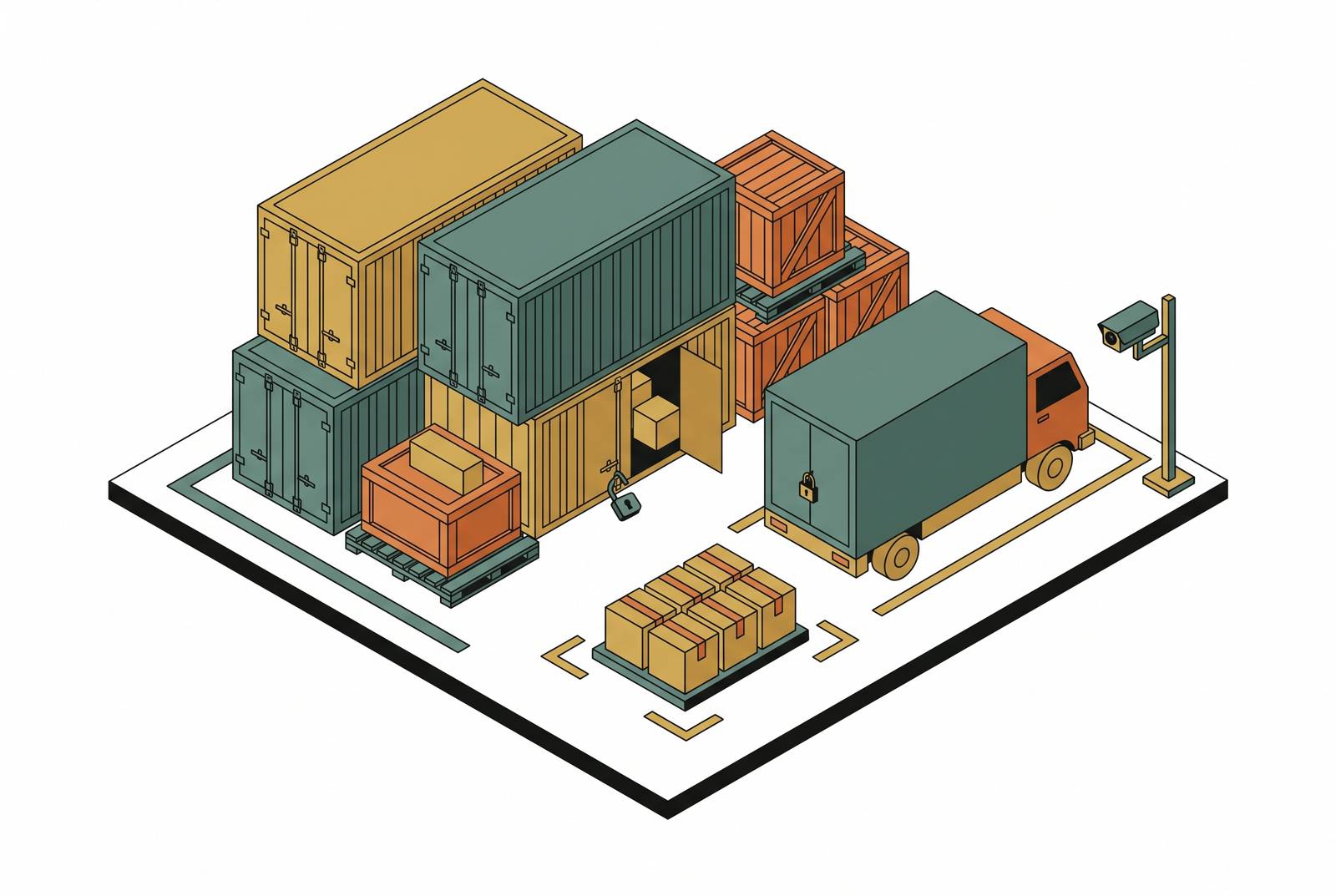
AI-augmented remote video monitoring for truck yards and freight facilities pairs alarm review with a human response, but how well it works depends on what it knows about the site and how fast escalation happens. Peak shipping seasons bring out gaps already present in staffing, verification, and surveillance, with cargo theft risk already there. The decisive measure is how quickly a real threat reaches someone who can act.
Why peak shipping seasons surface cargo theft vulnerabilities rather than create them
Verisk CargoNet’s Q1 2026 analysis found fewer total incidents year-over-year, while estimated losses stayed much the same. In Q2 2026, losses more than doubled to $304.6 million despite declining incident volume. That divergence challenges the simple assumption that more shipments necessarily explain more theft. Incident counts alone give only part of the risk when criminals choose more valuable loads and carry out fewer thefts that cause greater losses.
The pattern points to organized networks choosing which commodities to steal and when to strike. A loaded trailer left with no one watching gives thieves a different opening from freight moving through a site with a full staff, even if both hold the same goods. Peak seasons increase the time freight spends in that exposed state while reducing the attention available to protect it. The important change is therefore not simply how much cargo passes through a site, but how long vulnerabilities remain open.
As more freight moves through a site, it strains checks that already rely on a small staff, time to do the work, and reliable verification. Holiday closures then extend exposure while reducing the people available to recognize an exception. The resulting risk has two connected parts, namely the physical conditions that give criminals an opening and the monitoring gaps that let them use it.
The specific conditions peak seasons create that organized theft networks exploit
Dwell time is the primary operational lever. Loaded trailers sitting unsupervised at a yard or distribution center are freight in its most vulnerable state, and holiday closures can leave them staged for days with reduced personnel on-site. More cargo is therefore exposed for longer without a matching increase in supervision. Congestion compounds the exposure during the interval between freight arriving and someone being present to notice interference.
DAT Freight & Analytics names August through October as the stretch when the freight peak stays tightest, with another surge in November and December. These are two distinct pressure periods rather than one uniform seasonal rush. Higher load volumes compress the time available to verify carriers and shipment information. The checks meant to catch irregularities consequently receive less attention when the consequences of a missed irregularity are greatest.
Holiday staffing reductions deepen that verification gap. Fewer people are available to check unfamiliar drivers, confirm unexpected instruction changes, or retrieve and review surveillance footage in real time. Continuous AI alarm review paired with trained human operators offers one way to maintain the visual verification layer when site personnel are stretched thin. Verdun, an AI-powered remote video monitoring service, uses this model to filter routine activity and false alarms and bring a verified threat to a human operator in under 90 seconds. That review supports site security, but carrier identity and shipment instructions still require their own verification.
Verisk CargoNet’s Q1 2026 analysis recorded a 119% year-over-year increase in New Jersey incidents and documented growth in California. Both states have closely packed logistics infrastructure and are near major consumer markets, which organized networks favor.
How criminal tactics have evolved to exploit these conditions precisely
Impersonation-based fraud is the clearest example of criminals adapting to compressed verification windows. Verisk CargoNet’s Q1 2026 report names credential harvesting and outright acquisition of legitimate motor carrier businesses as two methods now in wide use. Credential harvesting uses phishing campaigns and remote access trojans to break into carrier business email accounts, internet-based phone systems, and industry applications. Criminals can then act through an identity that a shipper or broker already recognizes as legitimate.
Criminal networks purchase legitimate motor carrier businesses through social media, peer-to-peer marketplaces, and specialized brokerage services, inheriting valid operating authority and contact records. An ordinary approval check may therefore encounter authentic business information. Peak-season pressure makes that distinction consequential because a recognizable identity can receive less scrutiny when staff have little time to investigate.
FMCSA’s current fraud alerts include SAFER impersonation, carrier-profile phishing, fake audit requests, spoofed portals, fraudulent compliance notices, and registration scams impersonating FMCSA’s Motus registration system. The compliance infrastructure itself has become an attack surface. A compromised legitimate account can provide authentic access, recognizable contact information, and knowledge of an active shipment that a standard carrier-approval check at tender does not catch. Shipment misdirection can also occur after a legitimate carrier takes custody, so a successful pickup does not establish that the transaction remains secure.
Commodity selection follows the same deliberate pattern. Verisk CargoNet documents a dramatic increase in personal care and beauty product theft in Q1 2026, driven by cosmetics and fragrances that move easily through online resale channels. Those are also categories that peak retail seasons move through warehouses in volume. Criminals are selecting the goods that seasonal operations concentrate, rather than merely taking whatever happens to be accessible.
Where physical monitoring fails first when site pressure peaks
Overhaul’s Q2 2026 U.S. Cargo Theft Report shows that, among incidents where the location was known, the largest share took place at warehouses and distribution centers. Their share is well ahead of truck stops, fuel stations, and rail locations. That concentration makes the capacity of site monitoring central to cargo protection. Security measures on a vehicle or load do not resolve a facility’s inability to recognize activity around it.
More vehicles come and go in less time, making it harder to keep watch over the gates and yard. Holiday closures leave loaded trailers on-site without an active human presence to observe or intervene. Skeleton crews cannot keep up with the camera review, access control, and incident response that a full staff can handle. Each condition widens the gap between activity occurring and someone understanding whether it is authorized.
A camera can record that gap without closing it. Footage that is not actively monitored has documentary value, which becomes especially important during closures, when a theft may not be reported promptly. Footage retention gaps and siloed records can then leave the relevant recording overwritten or inaccessible by the time someone looks for it.
A site may retain a view of a staging area while losing the staff capacity to interpret what happens there. An off-site monitoring center takes on the job of working out what is happening, but moving the job there does not ensure it gets done. The center still has to keep up with the site’s alarms as its own workload grows.
Why traditional monitoring center architecture fails under peak-season alarm volume
Traditional monitoring becomes vulnerable when alarms arrive faster than operators can investigate them. The queue grows, and a real threat waits behind signals that may turn out to be routine. This is a capacity problem. An experienced operator cannot investigate an alarm that the system has not yet brought forward.
Peak seasons worsen both sides of that imbalance. More sites operate under pressure, dwell-time alerts increase, and overnight and holiday shifts can have fewer monitoring-center operators as well as fewer site staff. Less staff and less time for verification therefore weaken each layer of protection in turn. Moving an alarm off-site offers little benefit if it enters another understaffed review process.
A cargo theft triggering a low-priority motion zone may wait behind routine environmental alarms and panic buttons from unrelated sites. Human-only feed scanning averaging 20 minutes to detect an incident leaves time-sensitive theft exposed to that delay. Meanwhile, when most alerts keep turning out to be false or to show authorized activity, operators are more likely to clear them in batches than check each one. Organized criminals can take advantage of that habit by making an intrusion look like routine activity.
AI-first review changes which signals people spend time on. In this model, which Verdun uses, AI agents review every alarm, dismiss environmental noise and authorized activity, and escalate verified threats to trained operators. Routine signals do not first require a place in the same human investigation queue as a theft in progress. This tackles the 20-plus-minute queue delays found in traditional monitoring centers. Its effectiveness, however, depends on whether the system has enough operational context to distinguish routine activity from a threat.
What should AI video monitoring know about a truck yard or freight facility?
An AI model cannot make useful judgments about authorization from motion alone. An authorized 3 a.m. restocking crew and an intrusion may both produce activity after hours. Without the site’s schedule, flagging either as suspicious adds noise, while treating both as normal leaves the site at risk. Meaningful filtering requires the rules of the facility.
Shift schedules and authorized access windows establish who may be on-site and when. Knowing when carriers and drivers are due to arrive, and checking that against manifest data, helps the system judge what is happening around a shipment. Trailer staging locations and authorized dwell periods establish where loaded equipment belongs and how long it is expected to remain there. Holiday closure periods change what is expected, because activity that is normal during a working shift may call for escalation during a shutdown.
These distinctions matter most when peak operations produce large amounts of legitimate activity. Without context, that activity floods the queue with false positives precisely when exposure is elevated. Operators can then begin discounting signals from the sites that need the closest attention. The filtering problem is not solved by rejecting more alarms if the basis for rejection ignores how the yard actually operates.
Site-specific protocols are part of Verdun’s approach, with schedules, authorized activity, and access rules embedded in the AI agent’s decision context. An operator should receive a threat with the motion event explained in context. That is a useful distinction for buyers assessing AI-assisted monitoring claims. Buyers should assess whether the service interprets activity against the facility’s operating rules.
What faster alarm review actually changes for a cargo theft in progress
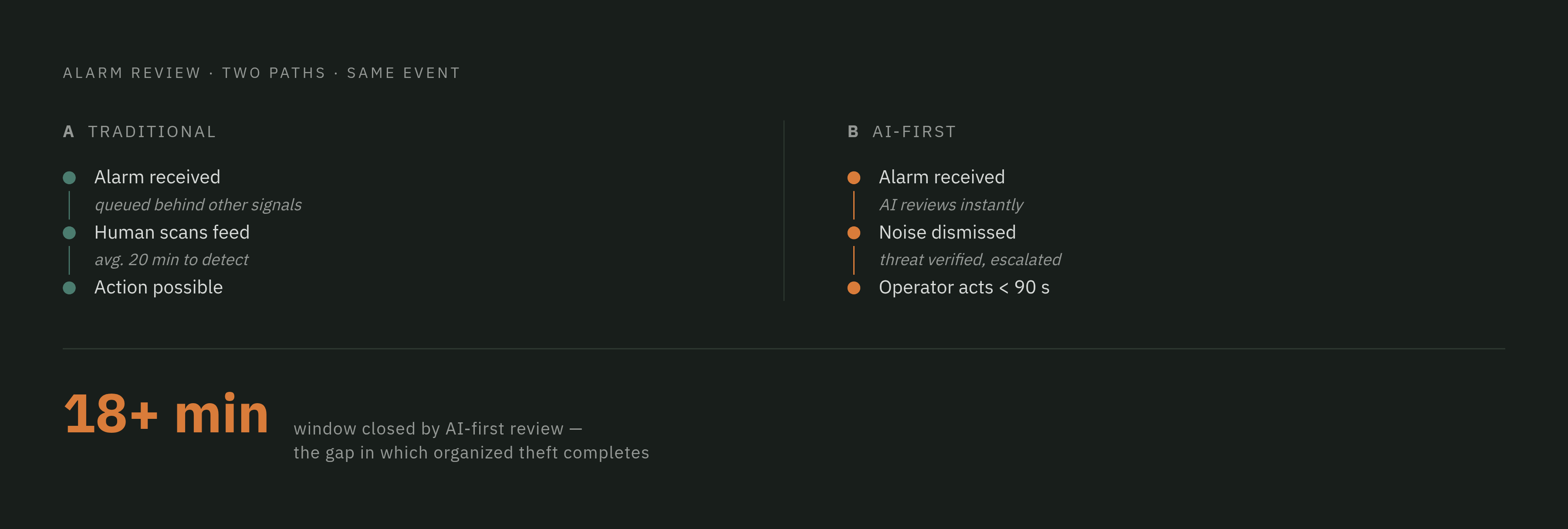
Organized cargo theft can move faster than a conventional monitoring queue. A staged vehicle, a known access point, and a practiced crew can move a trailer or strip a staging area before delayed review surfaces the alarm. Faster review changes the point at which a human becomes aware of the operation. It creates an opportunity for action while the event is still unfolding.
That makes speed to a verified threat more useful than camera count as a measure of protection. Extensive coverage routed through an overloaded human queue can leave a site less protected than a smaller installation with AI-first review and a fast escalation path. The monitoring process protects a site when it turns activity visible somewhere in the system into information a responsible person can use in time.
For an unmanned yard after hours, detection, verification, and response are distinct requirements. A motion alarm establishes that something happened, while contextual review helps establish whether it requires action. Escalation then brings that finding to a human operator. A claim of instant alerts does not, by itself, establish that these steps produce a timely, actionable result. Buyers need to evaluate the whole path.
The response protocol is therefore part of the monitoring capability. Rapid review has limited operational value if the person receiving the threat has no clear required action. For freight and distribution operators evaluating a service, the practical standard is how quickly a verified threat reaches a human who can act, and what the protocol requires that human to do.