Freight Trailer Seal Tampering and Load Integrity Threats
Organized theft rings now use credential fraud to bypass seals and authorization checks.
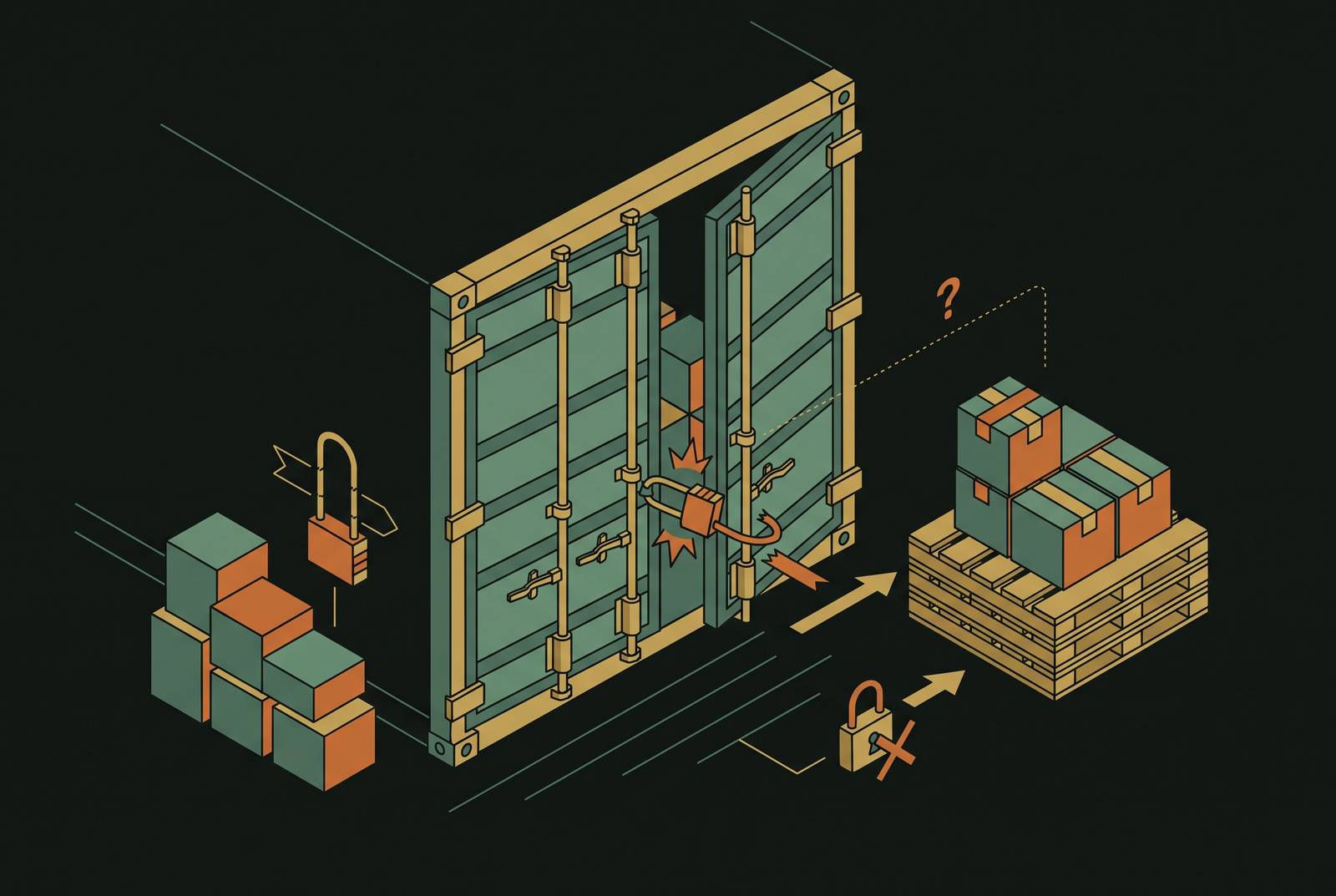
Freight trailer seal tampering is only one part of load integrity protection in 2026, because credential fraud can put an intact load into criminal hands. AI-augmented remote video monitoring for truck yards and freight facilities must link what is happening in the yard to pickup authorization, filter out routine alarms, and bring verified threats to human operators before the freight leaves. A seal documents physical integrity, but it cannot establish who is entitled to take the load.
Why cargo theft losses are rising even as reported incidents fall
In the electronics theft case, the trailer cleared the yard check, the seal was intact, and the driver’s credentials had been verified. Within minutes, the load was gone. The checks had accepted the pickup without exposing the fraud.
CargoNet’s Q2 2026 analysis showed that the number of incidents fell markedly from the year before, while estimated losses more than doubled versus Q2 2025. The average value per theft with a reported commodity value reflected multimillion-dollar, precision-targeted operations. CargoNet’s 2025 annual data showed a related pattern, with confirmed theft incidents rising while estimated losses surged much faster. The danger is not simply how often a facility loses freight, but how much value a single successful deception can remove.
Keith Lewis, VP of operations at Verisk CargoNet, stated, “Lower incident volume should not be mistaken for lower risk.” Continuous, real-time visibility into access events matters when organized groups succeed through stealth. Services that pair AI alarm review with trained human operators, including Verdun, let them check events as they happen instead of waiting for periodic audits or post-incident analysis.
How organized freight crime shifted from physical force to identity fraud
Michael Fisk, VP of Roadmaster Group and senior leader at Tri-State Motor Transit Co., described criminals hacking freight brokerage systems, generating fake bills of lading, applying the correct truck decals, and arriving with the correct pickup number. The shipper then hands freight to the wrong truck.
Aqil Naeem, co-founder and CEO of E3 Group, identified tools that make this impersonation practical. They include fake license plates and carrier decals available next-day, carrier email logins purchasable on the dark web, and AI-generated photos of a truck or a CDL producible in seconds. Business email compromise also gives criminals a way into shipment planning. A compromised logistics account can let criminals identify valuable loads, impersonate trusted parties, and alter shipment details while appearing legitimate to the businesses involved.
CargoNet’s 2023 Supply Chain Risk Trends Analysis recorded 576 fictitious pickup events, compared with an average of 66 events a year between 2012 and 2022. Fictitious pickups then stayed at nearly the same level in Q2 2026 even as the total number of physical theft events fell sharply. The infrastructure for credential-based theft was still operating despite the decline in more visible incidents. Monitoring must therefore catch false authorization before the load is released, as well as detect forced entry afterward.
What seals actually protect against and where they stop working
Seals are tamper-evidence tools. They help document unauthorized physical access and remain useful for chain-of-custody records and customs compliance. High-security seals that meet ISO standards do much to deter physical tampering with containers, especially in cross-border and ocean freight. That protection does not establish whether the person collecting a domestic full-truckload shipment is its authorized driver.
Fisk described the limits of ordinary trailer hardware directly. “The lock on most trailers is not a serious deterrent to a professional criminal,” he said. “It's a signal. It tells a thief how serious you are about what's inside.” Impersonation bypasses even that deterrent because the operator believes the transfer is legitimate. In most Q2 2026 fictitious pickup cases described in the notes, the seal was either untouched or willingly surrendered.
For that threat, the seal’s role narrows to evidence preservation. A monitoring model such as Verdun’s can support a separate review layer, but the yard must supply the authorization context that connects driver identity, load details, and release protocols. Neither a seal nor an image of an intact trailer supplies that connection on its own.
Why the identity layer is where freight yards are most exposed
The yard is where a paper identity becomes a physical handoff. Naeem described the central gap plainly. “Most vetting still checks the carrier on paper and never checks the person who actually shows up for the freight”. A motor carrier number, operating authority, and insurance can all check out while the arriving driver is using a compromised carrier account. A valid carrier record is not proof that a particular person may collect a particular load.
At the entry gate, convincing documents make that distinction difficult to see. A twenty-five-dollar fake CDL with working barcodes can pass a visual check, while asking for ID by phone or email provides no meaningful verification. Fraud rings also buy clean, legacy motor carrier authorities and sometimes buy real carrier companies outright. In those cases, basic checks turn up credentials from a real business, with no obviously fake company to spot.
The same gap appears when a verified driver is assigned but a different person arrives at the dock. Unless the protocol connects the authenticated identity to the arriving driver, the switch can pass unnoticed. Location data can expose a discrepancy that paperwork cannot, such as a verification link for a Texas pickup being opened in Kentucky. The physical site needs access to that authorization context at the moment of handoff. Otherwise, a truck that arrives with believable markings and paperwork can look like any other pickup.
What yard-level video monitoring can and cannot resolve on its own
Video monitoring gives a needed view of the gate, dock doors, and parking areas. At an unmanned freight yard after hours, it can bring activity to remote attention when nobody is present to observe it locally. Footage reviewed after the loss cannot undo a release that should have been stopped.
With conventional monitoring, human operators face another limit because they must check alarms from many feeds. Truck arrivals, yard trucks repositioning trailers, shift changes, and vendor deliveries all produce activity that may require attention. When routine alerts enter the same queue as real threats, the meaningful event waits behind noise. As operators tire of watching, the delay grows, so it stems from how the system is built as well as how closely operators pay attention.
For fictitious pickups, the dock-door window is the decisive constraint. The interval between an unauthorized driver backing into a dock and cargo being loaded leaves little time to distinguish legitimate work from theft. A camera can show the vehicle’s movement, but it cannot establish pickup authorization without supporting context. Full camera coverage can therefore coexist with no effective surveillance if nobody acts on the images in time. The requirement is not to replace cameras, but to change how their alarms receive review and response.
How AI agents change what a monitoring center can do with a yard alarm
AI agents change the monitoring workflow by reviewing alarms before those alarms reach a human operator. A vision-language model watches the clip behind an alert and classifies it, turning an undifferentiated queue into a ranked, verified shortlist. Routine activity no longer needs to consume the same human attention as a threat. The operator’s role shifts from sorting every possible event to deciding how to respond to the events that matter.
In a freight yard, that distinction depends on more than recognizing a truck. With site-specific context, the system can distinguish a yard truck repositioning a trailer from an unauthorized vehicle backing into a dock. It can also separate planned after-hours work from activity that conflicts with the yard’s protocol. Without that context, AI may recognize the scene accurately while still lacking the information needed to judge authorization.
The Monitoring Association’s ANSI/TMA-AVS-01-2024 standard provides a formal framework with five alarm classification levels. That graded structure gives AI agents defined outputs rather than a simple intrusion-or-no-intrusion signal. It supports a clearer handoff to humans, but it does not remove the need for human response judgment.
Speed makes that division useful against fictitious pickups because the intervention window is measured in minutes. A verified threat that reaches an operator promptly can still support prevention. AI can watch more feeds without needing a person to watch each new one. A site with a hundred cameras can receive the same review per alarm as a site with ten.
What site-specific protocols must cover for yard monitoring to work against credential fraud
The protocol must define what authorized activity looks like at that yard at that time. That requires the carrier schedule, the trucks assigned to each dock, and knowing whether after-hours activity is planned work or an unexpected arrival. Effective coverage connects gate guard protocols with driver verification, license plate recognition matched against shipment manifests, seal verification on entry and exit, and video analytics in parking and dock areas. Each control contributes a different part of the expected state against which an event is judged.
Verification timing is equally important. Naeem described E3’s approach of authenticating the driver before releasing the pickup number rather than waiting until the driver reaches the dock. If the identity does not check out, the broker or shipper has time to put another carrier on the load before arrival. Monitoring at the yard then needs the assignment context to distinguish that authorized pickup from a substitute driver or unannounced truck.
Chain-of-custody documentation must also connect physical evidence to verified identity. Photographing seals at application and receipt and recording serial numbers in the TMS preserves the physical record. Recording the credentials of everyone who touched the load adds the identity record that an intact seal cannot provide. Real-time cargo door monitoring sends an alert right away when a trailer opens outside an authorized location. That control links monitoring to the seal layer without treating the seal as proof that every prior handoff was legitimate.
Insurance carriers are also encoding protocol requirements into policy terms, with location-verified patrols increasingly required for cargo coverage discounts. The distinction is between a documented detection program and cameras that merely record. Treating installation as equivalent to protection repeats the mistake of treating an intact seal as equivalent to a secure load.
What operators should require from a monitoring program given how the threat has evolved
A freight yard monitoring program must address four connected failures, which are alarm queues, attention fatigue, missing site context, and delayed escalation. Alarms should be checked before they reach a human operator so that routine activity does not bury the threat. Site-specific protocols should define authorized schedules, carrier assignments, and dock-door states. The chain-of-custody record should connect seal verification with driver identity so an intact load can still trigger concern when the arriving person does not match the assignment.
Response performance should be measured from alarm to verified-threat escalation. A fast acknowledgment says little about how long a real threat waits for judgment. Operators should require a clear account of that delay when evaluating an existing program or selecting a new one. Human operators must retain the response decision, with enough time left to act. Automation without judgment and judgment delivered too late are different failures with the same practical limitation.
Verdun’s architecture is one example of the required division of work. Its AI agents review every alarm first, dismiss environmental noise and authorized activity, and escalate verified threats to trained human operators. That model addresses the queue rather than asking people to absorb more alarms, although its value at a freight facility still depends on the site protocols supplied. The evaluation standard is how long a verified threat waits before a human sees it.
The threat has evolved from physical access alone to fraudulent authority at the point of release. Monitoring requirements must follow that change. Sites that still measure security chiefly by camera count and seal specification are measuring defenses against a threat that no longer exists in its original form.