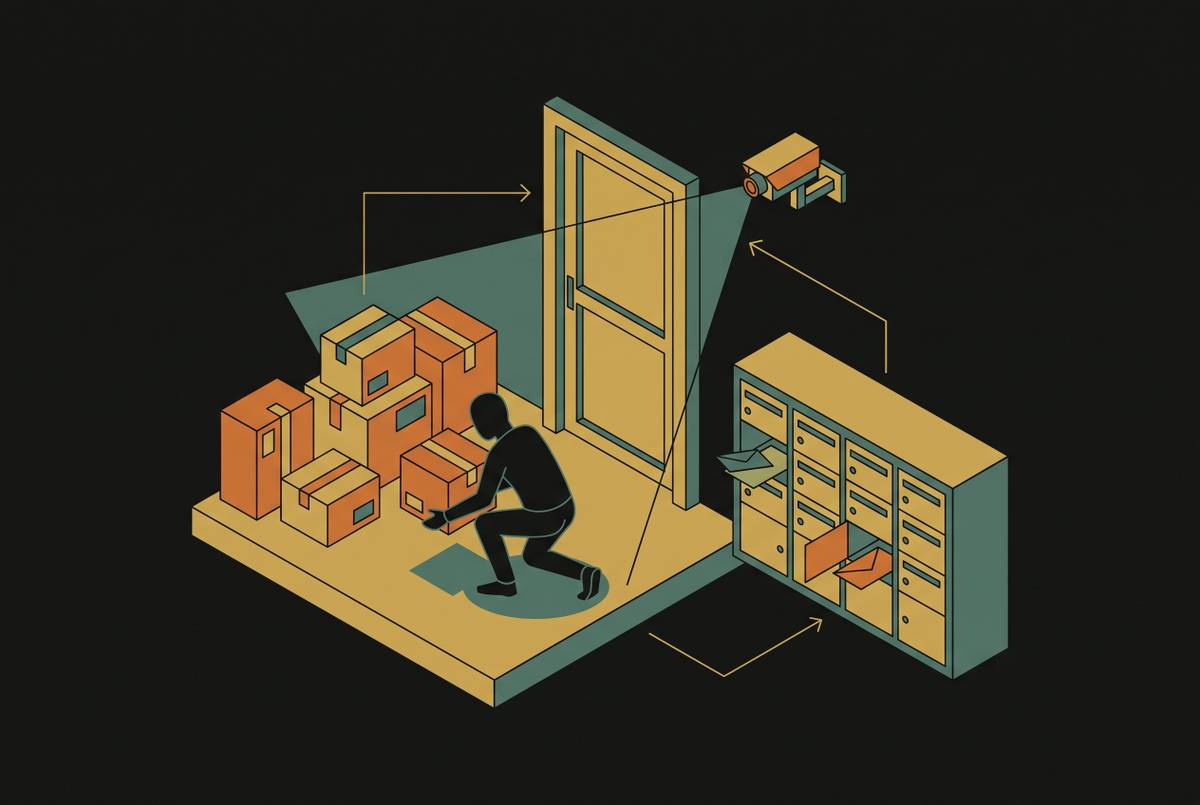
After-Hours Break-In Methods at Strip Mall and Retail Properties
Burglars exploit strip mall layout and slow alarm response to finish raids in minutes.

After-hours break-ins at strip mall and retail properties tend to follow the same patterns: burglars enter through glass, move fast, and use areas that are poorly monitored. An alarm must detect an intrusion and get a verified threat to someone who can act before the attack ends. Effective monitoring must therefore combine property-wide coverage with automated filtering and rapid human intervention.
Why strip malls and retail properties are a distinct after-hours target
Strip malls are designed to make access easy during business hours. Storefront glass exposes merchandise, surface parking brings visitors close to shops, and street-facing entries provide direct access to individual tenants. After closing, those same features give burglars ways to attack, with no staff or customers there as they are during the day. The property does not need an unusual defect to become vulnerable. Its everyday layout leaves it exposed night after night.
The tenant mix gives that exposure a predictable purpose for burglars. Personal care, quick-service food, grocery, and pharmacy tenants have cash and inventory close together that burglars still want after the public leaves. Several businesses share a property, but their security coverage may be very different. That puts targets that are easy to reach close together, though they may have no shared monitoring protocol. The resulting vulnerability belongs to the center as well as to each storefront.
Glass as the primary entry point and what makes it so reliable for burglars
Storefront glass is the dominant entry point because it can be breached in seconds with minimal tools. Glass in doors, sidelights, and display windows faces the street and is unobstructed after hours. Defeating it requires no specialized knowledge of the building. The smash-and-grab model depends on that low barrier to entry, which lets an attacker move quickly from outside the premises to the target inventory. Glass is therefore not merely a weak surface but a way to compress the attack.
That distinction matters because burglars do not always need to enter undetected. Most smash-and-grab attacks are over within a minute, so triggering an alarm can be compatible with the plan. The objective is to finish before a meaningful response arrives. An alarm at the point of glass breakage may accurately identify the intrusion while leaving very little time to interrupt it. Detection and prevention are different outcomes.
Front glass does not account for every route into a retail property. West Yorkshire Police identifies front-of-building smash-and-grab attacks and rear shutters at out-of-town sites as common targets. Opportunistic burglars also use vulnerable rooflights, forced windows, and insecure doors, generally seeking to avoid alarms. These methods differ in execution, but they share a dependence on accessible weak points. Monitoring only the most visible entry route leaves the broader access problem unresolved.
Speed-first execution: how burglars use timing to defeat conventional alarm response
Burglars who finish fast take advantage of the time it takes to work through the steps in conventional alarm handling. A sensor trips, a signal reaches the central station, a call goes to the premises, and a dispatch decision follows. Each stage consumes part of the time available for intervention. The process may be functioning as designed while still moving too slowly for the attack it is meant to address. That is a mismatch between the architecture and the speed of the attack.
Verification adds another constraint. A conventional operator receiving a generic zone-intrusion signal has no visual confirmation of what caused it. The signal must therefore be treated as unverified, which can mean lower police priority or no dispatch in jurisdictions with verified-response policies. The operator has evidence that a sensor activated, but not yet the context needed to establish a confirmed threat. Time passes while the system works to turn an alarm into actionable information.
For speed-first burglars, that delay is the opportunity. They do not have to defeat every part of the security system if they can complete the theft before its response chain catches up. A faster signal transmission alone cannot solve the problem when verification and decision-making still wait behind it. The relevant measure is the full interval from the event to a verified response. For a one-minute attack, every step in that interval must justify the time it takes.
Coordinated multi-tenant sweeps and why strip mall layout amplifies the damage
Organized retail crime groups can treat a strip mall or enclosed mall as one operation, targeting multiple tenants during a single visit. The lag between an individual alarm and a center-wide response allows the attack to move beyond the first premises. Easy parking lot access and nearby highway exits add to the attraction because departure can be as direct as entry. The property layout supports movement between targets as well as movement away from them.
Monitoring each tenant in isolation fragments the picture of that operation. Activity at the parking lot approach, in a corridor, and at separate storefronts may be related, but individual alarms do not establish that relationship on their own. Multi-camera correlation can connect those events and identify a coordinated sweep as it begins. Shared space makes that distinction operationally important.
But landlords and tenants split the responsibility for security. A well-monitored anchor store may share a corridor with businesses that have no monitoring, allowing a sweep to move through the weakest coverage. The British Retail Consortium reports that more than three-quarters of all burglaries against retailers are repeat attacks against the same premises within a year. A successful intrusion therefore cannot be treated only as an isolated loss. Where the layout and coverage gaps remain exploitable, the same property can support another attack.
Loading docks, service corridors, and the overnight blind spots conventional monitoring leaves uncovered
The front of the property explains the most visible attacks, but the rear completes the access picture. Loading docks and service corridors are there for deliveries, for vendors to get in, and for tenants to load goods. They are also commonly unstaffed overnight and rarely included in active monitoring coverage. Those conditions make after-hours activity in these areas a consistent unauthorized-access pattern at commercial properties. A center can have storefront cameras in plain sight while few cameras watch its service routes.
The difficulty is not simply detecting movement. The same space can host authorized activity during the day and an intrusion at 2 a.m., so motion alone does not establish which event is occurring. Without site-specific schedules, generic detection cannot tell ordinary use from activity that someone needs to act on. Coverage must include both a view of the space and rules that make its overnight use intelligible.
Split responsibility makes these gaps persistent. Loading dock and service corridor monitoring may be neither a tenant’s clear obligation nor an area actively claimed by the landlord. Cameras also tend to go where people walk, so they cover less of the rear than the front even though the overnight risk calls for cameras there. This reverses the priorities of the after-hours threat. Faster handling of storefront alarms cannot compensate for an intrusion that begins in an uncovered service area, so monitoring requires both coverage and response speed.
Why human operators alone cannot catch these attacks before they are over
Once coverage is in place, the next constraint is attention. Under realistic operating conditions, a conventional monitoring operator can take longer to notice, verify, and act on an alarm than a smash-and-grab takes to finish. Operators may be watching many feeds while also checking alerts as they come in. People who watch feeds for long periods are subject to vigilance decrement, so having a person there does not ensure they will keep spotting the behavior they need to catch.
High alert volume compounds that limitation. When alarms arrive faster than a team can evaluate them, real threats compete with repeated signals that have no consequences. Operators may clear many alerts at once, mute noisy sensors, or move signals that look familiar farther back in the queue. That gives operators less to deal with at once but can also hold up their response to a real threat. At a retail property, a short delay can consume the entire opportunity to interrupt a break-in.
More operators may redistribute work, but leaving a human responsible for reviewing every individual alert preserves the same basic dependency. Muting noisy cameras trades away coverage, while moving the same workload elsewhere does not remove the need to triage it. Charging overage fees changes the cost of alert volume while leaving its cause unchanged. The necessary change is to reduce the noise reaching operators without suppressing genuine threats or abandoning difficult areas of the property.
What monitoring architecture can actually interrupt a one-minute attack
That change requires automated review before an alert enters the human queue. AI agents must evaluate incoming alarms, filter environmental noise and authorized activity, and escalate verified, high-confidence threats. The purpose is to reserve human judgment for events that warrant action. This architecture must compress the interval from event to verified response into seconds.
Detection latency is consequently a capability threshold. Sub-second detection is the relevant benchmark for the retail smash-and-grab window, although detection alone is not the whole response. The whole process must still be fast enough to sound an alarm, close a gate, or let an operator voice challenge reach the intruder. If the information arrives too late for intervention, its value is investigative.
Precision begins with rules that reflect how the property operates. Virtual tripwires and intrusion-zone logic identify a defined boundary crossed after hours rather than treating all nearby movement as equivalent. Site-specific schedules then supply the context that generic motion detection lacks. For example, knowing that a cannabis dispensary closes at 9 p.m. makes a person at its rear loading dock at 2 a.m. anomalous. The classification becomes useful because the system evaluates activity against the rules of that place and time.
Those rules must also account for which areas are shared and which zones tenants control. The deployment hierarchy begins with entrances, moves through corridors and restrooms, adds specific after-hours coverage for loading docks and service corridors, and then covers the parking-to-entrance transition. Each zone must have its own schedule and authorized-activity rules loaded before an event takes place. This gives the whole property a shared structure while allowing each tenant to have its own hours and ways of working. The protocols must also change as the system learns the property’s rhythms and past incidents show where the gaps are.
The human operator’s role then shifts from watching feeds to acting on confirmed visual events. A trained person can apply judgment to a threat with usable context rather than reconstruct its meaning from a generic zone signal. That supports faster, more confident intervention and better-informed law enforcement dispatch, without making interruption automatic or guaranteed.