How Traditional Video Monitoring Centers Measure and Misrepresent Response Time
Monitoring SLAs start the clock after the dangerous wait.
· 10 min read
Why monitoring SLAs are built around the wrong clock
- Role: Opens the argument by exposing the foundational deception in how traditional monitoring centers define and sell response time — establishes the "two clocks" frame that every subsequent section will build on.
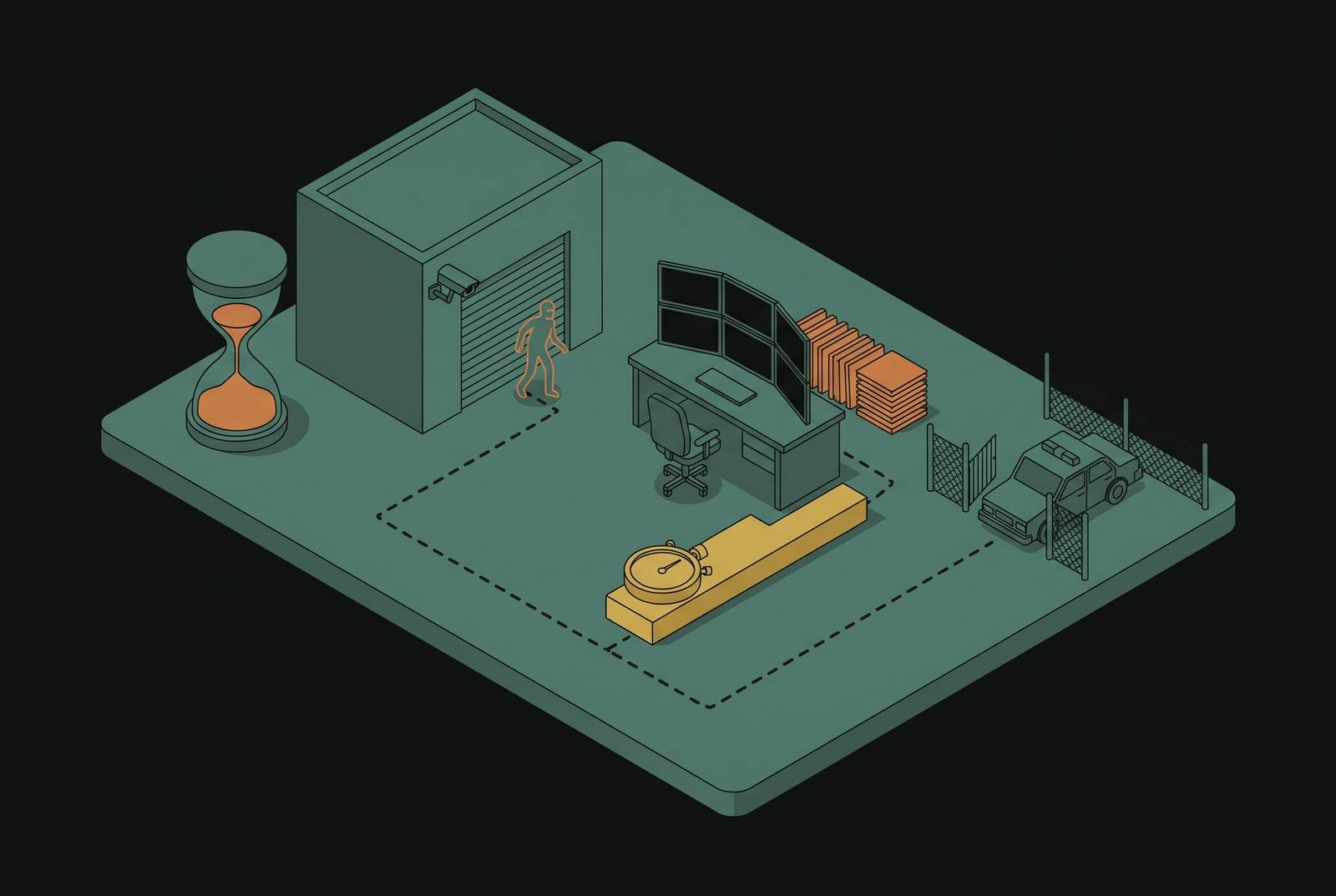
- Traditional monitoring SLAs promise a fast response time, but the clock they advertise starts at the wrong moment — when an operator picks up an alarm, not when a threat first appears on camera.
- The distinction that matters: acknowledgment time (how quickly an operator acts once they reach an alarm) versus verified-response time (how long a real threat waits before any operator sees it)
- These are two entirely different clocks; most SLA language conflates them or measures only the first
- A monitoring center can advertise a fast acknowledgment time and still leave a live intrusion sitting in a queue for many minutes — both statements are technically true, and together they are misleading
- The gap between the two clocks is where real losses happen: theft completed, property damaged, suspects gone before dispatch
- Note: Open on the concrete scenario — a burglar is on camera, the alarm fires, and the clock the vendor advertises hasn't even started yet. Keep this section tight; its job is to name the two clocks and show they are different, not to explain the whole queue mechanism yet.
How the alarm queue creates the hidden wait before the advertised clock starts
- Role: Moves from naming the problem to explaining the mechanism — shows why the gap between the two clocks exists structurally, not incidentally, setting up the argument that this is architectural rather than operational.
- The wait before an operator ever sees a threat is not a staffing mishap — it is the predictable output of a system that floods human operators with more alarms than they can process.
- Industry standards on alarm system monitoring set a ceiling on the number of alarms a single operator can meaningfully handle per hour; above that ceiling, important alarms are obscured by volume
- When alarm volume exceeds that ceiling — which is routine at busy sites — every new alarm joins a queue and waits its turn regardless of severity
- A genuine threat alarm has no priority tag that moves it ahead of the routine motion alerts, environmental triggers, and authorized-activity flags ahead of it in the queue
- Objection: "We staff to peak volume." Answer: peak alarm volume is unpredictable and non-linear; staffing to the peak means idling operators most of the shift and still being caught short at true spikes — the ceiling is a cognitive one, not just a headcount one
- Note: This is the queue-math section. Keep it conceptual — explain the ceiling and what happens above it. The fatigue dimension belongs in the next section; don't conflate them here.
Why human operators cannot hold attention long enough to clear the queue reliably
- Role: Adds the second structural layer — beyond queue depth, the operators working through that queue face a physiological ceiling that makes sustained vigilance unreliable, compounding the wait-time problem established above.
- Even a well-staffed monitoring center erodes in practice because human vigilance on sustained, repetitive camera-watching degrades faster than any shift runs.
- Cognitive psychology research on sustained vigilance tasks shows meaningful performance degradation within the first half-hour of a monitoring shift
- A study of trained video monitoring operators found they detected only roughly half of target behaviors across a 90-minute review, with a high rate of false alarms alongside the misses — these were experienced professionals, not novices
- Fatigue compounds the queue problem: as attention drops, operators process alarms more slowly, which lengthens the queue, which increases the gap before a threat is seen
- High alarm volume, fragmented systems, and unclear priorities accelerate the onset of this fatigue — the conditions typical of a busy monitoring center make the cognitive ceiling arrive sooner
- Annual turnover in the security workforce is very high, according to industry analysis, meaning the trained-operator continuity that any SLA promise implicitly depends on is constantly being reset
- Note: Cite the trained-operator study carefully — it is the strongest piece of evidence in this section and should be presented precisely. Avoid making this feel like an attack on individual operators; the argument is structural, not personal.
How false-alarm volume makes the queue problem self-reinforcing
- Role: Explains why the queue never empties — the overwhelming majority of alarms feeding it are noise, which is not a correctable exception but the baseline operating condition of traditional monitoring.
- The queue stays full because the alarms filling it are almost entirely false, and the system has no structural mechanism to distinguish them from real threats before an operator spends time on each one.
- Every false alarm an operator processes is time a real threat spends waiting; because false alarms dominate, real threats are almost always waiting behind noise
- The industry's common responses — muting noisy cameras, raising alarm thresholds, or simply letting alarms age off the queue — reduce the volume operators must handle, but only by guaranteeing that real events in those cameras or time windows go unreviewed
- This is not a fixable edge case; it is the structural output of asking humans to filter signal from noise at high volume and under cognitive load
- Objection: "Better motion detection settings reduce false alarms." Answer: hardware-level tuning reduces trivial triggers but does not reason about context — an authorized employee moving after hours looks identical to an intruder to a motion sensor
- Note: The DOJ false-alarm figure is context-only sourced; present the concept (vast majority are false, this is the default condition) without asserting a specific percentage. Keep this section focused on the self-reinforcing loop; the AI solution belongs later.
What monitoring SLA language typically measures and what it quietly omits
- Role: Brings the structural argument back to the commercial claim — shows specifically how SLA documents are written to advertise the favorable clock while remaining silent on the unfavorable one, giving buyers a framework to read contracts more critically.
- Monitoring SLA language is written around acknowledgment time because that is the number a center can control and optimize; the queue wait before acknowledgment begins is structurally absent from most contract language.
- Standard SLA metrics measure time-to-first-response (operator acknowledges the alarm) and resolution time (operator completes a defined action) — both clocks typically start at ticket/alarm creation or receipt, though some contracts define the start as after queue assignment, a distinction the SLA must specify
- The gap between alarm trigger and operator pickup — the period during which a real threat is actually occurring and unattended — has no standard metric name, no required disclosure, and no typical contractual commitment
- A monitoring center can report full SLA compliance in a period when every single verified threat waited many minutes before being seen, as long as operators acted promptly once they reached each alarm
- Research has found that only 19% of security teams consistently meet their own internally defined SLAs — which suggests the acknowledged clock is already a stretch, before the hidden clock is even considered.
- Buyers evaluating SLAs should ask for a different metric: time from alarm trigger to first verified human review — not time from operator pickup to action
- Note: This is the practical, buyer-facing section. Ground it in what the contract language actually says and doesn't say. Keep the Hivewatch reference brief — use it to show that even the favorable clock is often not met, which makes the hidden gap worse.
What the gap between the two clocks costs in practice
- Role: Makes the abstract argument concrete by showing what happens during the unmonitored interval — translating queue wait into real-world outcomes so buyers understand what they are accepting when they sign a traditional SLA.
- The time between alarm trigger and verified operator review is not a paperwork gap — it is an open window during which a threat progresses without interference.
- What is lost in those minutes is not just property: it is the ability to intervene in real time — to issue a voice challenge, alert on-site personnel, give law enforcement an accurate description of an active situation
- Post-event review of recorded footage is not monitoring — it is evidence collection, and it carries none of the deterrent or intervention value that a live-monitored SLA implies
- Commercial, multifamily, and industrial sites are disproportionately exposed: after-hours threats happen precisely when alarm volume from daytime activity has cleared but operator fatigue from the shift has accumulated
- Note: Use the detection-delay figure carefully — it comes from context-only sources, so characterize it in approximate terms and tie it to the principle rather than asserting it as a precise study finding. The SDM link is a primary source and can be cited directly.
How an AI-first architecture eliminates the queue rather than managing it
- Role: Pivots the argument from diagnosis to solution — shows what a structurally different system looks like, establishing that the fix requires changing what reaches human operators, not improving how fast operators handle what the current system sends them.
- The queue problem cannot be solved by faster operators or more operators — it requires removing the queue by changing what reaches a human in the first place.
- AI agents that analyze every alarm before a human sees it change the unit of work: instead of an operator sorting noise from signal at high volume under cognitive load, the AI does the pre-classification continuously and without fatigue
- Computer vision models process camera frames continuously, at high frame rates, across all cameras in parallel — and match patterns against defined threat signatures; this is a different capability class from human scanning, not a faster version of it
- In an agentic model, AI handles detection and pre-classification; human operators handle verification and response — the two functions are separated by design rather than collapsed onto the same person at the same time
- Objection: "AI generates its own false positives." Answer: the question is not whether AI is perfect, but whether AI pre-filtering produces a queue that human operators can meaningfully clear — and the answer is yes, at a volume and pace that unaided human operators cannot match
Why site-specific context is what separates AI filtering from AI guessing
- Role: Addresses the practical objection that AI cannot make meaningful decisions about context-dependent alarms — and shows that site-specific protocols are what make AI pre-classification reliable rather than another source of noise.
- An AI agent that does not know a site's schedules, authorized personnel, and behavioral baselines will pre-classify alarms no more accurately than a generic motion sensor — context is what makes the filtering meaningful.
- A loading dock has a different behavioral baseline than a lobby; a truck yard at 2 a.m. differs from a retail parking lot at closing — generic detection policies applied uniformly fail in practice because the same pixel-level event means different things in different places
- Site-specific protocols define what authorized activity looks like at each location and time window, allowing AI agents to dismiss activity that a human operator with context would also dismiss — without consuming operator time to do it
- When the AI agent's decision is informed by site context, the pre-classification is a reasoned one — not a pattern-match against a generic template — and the human operator who receives an escalated alarm gets a verified, contextualized alert rather than another ambiguous flag
- This is why the quality of site onboarding — capturing schedules, access rules, and exception conditions before monitoring begins — determines whether an AI-augmented system actually shortens the verified-response clock
- Note: Keep this grounded in the architectural argument; this is not a product features list. The point is that context is a design requirement, not an optional add-on, and its absence is what makes generic AI monitoring fall into the same false-alarm trap as traditional systems.
What security buyers should actually ask when evaluating a monitoring SLA
- Role: Closes the argument by converting the myth-busting analysis into actionable buyer guidance — giving readers the specific questions that expose the gap between advertised and actual response time before they sign a contract.
- A buyer who understands the two-clock problem can ask the questions that force a monitoring vendor to account for the hidden wait — and those questions reveal more about monitoring quality than any advertised SLA number.
- Ask for time from alarm trigger to first verified human review — not time from operator pickup to action; if a vendor cannot or will not quote the first number, the hidden clock is the answer
- Ask what happens to alarms during peak volume periods: does the center queue them in order, triage by severity, or mute cameras to reduce load — each answer reveals a different failure mode
- Ask how false alarms are filtered before they reach an operator: a vendor that relies on operators to sort noise from signal is describing the same structural problem this piece opens with
- Ask what site-specific context the monitoring service incorporates: a vendor that applies generic detection policies is not making meaningful decisions about your site
- Ask what the escalation path looks like for a verified threat: how many handoffs, to whom, in what sequence — and whether that path has been tested against real scenarios at your site type
- The right monitoring vendor can answer all of these questions with specifics, because their architecture is built around the verified-response clock rather than the acknowledgment clock — and that distinction is the structural upgrade that legacy SLA language was never designed to deliver
Sources
More in Video Monitoring Center Performance and Failure Modes
The Real Cost of Delayed Alarm Response for Warehouse and Retail Properties
Marcus Fell
Signal Fatigue and the Cognitive Ceiling That Breaks Traditional Monitoring Center Response
Renata Solís-Ware

How Triage Priority Logic Collapses When Monitoring Centers Face Simultaneous Alert Floods
Marcus Fell